To the begin with, I want to apologize
for my not so good English (which is self-learned). I hope that
you will understand the most important things. If something
sounds to you wrong, please let me know, and I will change it.
Introduction
My name is Hristo, I live in Bulgaria, and want to share with
all AG growers the technique that I use when growing Atlantic
giant pumpkins, since I'm growing AG's (2003). I call that
technique "Direct Root Feeding" (DRF). As you will see
this technique is very simple, and because of that I believe,
that maybe someone already use it, but I do not know of that,
so...
DRF will be especially helpful to those grower who's AG
plot(s) are not well prepared and the soil is imbalanced. That
technique can be useful and to the so-called "heavy
hitters". Especially if they want to experiment with
different feeding programs, without the need to change their
plot's soil composition!
Short pre-history
My #1 hobby is to grow unusual (and tasty) edible (mostly
edibles) plants, and especially fruits. My #2 hobby is to
exchange seeds of such a plants with people from all over the
world.
Till 2002 I didn't knew that the pumpkin/squash can reach 300+
kg. / 660+ lb. When I learned that that is possible, I was hooked
(since I'm growing and many other plants, I can't tell that I'm
addicted, but for sure it is real pleasure for me). For 2002 I
did not found 'Atlantic Giant' variety seeds, but I trained with
'Big Moon'. For 2003 season I received some AG seeds with unknown
background (now they are proven under 400 (lb.) :-)), but despite
that they were good for me. Having AG seeds and knowing that my
soil is unprepared and pretty imbalanced (for example: P2O2
- 3090 ppm; K2O - 2020 ppm; Fe -- 2.12 ppm; don't know
- Ca, Mg, S, B, CEC, %BS) I started to thinnk - how can be
combined the easy of the classical soil plant growing, and the
advantages of the hydroponic growing. Because most cucurbits are
very suitable for such a combination, I didn't thought much...
Here I want to thanks to the people who sent me AG
seeds, and personally to Michel White who sent me proven seeds.
Because of these seeds, now I can share my experience. Which is:
DRF step by step
Look the pictures and you will understand (sorry for their bad
quality).
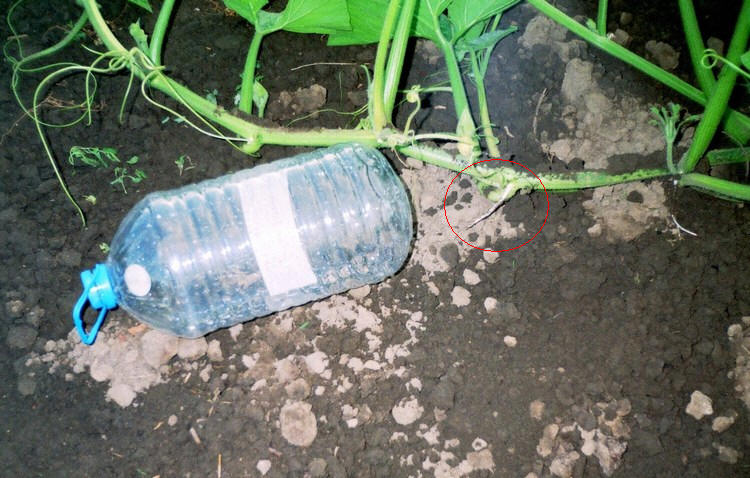
Placing the hydroponic container (the bottles shown on
the photos are 10 l. / 2.2 gal.):
Bury the vine. After few days (when on it must has
long enough secondary root(s)) lift it (the vine) and
move it carefully to one side.
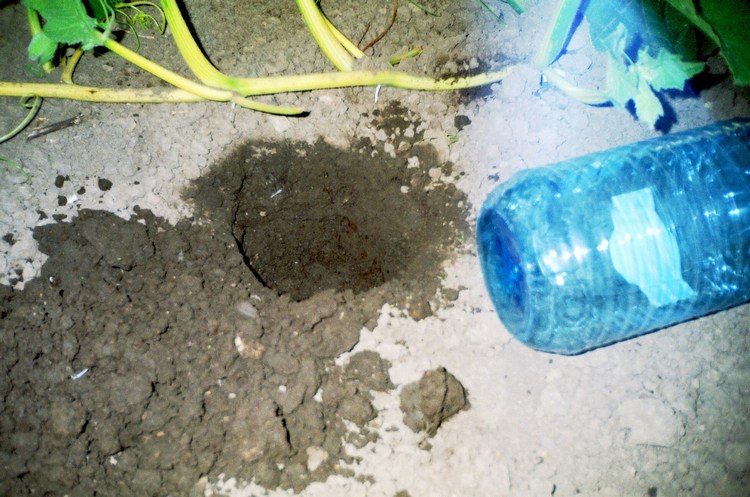
Dig a hole which is under the secondary root (that
photo is of different plant)
As you can see you have to provide some type of
container (preferably transparent and clean) that can
hold at least 10 l. / 2.2 gal.water.
Place the
container with the water (at this stage can be used
almost any clean water)
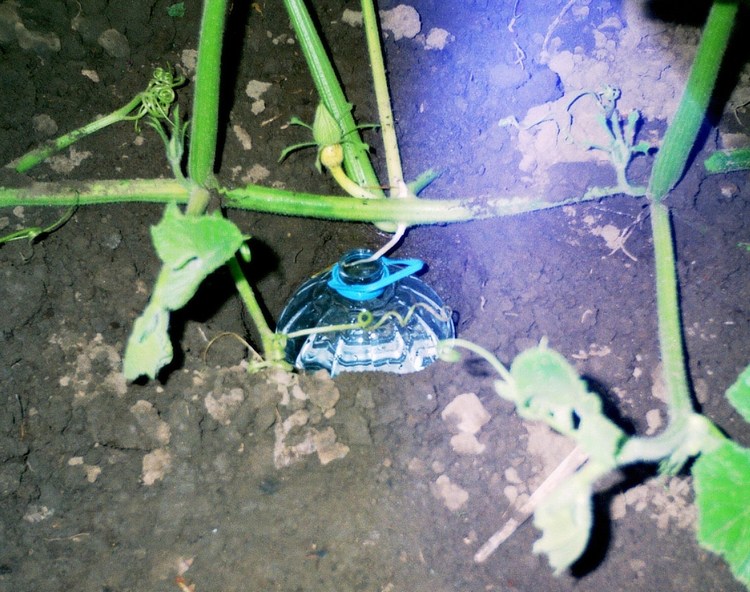
Return the vine on the previous place and put the
secondary root into the water (If the node has more than
one long enough secondary root, you can put in and them).
After 1-2 weeks it must "take" (the plant
will start to "suck" / "drink").
Meantime:
- you can add some nutrients and/or hormones, but usually
at this stage even only clean water is fine
- aerate the water - there is 2 chooses:
1st - is to use small air pump (example - aquarium pump);
2nd - which I use and recommend, is to use chemical
aeration through adding (at this stage) every 3-4 days
Hydrogen Peroxide (H2O2) - to say
500 ppm / 0.5 ml. H2O2 per 1 l.
water (when using 3% H2O2)
- keep shaded
- regularly check the growth of the root(s). If the
growth stops - do something: change the water / add some
nutrients / hormones ect.
When it "takes" (if didn't "takes" -
change the water/nutrients/hormones and wait till
"takes"), start your feeding program. There is many
recipes for making nutrient solution depending on the kind of the
plant. But they all are only for hydroponic growing (only), and
are not always suitable for combined (soil + hydroponic) growing.
For example: in my soil the P and K levels are extremely high,
and because of that I do not need these elements in my
hydroponics. It is much better you to make the mixes depending on
your soil composition and your aims.
Few rules (most of them learned the hard way):
For more comprehensive explanations see
"Useful Hydroponic Links" here,
or search Internet.
Use transparent containers. This will allow you to see at
any time the roots. But obligatory cover the containers
with something opaque. If that opaque material is with
dark colour, then cover it to say with white cloth to
reflect the sun rays and to decrease the temperature.
Use distiled or clean rain water. If you use any water
and that water contains carbonates (as mine), these
carbonates can react with some salts (example - the
sulfates SO4) and make them unavailable to the
plant (sediment). If you can't provide distiled or clean
rain water, then use the water that you have, but if is
hard water (contains carbonates) - neutralize them to
about pH 6.0.
Don't waste your time using usual fertilizers to make
nutrient solution. Buy from some specialty store pure
salts (a chemical substances). They are much more
expensive, but you need only a bit of them.
When choosing the salts, remember that some salts even if
they contain some plant nutrient(s) are
"inedible" even toxic for the plants. Sounds
complicated? No, it is not! Because you need only once to
learn which salts are appropriate, and how they can be
combined.
Don't mix salts in concentrated form. Keep particular
nutrients separated in the concentrated form because of
the fact that many nutrient combinations will
precipitate.
The best concentration of the nutrient solution is
between 500 - 1500 ppm / 0.05% - 0.15% (0.5 - 1.5 g.
salts per 1 litre water), depending of plant's growing
stage. If the concentration is (much) higher, for the
plant will be difficult or even impossible to uptake the
water and the nutrients (to "drink").
After dissolving the salts in the water (makeing the
nutrient solution) check out the pH - the best is if it
is between 5.8 and 6.4. If not - adjust the pH level.
(Note: there are needed 2 pH adjustments - 1st - adjust
the pH of the water (if needed) before adding the salts;
2nd - adjust (if needed) the the pH level of the nutrient
solution (i.e. after disolving the nutrients in the
water)).
Aerate the nutrient solution - mechanically - with pump,
or chemically (preferably) - with Hydrogen Peroxide (H2O2).
H2O2 is easy to be used and will
not only supply oxygen, but also will protect the roots
and will do and other beneficial things, which I will not
describe here. Here I will show some data which maybe is
not in the Internet. They are from a Russian book (the
plant used for the research is wheat):
Kind of
aeration
Uptaked
for 8 days
N (nitrogen)
P (phosphorus)
K (potassium)
Without (control)
0.72 mg.
2.35 mg.
0.74 mg.
Mechanical (with air pump)
1.12 mg.
3.57 mg.
1.10 mg.
Chemical (with H2O2)
1.64 mg.
6.75 mg.
1.16 mg.
Usually the Hydrogen Peroxide is used
as follows (3% H2O2):
- at the early stage - 500 ppm (0.5 ml. 3% H2O2
per 1 l. water) every 3-4 days
- afterwards - 1000 ppm (1 ml. 3% H2O2
per 1 l. water) every other day
Constantly fill up the nutrient solution in the container
with distiled / clean rain water (replace the water that
the plant is "drinked"). That can be made
automaticly.
Change the nutrient solution at least once weekly
Share your experience!
This was/is my way of growing, but of course there can
be many different ways (modifications), including the used system
(different hydro/aeroponic systems).
Does it works for me?
Frankly speaking I did not achieved significant results. But
this is because of me, not because the technique (there is no
doubt about that that the hydroponic growing works). I do not
followed the rules. I know what is hydroponic and how it works,
but I have never been used it. I was, and I'm still not enough
experienced, and I make mistakes. Till now I have grown
successfully only 4 plants using combined feeding - 2 plants in
2003, and 2 plants in 2005 (2004 season was zero season for me).
During 2003 I have been placed 1 bottle (as on the photos
above) per plant (and one secondary root per bottle). I
maintained the hydroponics from July until the end of season.
Because this was my first season I was very enthusiastic and I
tended for the hydroponics (and not enough for the plants :-)). I
changed the nutrient solution every 3-5 days, added H2O2
every other day. These operations I did properly, but... I used
only spring water, which in my area is hard (high of carbonates);
I never checked the pH; despite that I knewed that my soil P and
K levels are extremely high, mostly I followed the late season
formula - 1-2-1... ect. and ect.
The main observations and conclusions for the 2003 season:
for 24 hours the plant can "suck" up to 2
litres (1 root from 10 litres bottle) (the summer of 2003
was hot and dry, and because I can't supply enough water
to irrigate, my soil was too dry, and the plants
"sucked" a lot from the bottles)
after changing the nutrient solution in the bottle, the
first noticeable reaction of the plant is after 24 hours.
I think that one 10 litre container per plant is not
enough
During 2005 I have been placed 2 bottles (see photos above)
per plant (and one secondary root per bottle) (I do not include
another plant (713 Sherwood 04) wich was with bad genetic and
didn't produced fruit). Three of them "taked", but not
for long... I didn't cared for them enough - again used spring
water; changed the solutions once at 10 - 15 days; added H2O2
once at 5 - 10 days. Why?
First - because I had great expectations for the 2004 season, but
that season become very disappointing to me - bad genetics, bad
weather, fatal diseases. Because of that I had no expectations
for 2005, and did not cared what will happen.
Second - this year i had to care to much more other plants (more
than 100 varieties of different species).
Despite all careless, 2005 season became my the best season.
For sure that is because the seeds - thanks Michel! Again, I'm
very excited for the next season, and even prepared few patches,
which I will use if I find the seeds that I'm looking for. After
that excitement I'm begin to expect... bad season :-)
So, DRF works, but only if is properly used (follow the
rules). (I think that it can't totally compensate poor soil and
especially soil with low organic matter, even if is properly
used. Of course maybe if you place 10 containers of 20 litres /
4.4 gal. each (or even more / bigger)... Share your
experience!)
Advantages and disadvantages
Advantages:
Maybe the fastest method to feed the plant
Much better than the foliar feeding (logically, but still
just my opinion - needs practical confirmation)
The possibility to be done mistake which is harmful to
the plant is very, very, very low
Gives many possibilities for experiments...
ect.
Disadvantages:
One more thing to do ;-)
A bit tricky work, which needs some experience.
??? Share your experience!
Future plans
I will (maybe) place not only secondary roots in
hydroponic containers, but and one (or more) root which
is part of the maine root system. In this way the
combined feeding can start much earlier - few weeks
before the time when can be used for that purpose
secondary root.
Also this will help and to understand how the secondary
root system works - simultaneously (together / as one)
with the maine root system or as an emergency system (as
backup / secondary level system) which is "turned
on" only when the maine root system can't supply
enough water.
Why I'm wondering this? Because I saw how during days
with relatively low temperatures and high soil moisture
and / or humidity the plant stops to "drink"
water from the hydroponic containers. But at same time
the fruit still grows, consequently the plant must
transpirate (or guttate), consequently the plant must
"drink"... If the plant didn't use the
secondary root system to supply the water it must use
only the maine root system, consequently the secondary
root system works as an emergency system. But for secure
this must be checked again.
I will place a hyrdoponic container under secondary root
situated on vine after the pumpkin (the fruit). I always
placed the containers before the fruit (somewhere between
the maine root (the stump) and the fruit). Maybe that
will improve the growth of the vine/leafes after the
fruit, and as a result and the growth of the fruit.
Comments
If you want to post comments and/or thoughts - use the guestbook.
Share your experience
As you see this technique is very simple, and maybe someone
already use it. If so... share and your experience!
Maybe the most important questions to answer:
For the plant: when the seed germinated; when the pumpkin
/ squash was pollinated; what was the final size of the
plant?
How many hydroponic containers you placed and how big
they were?
Where you placed them (distance; main / secondary vine)?
When the plant started to "suck", and how long
you maintained the hydroponic (how long the plant was
feeded with hydroponic)?
Which rules you followed, and which not?
Do you made mistake(s)? What kind?
And of course your personal view - is it works or
not?