
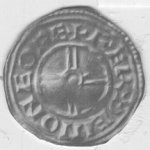
1017 to 1042 Farthin / Farthein / Faerthein / Faerthen - moneyers for King Cnut and his son King Harold I in York. With the help of Farthein and other English moneyers King Cnut transferred England's well-organized royal coinage to Denmark. At Cnut's request, Farthein traveled to the town of Lund, Denmark to help establish a mint there. As a result, Lund grew and flourished and became the most important mint town in Scandinavia. After Cnut died, Farthein continued to produce coins, this time for Cnut's son, King Hardecnut.

1017 to 1042 Farthen / Faerthen / Faerden - moneyer(s) for King Cnut and his sons, King Harold I and King Harthacnut in Huntington. Moneyers were not moneylenders but royal officials that actually produced coins for the King. They oversaw minting and exchange and managed the operation of the mint. They were wealthy enough to hire blacksmiths to hammer out the coins rather than doing it themselves.
1033 Faryem was one of King Cnut's witnesses for a grant to Archbishop Aelfric of York. Apparently unfamiliar with the personal name Farthegn, the scribe misspelled it a second time as Farhengu.
1050 Farthain Greva - surety for Archbishop Aelfric in York. Experts are divided on what exactly Farthain's byname meant. Some believe that Greva meant "reeve" or "steward". Still others believe it was derived from an Old Norse name meaning "count" or "earl". M. K. Lawson, in Cnut, The Danes in England in the Eleventh Century writes: "To run this system the kings had not only his ealdormen (later, earls) but also reeves, some of them in charge of shires, who looked after royal estates and aspects of the judicial system, and sometimes led armies."
The Norman Conquest
For centuries England had been alternately ruled by the Saxons and the Vikings. The year 1066 marks the last Viking invasion of the island, this time by the Normans. They were descendants of Norwegian and Danish Vikings who had settled in Northern France.
1066 Fardein(Farthin) - he was the lord of Arthingworth, a village 12 miles north of Northampton, and was not just an ordinary thegn. He was a "King's thegn". He was a direct descendant of the Viking chieftain named Farthegn that settled in Northamptonshire 200 years earlier. It is not known if he survived the onslaught of his cousins, the Normans.
1066 Fardan(Farthegn) - he was the lord of Appleton Roebuck, a village 6 miles south of York. He also had the status of being a "King's thegn". It is not known if he survived the Norman Conquest. The Domesday Book does tell us, however, that several of Farthegn's family members did in fact survive this tumultuous period. Farthegn's sons Tonni and Alwine are listed as holding property in 1086. Tonni's name was derived from the Scandinavian god Thor. He had been a very wealthy King's Thegn before the Conquest, owning large tracts of land no doubt partly inherited from his father. Alwine was also a survivor and had also been very wealthy. Alwine had a son named Uhtred and a grandson named Northmann. Wulfstan the priest and his son Arnkettle were also Farthegn's relatives, as were Eadric and his son Godric. As these men survived, so did their names, passed down from generation to generation until they became surnames. Tonni's name survives today as the modern English surname Tunney, Alwine's as Alwin, Wulfstan's as Woolston, Godwine's as Goodwin, Eadric's as Edrich, Arnkettle's as Arnkell, Uhtred's as Ughtred, Northmann's as Norman, and of course, Farthegn as Farthing.