W
hat is Monsoon?Monsoons are large-scale wind systems caused by differences in the temperatures of land and sea over the seasons.
The "Monsoon", from the Arabic "mauism" meaning "season", a wind that changes direction with the seasons. Monsoons develop as a result of changing patterns of atmospheric pressure caused by the heating and cooling rates of continental and oceans. They are wave-like air masses that occur in the sub-tropics, moving from sea to land during the summer and from land to sea in winter.
The word itself does not really mean heavy rain. Apart from wet monsoon, the monsoon may also be associated with dry weather as well. The phrase of warm, moist air is seasonally replaced by a "dry" monsoon of cool, dry air.
This phenomenon is the feature of the climates from West Africa to the western Pacific Ocean. The southwest monsoon occurs from May until August while the northeast monsoon occurs from November until March. April and September/October are the months that it pass over.
The monsoon is one of the most dramatic climate phenomena on the planet. Monsoons occur when precipitation is heavy are the opposite of droughts.
A monsoon seasonal change is characterized by a variety of physical mechanisms which produce strong seasonal winds, a wet summer and a dry winter. Monsoon occurs by three basic physical mechanisms: the differential heating between the land and oceans, the rotation of the Earth, and as the water stores and releases energy that changes from liquid to vapour. These three mechanisms produce the characteristic of monsoon (high winds and precipitation).
As the position of the sun moves round the earth and the differential heating over lands and oceans of the earth, the surface winds also change direction seasonally.
There are two types of monsoon that occurs at different times are called the summer monsoon and winter monsoon. The climate happens to be opposite.
The winds also blow in different directions.
Summer monsoons
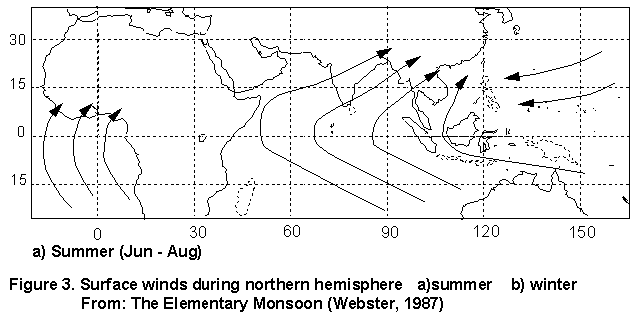
During the summer, radiant energy from the sun heats the land surfaces far more than it does sea surfaces. The strongly heated air over the land rises and is replaced by a southwesterly wind carrying warm, wet air from the Indian Ocean. Water vapour in the rising air condenses and forms clouds and rain. This process releases large amounts of heat, which will help to drive the monsoons. The winds are extremely wet and warm. In summer, intense solar heating leads to scorching temperatures over the Asian land masses. As a result, the overlying air heats up, expands and rises upwards. This leads to the formation of a semi-permanent low pressure area near the heart of the continent. Warm and moist air from the Indian Ocean and the South China Sea flowing into this low pressure area is experienced as the summer monsoon over south and southeast Asia.
Winds associated with the monsoons are generally more persistent than those brought by tropical cyclones and may last for days. In intense surges of the winter monsoon, northeasterlies of up to gale force are not uncommon over the south China coastal waters. However, the full impact of these winds is not always felt in Hong Kong, particularly in heavily built-up areas or where nearby terrain provides some sheltering.
Winter monsoons
In winter, the land is cooled faster than the sea. The cool air over the land sinks and spreads out to the sea as a dry northeasterly wind. The winds are very dry and cool.
Occasionally, in winter, tropical cyclones traversing the South China Sea pass to the south of Hong Kong just when a monsoon is affecting the coastal areas of south China. Winds in Hong Kong are greatly enhanced due to the very large pressure difference between the continental anticyclone and the centre of the tropical cyclone.

Therefore, rainfall is higher during summer than winter, which the monsoons can bring many thunderstorms. The weather will also be hotter.
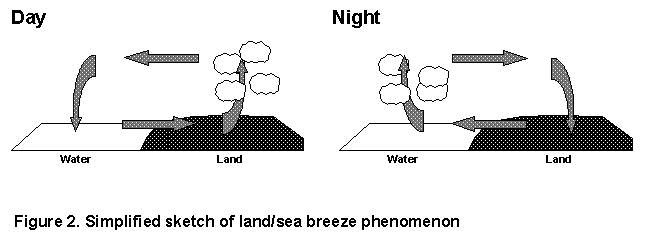
Sometimes, there may be a difference during the night and day. For example, on a sunny day at the beach, the land warms more quickly than the ocean. As the hot air rises over the land, it is replaced by the cooler air over the water. At night, however, the land cools at a quicker rate than the water, so the wind blow from the land to the warmer water.