Vienna Home
Main Home

"ANIS INFERNAL"
Miguel Serra Lerida

"Absinthe Robette"
by Privat Livemont 1896

"ABSINTHE PARISIENNE"
A vintage French wine advertising art poster for Absinthe in France

Print for Maurin Quina absinth liquour in 1906 by Cappiello.


Kunst & Spiegal

DUBONNET


Raigdor Absinthe Ad from the 20s and 30s

ABSINTHE Sir Edgar-Hilaire-Germain Degas
|
|
A hundred years ago, it was the very nectar of art; the taste of sweet decay; the color of avant-garde transcendence. Oscar Wilde claimed, "A glass of absinthe is the most poetical thing in the world." Hemingway characters drank it in Spain to forget war and women. Painting after painting - most famously by Degas and Manet - depicted "The Absinthe Drinker" seated in a cafe by a pale green glass, hovering between stupefaction and infinity. A figure in a Rilke poem looks dolefully into a murky cup of the stuff and murmurs, "Spring is here."
What happened to it? ABSINTHE contains wormwood, which had a psychedelic reputation. Some sensational murders of the time were blamed on ABSINTHE delirium; some scientists decided that the drink could bring on epileptic fits and lead to addiction. Such research is now regarded as worthless, but progressive crusaders in the United States and elsewhere succeeded in getting the liqueur banned. My first and virtually only experience with ABSINTHE was in the Czech Republic at a nightclub. A few friends of mine and I ordered a shot from the bartender and albeit improperly prepared we shared a sip. One shot to five guys and the stuff barely got finished. I would describe the taste to one of warm/cheap vodka, old/stale gasoline, and cheap moonshine. Not very appealing.
A noted Historian once tracked down a home-brewed bottle of the stuff on the continent and drank it quietly in his Paris hotel. He dozed off, remembering nothing the next morning until he was drinking coffee. "Then it came to me," he writes, "that at some point in the previous evening, I thought I knew the answer to life; only now I had forgotten it."
“Water, the liquid so pernicious,
That only a drop will suffice to
Disturb the purest absinth”
ALFRED JARRY
Despite doctors' warnings about the dangers of ABSINTHE, the beverage became very popular, especially in France. Between 1905 and 1913, Belgium, Switzerland, the United States, and Italy cracked down, banning the liqueur. France followed in 1915.
Britain never did so, the Post reports, because the stuff was never popular there. Green Bohemia, the distributor of the new absinthe, is claiming its variety is quite safe, though it would seem the lure of the drink lies in the reputed risk. In fact, there are no useful data on the long-term effects of ingesting wormwood.
In some countries, notably the Czech Republic, ABSINTHE is still available and where I first tasted it, albeit in a less potent form (although surely just as disgusting). Old ABSINTHE contained about 260 parts per million of alpha-thujone. Present-day ABSINTHE generally has less than 10 parts per million, which is below the maximum concentration permitted by European beverage guidelines. In today's ABSINTHE, the most toxic compound is the alcohol.
The issue with ABSINTHE is the herb wormwood, which ABSINTHE derives its flavor from. Alpha-thujone comes from the herb wormwood and although few people now drink the liqueur, "a lot of herbal preparations are available on-line, and one is wormwood oil." People have used this oil since antiquity to treat digestive disorders. The alpha-thujone concentration in the oil is much higher than in ABSINTHE and is a greater potential health concern. One note is that since prohibition, research has determined that alpha-thuione is useful as an insecticide. (Maybe thats what gives it its kick)
Pastis refers to a category of anise-flavored spirits descended from ABSINTHE. Wormwood was the active ingredient in ABSINTHE that many claimed was responsible for driving people insane. So after it was banned, distillers simply removed the wormwood, lowered the proof -- which in all likelihood was a bigger problem than the wormwood -- and offered the public at large ABSINTHE substitutes.
Many of the more popular bottlings of pastis are somewhat sweeter than their elder brother. But recently a couple of new labels have shown up that are drier and hark back more authentically to the complex flavors of true absinthe. The sweeter varieties work well when mixed with just water, and the drier bottlings require the drinker to sweeten the beverage to suit his or her taste.
Nevertheless, both species are incredibly hard to use in cocktail- and mixed-drink recipes since the powerful anise flavor can dominate other ingredients if it is not used sparingly.
Other drinks that call for ABSINTHE substitutes, however, require far more thought on the part of the bartender. Take The Third Degree, a Prohibition-era cocktail that calls for gin, dry vermouth and pastis. As anyone can see, it is merely a dry gin martini with absinthe added, and the formula actually dates back to turn-of-the-century London when some gentlemen's clubs offered a Martini with a "spot." The spot referred to ABSINTHE.
So, ABSINTHE is becoming popular again and a less-potent version is probably going to be available soon. So how do you judge an ABSINTHE?
It is a question the judges at the International Spirits Challenge cannot agree on. "You should be able to taste mint, coriander, lemon balm and verbena," pronounces one. "What I'm looking for in an absinthe", quips another judge, a master bartender and cocktail king, "is to get completely off my tits." And you can't help thinking that she's got a point.
We know he drank it, and some say he lost an ear because of it, but it's hard to believe that even Van Gogh liked it. He probably just wanted to be weirded out like the rest of us, and to live up to some outrageous artist image to send up the price of his paintings. Some will drink ABSINTHE now that it's back in the country, but I've always sensed it's done for plain bravado and not for pleasure. Certainly, ABSINTHE is one of the strongest drinks (often around a minimum 70% proof) you'll come across. Add its strength and its half-medicinal, half-herbal flavour to its fabled hallucinogenic properties, and you have a substance more likely to be treated like a drug than a drink.
ABSINTHE, banned since 1915 in the United States because of its dementia-inducing ingredients, is making a comeback. ABSINTHE brand has replaced the wicked ingredients with merely mischievous ones, putting the licorice-flavored drink on the right side of the law once again.
ABSINTHE now retails for about $40 per 750 ml bottle, and I have heard that it is currently available in Las Vegas.
In the old days of the 19th century these ABSINTHE Fountaines were part of the traditional Absinth Ritual. In the rainy streets of France people always liked to relax in their favorite "Bistro" to feel the spirit of the Green Fairy. The distinguished Bistro owners were proud to present their visitors their little secret. Behind the bar, in a special "Vitrine", the Fontaine was stored, safe and secure, but ready for donating the inspiration Van Gogh, Picasso and Baudelaire fell in love with....
At a round table the Fontaine stood in the middle of the action and was filled with ice and water. The ABSINTHE glasses were placed under the tap as the cold water dripped on sugar cubes held in Absinth spoons and distilled into the Green Fairy, creating a louche effect.

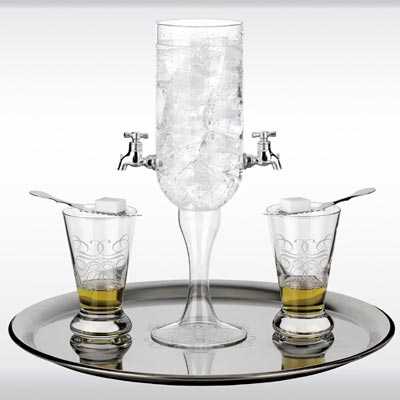
Its unique hourglass shape evokes the times that once were:
Time transformed the ice contained high in the hourglass of fresh water.
Time allowed fresh water to be stored in the lower part of the hourglass.
Time allowed the faucet to distil drop by drop the fresh water onto the
sugar, while, melting slowly, transformed pure Versinthe into delicious
nectar, which led to the beautiful louche effect...


The ritualistic burning of sugar, the poor green fairy the magic at work. All properly prepared ABSINTHE is a shade of green and it is really very nasty. It looks like mouthwash but taste like you swallowing a filling.
"I don't drink my cocktails. Certainly not the ABSINTHE ones."
"It's guaranteed to ruin any good drink"
"That one is one of the nastiest things I've ever tasted in my life."
"I'm afraid I must confess that we drank it more for effect than flavor."
"My cheeks are still taut with the effort of keeping the ABSINTHE away from as many taste buds as possible. Even so, I can feel it insinuating its way into my bloodstream via the gums."
|