


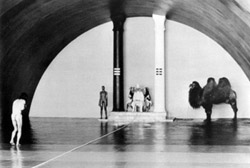
Fando and Lis (1967) by Alexandro Jodorowsky
From Zona Rosa to the Holy Mountain
Experimenting with new forms as modern day alchemists, Alejandro Jodorowsky and cinematographer-turned-director Rafael Corkidi cultivated an esoteric cinema that mingled countercultural fascinations with PreHispanic cultures and Eastern philosophies with stylistic elements of the Baroque and Gothic-plus a dash of Pop and psychedelia. For Jodorowsky, strong connections to the avantgarde cinema of the United States are apparent. The occult fascinations of Kenneth Anger, the surrealism and ethnopoetics of Maya Deren, the beat hysterics of Robert Frank: all have interstitial moments in Jodorowsky's oeuvre. But just as strong, one could argue, are a myriad of other influences, from the Theatre of Cruelty of Antonin Artaud to the visceral and explicit strains of George Bataille, and on to the performances involving bodies and sculptural forms of the sixties/seventies, like Latin American conceptual artists Hélio Oiticica and Lygia Clark.
Jodorowsky introduced theater audiences to the lawlessness that could be in the dramaturgical space. Without bounds, or limitations upon the imagination, the aesthetics of Panic involved the transgressive or unnameable act. A movement that celebrated sadism, eroticism, and the abject, Panic evolved out of Jodorowsky's studies in France and from exposure to the experimental playwrights Eugene Ionesco and Samuel Beckett. Before arranging Fando y Lis for cinematic treatment, Jodorowsky produced Fernando Arrabal's play for the stage in Mexico City. Elements of free-spirited performance strategies appear in the film, including the protagonists writhing and miming on tombstones in a cemetary, and the appearance of Jodorowsky as a puppeter who cuts the strings from the limbs of his marionettes until they fall completely limp. In another episode of theatrical gestalt, a group of finely dressed hipsters slowdance among architectural ruins to the tunes of a piano on fire. Jodorowsky would appear on television a few years later and reprise the destruction of another piano (à la Fluxus performances by the U.S.-based artist Raphael Montañez Ortiz).
The first exposure of Jodorowsky's film version of Fando and Lis (1967) at the Reseña de Acapulco set him up against the convictions of censorers and authorities. Desecrating narrative, placing a nearly naked actress spread eagle on a hill of dead animal parts, including scenes of extreme violence and gender dysphoria--these all guaranteed a harsh reception for this cinematic experiment. Myth has it that a riot broke out after the screening. Censorship limited the distribution and exhibition of the print, and would recur throughout the filmmaker's career. Not until the surprise embrace of his El Topo (1969) by an international midnight movie circuit would Jodorowsky find a large-scale and willing audience for his visions. Elements of hyper-violence, excessive appropriations of the Sergio Leone spaghetti western, plus trademark inclusions of Zen poetics ("I tried to make a Western and ended up with an Eastern," said the filmmaker) and surrealist symbolism would insure the cult status of El Topo for years after its release.39
The overly-ambitious follow-up to El Topo, La montaña sagrada (1972)--also shot in Mexico--includes a scene early on that establishes the ribald sensibility of the rest of the film. A Jesuslike figure lays on the ground festering in his own fluids, with a face covered by buzzing flies. Rescued from an angry mass of young boys by a dwarf without hands, the fractured Jesus makes his way to the city where he encounters all types of temptations and vexations. His journey ultimately leads to the central figure of the film, the alchemist (played by none other than Jodorowsky himself). Via the portal of Mathias Goeritz's modernist towers in Ciudad Satélite, the wanderer finds the domain of the alchemist with its jumble of signs and symbols from tarot, Kabbala, Koran, and Eastern religions. At the request of the alchemist he joins forces with messengers of other planets, each involved in treacherous pursuits ranging from arms dealing to conceptual art, to seek enlightenment at the top of a sacred mountain.
In Santa Sangre (1992) Jodorowsky returned to Mexico City after a long exhile in France. His son portrays a character with a strong resemblance to Alfred Hitchcock's Norman Bates; both have common delusions of resuscitating their dead mother through fantasy and transvestism. As in his earlier films, Santa Sangre involves one excessive theatric gest after another. As one wonders how Jodorowsky could possibly create a scene more excessive than an elaborate hillside funeral for an elephant (with a full cast of circus attendants and marching band in tow), the director procedes to outdo all expectations. Mexicanidad and its signifiers-bleeding hearts, violence, and fatalism, in Jodorowsky's hands, do iconic battle with pantheistic rituals and countercultural happenings.
Among the Aquarian figures of the moment, Gelsen Gas (née Angel Sánchez Gas), interwove his interdisciplinary interests as theater director, painter, poet, sculptor, inventor, and comrade-in-arms of Jodorowsky into the production of his magnum opus Anticlimax (1969). Functioning as a series of visual haikus, the segments that make up Gelsen Gas' work reflect the sexually charged and politically heated time period. The film is loosely sandwiched by two scenes that make reference in a reflexive manner to the very movie the audience is watching. Early on in the film, a lone figure in the middle of a desert digs up film in cans. These tins emerge like relics covered with years of sand and debris. The title slowly revealed reads "Anticlimax" and the image fades to black. In the film's final scene, the protagonist exits from a movie theater whose marque announces Anticlimax. Both psychedelic and snide, Gelsen Gas involves the audience in the unearthing and projection of his own cinematic trip.
A particularly earthy scene recalls the crowded bus ride of Buñuel's Subida al cielo (1951) as Gas reveals the latent erotics of public transportation. A young boy's eyes drift toward a woman's thighs as her skirt travels slowly upward. The one amorous couple of longhairs on the bus ignite fear and pleasure in an older solitary man. Riders squeeze through the aisles and brush up against each others' fronts and rumps. Beads of sweat run down the forehead of one, as another character sucks intently from the concave space of an orange. This highly controlled scene begins the film's diverse representations of desire, both realized and frustrated.
The main character, if one attempted to distinguish a narrative agent in this loosely-knit film, works as an architect and designer. In a scene recalling Chaplin's Modern Times, the young designer's connections to the industrialization of the city are exaggeratedly referenced. The factory that manufatures the his designs contains elaborate metal contraptions of cogs, pulleys, and chutes which after steaming and churning extrude artificial flowers. Other quotidian references include canned food, canned music, xeroxes that pass for originals, and an erotic encounter between a man, woman and a giant can opener.
Unapologetic nonconformity couples with mangled pop references in experimental works of the sixties and seventies. One element of Gas' work that appears in the work of Jodorowsky, as well as in Gámez's La fórmula secreta is a cynical appropriation of the syntax of consumerism. Gámez transmogrifies the Coke bottle into a drip bottle. Jodorowsky's astronomical superheroes in La Montaña sagrada market beauty and aggression through the promotion of cosmetic aides, toys, and weapons.
This deluge of cynicism was not only a response to the always encroaching specter of exported U.S. consumer culture but also to the growth of the Mexican middle class. Over the course of a decade a string of films placed the comfort and complacency of the privileged in jeopardy, among these Buñuel's El Angel exterminador (1962), Juan Ibáñez's Los Caifanes (1966), Sergio García's El Fin (1971), and Raul Kamffer's El perro y calentura o Conducta (1973).
Although Raúl Kamffer began his years of schooling with studies in philosophy, biology, theater, and architecture, he eventually arrived at his chief preoccupation, cinema. Kamffer first studied film in Italy at the Centro Experimental de Cinematografia. He was also involved painting and ventured with his wife Leonor Alvarez into the art world, establishing a string of successful galleries in the Zona Rosa in the late fifties, and making ties with contemporary Mexican artists. In the sixties, Kamffer became part of the first generation of filmmakers to graduate from the CUEC.
Filmed in an improvisational manner, with Kamffer bouncing the script off of the performers during its production, El perro y la calentura resonates with an air of spontaneity, bordering at times on the reckless. The loosely constructed plot examines the social and sexual mores of a young bourgeois couple in Mexico City. After a night at the opera, the couple is lured to a psychedelic party by a mysterious man and his "daughter." As the sequences become more labyrinthine and abstract, the couple becomes involved in a liaison of sex and violence that breaks down their comfortable facade.
Kamffer's frequent collaborator LucToni Kuhn has elaborated on
the recurring tendency in the films to address the deep chasm
between the "PreHispanic and the European worlds."40 Conquest and culpability, deepseated issues for generations
of Mexicans, are central to Kamffer's first featurelength film
Mictlán o La casa de los que ya no son (1969). While the temporal disjunctiveness of Reynoso's El Despojo reccurs in a whirling flashforward, the scene that breaks apart
the narrative in Mictlán involves a hallucinatory collapse of the "past" and "present."
The story involves the consciousness-raising of a young man born
into an aristocratic Mexican family during Porfiriato as he comes to respect and validate indigenous cultures. In creating
a story that affirms the magical elements of Indian rituals, Kamffer
began (according to Ayala Blanco) an entire tendency in Nuevo Cine. Kamffer's filmic allegory transposes the history of the nation
onto a lifecycle. Roger Bartra's has used and critiqued this
metaphor of evolution, originally developed by Ernst Haeckel in
his recapitulationist theories.
The belief that the development of the individual recapitulates the evolution of the species has its parallel in the idea that nations, like people, pass through a complete life cycle (infancy, youth, maturity, old age, and death). Jung's ideas on the collective unconscious and archetypes are also an expression of this parallelism.41
In Mictlán, the main character Santiago goes through the death and rebirth of a "noble warrior" after he is given peyote by a medicine woman.
Kamffer's collective work with Grupo Yolteotl Parto Solar Cinco (1979) has a Marxist and neoindigenous thrust. Shot with a crew
of ten cinematographers, the episodic film involves modernized
versions of the five phases (or suns) of Aztec creation. Kamffer
has remarked that the schizophrenic interests of those involved,
ideas ranging from Hindu symbology to Marxist political critique
to new age earthiness produced tensions between the unifying vision
of the collective and individual artistic inflections. Offering
an ambiguous appraisal of the film, Kamffer stated, "Parto Solar is a collage, mixing paper, gold, ground glass and acids." ["Parto solar es collage: estan mezclados el papel, el oro, el vidrio molido
y acidos."42] This is less successful as a collective effort than his earlier
films on the student movement of 1968.
39. Described as the "the first major Midnight Movie" in Danny
Peary, Cult Movies (New York: 1981), p. 75.
40. Armando Partida Tayzan, Raul Kamffer: Sonador del cine de
autor (Mexico City, 1994), p. 139.
41. Roger Bartra, La jaula de la melancolía (Mexico City, 1987),
p. 7.
42. Interview from Imagenes, quoted in Armando Partida Tayzan,
Raul Kamffer: Soñador del cine de autor (Mexico City, 1994), p.
158.

Anticlimax (1969) by Gelsen Gas

Anticlimax (1969) by Gelsen Gas

Anticlimax (1969) by Gelsen Gas

Anticlimax (1969) by Gelsen Gas