Background
A recent addition to the plains of Malnev's continent, no one knows exactly where these new dragons came from. One day they were just there, and they will say nothing about their homeworld. It is clear from their reaction to the races that live here, that these rather large, wingless dragons had rarely, if ever, seen a humanoid before arriving on Malnev. They are intrigued by the much smaller bipeds, and have no qualms about meeting or interacting with them.
Physiology
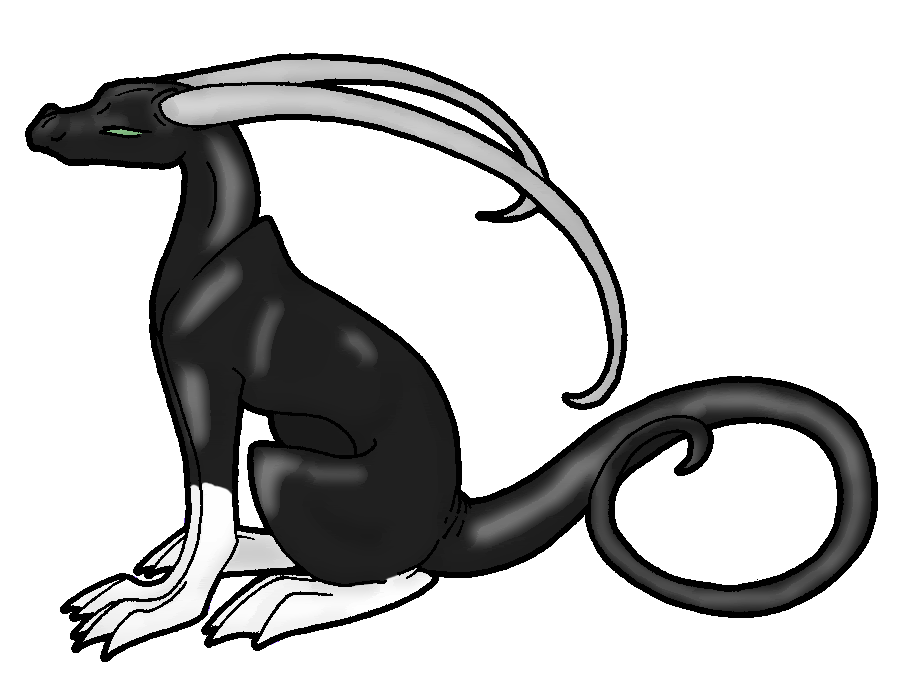
It is obvious they originated in a similar plains environment; their colors, for the most part, blend well with the savannah. There are the odd black, or darker shades, as well as a very few white or nearly so. Their immense horns, used mostly for display, are usually a tone complementary to their sleek fur. Bearing a generally lean build, they are well suited for the open, hot, and rather dry savannah they have chosen to inhabit. While they are technically omnivores, many prefer an almost completely vegetarian diet, though most hunt at some time, either for friends or to trade with their new neighbors.
Physical Characteristics and Description
Approximately 8-10' tall, at the shoulder, they are lean, even around the neck, despite the massive horns. They are covered in fur that is so sleek and silky it is hard to distinguish from glossy hide. Their horns are nearly as long as their shoulder height, depending on the individual.
They come in multiple colors, usually in shades of brown, grey, and gold. Black is not common, but it is also not unusual to see one or two in a clan. White is less common than black. Occasionally, markings occur, but these are unusual, and are usually the result of random mutation, and may pass to their offspring, but might be hard to find elsewhere. Regardless of body color, all ouvriax share one common trait - all of their eyes are green. The shade may vary, but is always distinctly green.
Society and Bonding
An incredibly social species, they have a strong, and unique, clan structure. Each clan consists of approximately 20 individuals at a given time, these individuals forming groups of up to 4 bonded members. Each bond group, known as a kret in their original tongue, has at least one male and one female. While it is very common for bonds to become mates, it is not expected, nor is it uncommon for the bonds to seek mates outside their kret.
Bonding itself is a unique part of their culture. At hatching, all members of the clan who do not have a full kret wait for the eggs to hatch. Once they do, each hatchling "inspects" the candidates, looking for one, or a kret, that suits them. Occasionally, a hatchling will bond another hatchling, and once in a while, if there are few available adults in one clan, they may invite other clans to attend. In the case of hatchlings bonding, the parents look after them until they are old enough to form their own kret.
When there gets to be more than 25 members of the clan, the krets usually discuss amongst themselves and the rest of the clan, and choose one or two, sometimes even half the clan, to leave and form a new clan. This can be done at any time, as well; it does not require overpopulation. Some younger members may become restless and their kret may leave to start their own clan.
In general, the kret that starts the clan is the "leader" of the clan. This is rarely disputed, but if something should happen to this kret, the oldest kret usually takes over.
The bond between members of a kret is a life bond. They cannot dissolve it once it is made. Generally, the bond is made at hatching, but should the ouvriax meet someone later in life who they feel is a good match, they may bond then as well. Each member of the kret is completely bonded to each other member, regardless of who bonded whom originally. They can communicate telepathically with each other, and to a limited extent, to the other members of their clan. Should a member of the kret die in some way, the others members enter a period of mourning, lasting anywhere from a month to a year, depending on the kret. Afterwards, they will attend hatchings, or even wander the continent, looking for a new member to fill the void.
With their discovery of the furry humanoids in their new land, a few have decided to try a new type of bonding, allowing the different tribes access to hatchings. This was implemented after several recent hatchlings had oddly decided to remain unbonded, until one of the malnevian traders came to visit, and apparently had the right characteristics for one of them.
Breeding and Kits
When a female decides to breed, she has two options: she can choose one of her bonds, or she can look elsewhere, be it another kret, or even another clan. Often, if there is more than one female in a kret, both will take a mate at the same time. Each female will lay 1 to 4 eggs, and they are placed together with any other eggs from the kret, possibly the entire clan, if it is small, or females from multiple krets around the same time.
The eggs remain together until hatching, the mothers all taking turns to care for them, but once they are all together, no one knows which egg belongs to which parents. When they hatch, all the hatchlings find their bonds, or in rare cases, do not. The species as a whole apparently has no problem with inbreeding or incest, as the hatchlings have no idea which in their egg group are their siblings, and as such, often bond and occasionally breed with them. Most, however, do try to avoid breeding too often with those from their own hatching.
Naming
Naming traditions are relatively simple. A specific letter ending denotes a male or female. The letter "l" at the end of the name denotes a female, and the letter "e" denotes a male. This tradition will pass to the abot the second or third generation, depending on the other parent species' tradition, if they are non-ouvriax.
Personality
Generally light-hearted, individuals' personalities may vary. Most will feel incomplete with less than 3 bonds, but there are exceptions to this as well. They will be depressed if they do not have sufficient company, however, given their very social nature. Even if one does not bond, he or she will need a companion or two to keep from being lonely. They can be competitive, but rarely antogonistic. But again, individual personalities are up to you.
An example... Black female with socks