(click on a photo to enlarge)


That said, there are some peculiarities about Zimbabwe that are a direct result of five years of bad politics. The first is the monetary system. The Central Bank obviously wasn't prepared for hyperinflation the last time it printed money, so the largest bank note is worth 500 Zimbabwean dollars, not enough to buy a beer with. These bills are called "Harare Ferraris" because they are red and they leave your pocket so fast! I exchanged three US $20 bills for a huge stack of local currency that weighs as much as a couple of days' worth of food on my bike. Fortunately there are plenty of things to spend it on, like chocolate and all of the other Western foods that aren't made elsewhere in Africa. In fact, everything that is made locally is dirt-cheap right now if you're exchanging US dollars, so I lived quite well here. In addition, everything from money to bread to gas has to be bought on the black market when it's not available through the traditional channels.
I entered Zimbabwe by crossing the Kariba Dam, which holds back the waters of the Zambezi to form one of the largest artificial lakes in the world. The town of Kariba is where all of the displaced white farmers seem to hang out. The whites in Zimbabwe are quite a closely-knit group, but they are as African as anyone else here. For years they supplied grains and tobacco for much of southern Africa on huge farms, and until recently they made quite a good living at it. By meeting some of them I got connected with a network of people all over the country with offers of places to stay, good company, and, of course, lots of perspectives on the political and economic situation. The Mugabe government's decision to allow white-owned farms, even the ones that were acquired legitimately, to be taken over by just about anyone was truly a crime against its own people. Most of the farms now sit idle, as the people who came to occupy them couldn't afford seeds, water, fuel, electricity or any other inputs to make the crops grow. These inputs were handed out to Mugabe's buddies but not to anyone else. The result is that the farms' current occupants can be seen slashing, burning, working tiny subsistence plots with outdated techniques, and generally living a lifestyle that is akin to that of rural people in the less-developed countries further north. All of this is done on farms that were set up to provide huge amounts of badly-needed food and foreign exchange in an efficient way. In other words, people are carrying water buckets on their heads for miles when water pipes run beneath their feet, dragging iron ploughs when tractors sit idly on their land, and cutting wood to provide heat and cooking power despite being hooked up to an electrical grid. As any middle-school economist could have predicted, the majority of the current occupants were much better off working on the white-owned farms, where they received social and medical services, food and schooling for their children (all subsidized by the farm owners) and a wage that, while certainly very low, was determined by the government to be fair. Despite all of this, the Zimbabweans that I met, regardless of ethnicity or wealth, have been some of the most pleasant, well-informed and optimistic people I've encountered anywhere.
On my way east from Harare I stopped at the Halfway House, a lovely Cape Dutch-style farmhouse converted to an a country pub/restaurant/inn. The place has beautiful gardens and tasty homemade farm products, and is typical of the mix of European and African influences to be found in Zimbabwe. For two nights I stayed at one of the few tobacco farms that is still operating in the country. It was planting day, so I had a chance to watch the planters in action. I didn't envy the people doing the planting or the supervising, but it was certainly interesting to watch. I then moved on to Mutare, at the base of the Vumba, the mountainous area that separates Zimbabwe and Mozambique. This was one of the most beautiful places I've been in Africa, with lush jungle covering steep hillsides. From Mutare I moved south and west, doing sort of a zigzag pattern through the country. The south of Zimbabwe is more rural and traditional than the north. However, I found a few nice campsites that sit on extensive game ranches providing habitat for giraffes, monkeys, impalas, warthogs, and other species threatened by a rapidly-growing segment of the population that can't afford to get food except by poaching.
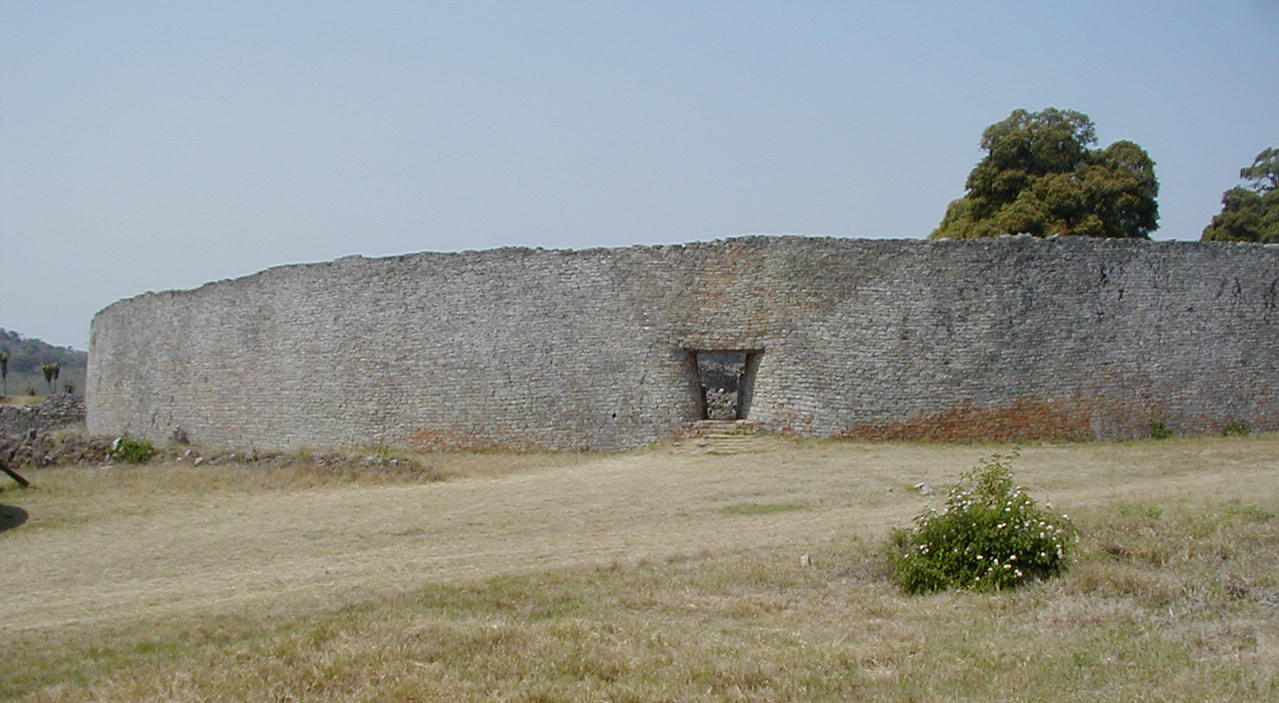
On my way to the Limpopo River and the South African border I stopped at the Great Zimbabwe Ruins. This is a collection of stone structures built by what was the most powerful dynasty in this part of Africa in the 15th-16th Centuries. Walking around the ruins was even more fun than seeing the Acropolis, partly because there was not a single other person there, despite being one of the most famous sights in the country. In fact, I didn't meet any tourists from anywhere other than South Africa the whole time I was in Zimbabwe!
The only part of the country that I didn't enjoy was the far south. The area between southern Zimbabwe and South Africa, known as the lowveld, is low-lying, flat, hot and boring. For 120 miles I didn't see a single thing but dry mopane forest. However, I rode hard and finally arrived at Beitbridge, just across the Limpopo River from South Africa and nearly 3,000 miles from my starting point in Kenya.