
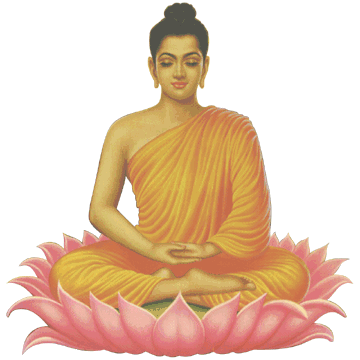
 "The Tathagatas are only teachers."
The Dhammapada "The Tathagatas are only teachers."
The Dhammapada
Characteristics of the
Buddha
After a stupendous struggle of six strenuous years, in His
35th year the ascetic Gotama, unaided and unguided by any supernatural agency, and solely
relying on His own efforts and wisdom, eradicated all defilements, ended the process of
grasping, and, realizing things as they truly are by His own intuitive knowledge, became a
Buddha -- an Enlightened or Awakened One.
Thereafter he was known as Buddha Gotama, one of a long
series of Buddhas that appeared in the past and will appear in the future.
He was not born a Buddha, but became a Buddha by His own
efforts.
The Pali term Buddha is derived from "budh",
to understand, or to be awakened. As He fully comprehended the four Noble Truths and as He
arose from the slumbers of ignorance He is called a Buddha. Since He not only comprehends
but also expounds the doctrine and enlightens others, He is called a Samma-Sambuddha --a
Fully Enlightened One -- to distinguish Him from Pacceka (Individual) Buddhas who
only comprehend the doctrine but are incapable of enlightening others.
Before His Enlightenment He was called Bodhisatta
which means one who is aspiring to attain Buddhahood.
Every aspirant to Buddhahood passes through the Bodhisatta
Period -- a period of intensive exercise and development of the qualities of generosity,
discipline, renunciation, wisdom, energy, endurance, truthfulness, determination,
benevolence and perfect equanimity.
In a particular era there arises only one Samma-Sambuddha.
Just as certain plants and trees can bear only one flower even so one world-system (lokadhatu)
can bear only one Samma-Sambuddha.
The Buddha was a unique being. Such a being arises but
rarely in this world, and is born out of compassion for the world, for the good, benefit,
and happiness of gods and men. The Buddha is called "acchariya manussa"
as He was a wonderful man. He is called "amatassa data" as He is the
giver of Deathlessness. He is called "varado" as He is the Giver of the
purest love, the profoundest wisdom, and the Highest Truth. He is also called Dhammassami
as He is the Lord of the Dhamma (Doctrine).
As the Buddha Himself says, "He is the Accomplished
One (Tathagata), the Worthy One (Araham), the Fully Enlightened One (Samma-Sambuddha),
the creator of the unarisen way, the producer of the unproduced way, the proclaimer of the
unproclaimed way, the knower of the way, the beholder of the way, the cognizer of the
way."
The Buddha had no teacher for His Enlightenment. "Na
me acariyo atthi" -- A teacher have I not -- are His own words. He did receive
His mundane knowledge (from His lay teachers, but teachers He had none for His a
supramundane knowledge which He himself realized by His own intuitive wisdom.
If He had received His knowledge from another teacher or
from another religious system such as Hinduism in which He was nurtured, He could not have
said of Himself as being the incomparable teacher (aham sattha anuttaro). In His
first discourse He declared that light arose in things not heard before.
During the early period of His renunciation He sought the
advice of the distinguished religious teachers of the day, but He could not find what He
sought in their teachings. Circumstances compelled Him to think for Himself and seek the
Truth. He sought the Truth within Himself. He plunged into the deepest profundities of
thought, and He realized the ultimate Truth which He had not heard or known before.
Illumination came from within and shed light on things which He had never seen before.
As He knew everything that ought to be known and as He
obtained the key to all knowledge, He is called Sabbannu -- the Omniscient One.
This supernormal knowledge He acquired by His own efforts continued through a countless
series of births.
Who is the Buddha?
Once a certain Brahmin named Dona, noticing the
characteristic marks of the footprint of the Buddha, approached Him and questioned Him.
"Your Reverence will be a Deva ?"
"No, indeed, brahmin, a Deva am I not," replied the Buddha.
"Then Your Reverence will be a Gandhabba?"
"No indeed, branmin, a Gandhabba am I not."
"A Yakkha then?"
"No, indeed, brahmin, not a Yakkha."
"Then Your Reverence will be a human being?"
"No indeed, brahmin, a human being am I not."
"Who, then, pray, will Your Reverence be?"
The Buddha replied that He had destroyed Defilements which condition rebirth as a Deva,
Gandhabba, Yakkha, or a human being and added:
"As a lotus, fair and lovely,
By the water is not soiled,
By the world am I not soiled;
Therefore, brahmin, am I Buddha."
The Buddha does not claim to be an incarnation (Avatara)
of Hindu God Vishnu, who, as the Bhagavadgita charmingly sings, is born again and again in
different periods to protect the righteous, to destroy the wicked, and to establish the
Dharma (right).
According to the Buddha countless are the gods (Devas) who
are also a class of beings subject to birth and death; but there is no one Supreme God,
who controls the destinies of human beings and who possesses a divine power to appear on
earth at different intervals, employing a human form as a vehicle.
Nor does the Buddha call Himself a "Saviour"
who freely saves others by his personal salvation. The Buddha exhorts His followers to
depend on themselves for their deliverance, since both defilement and purity depend on
oneself. One cannot directly purify or defile another. Clarifying His relationship with
His followers and emphasizing the importance of self- reliance and individual striving,
the Buddha plainly states:
"You yourselves should make an exertion. The
Tathagatas are only teachers."
The Buddha only indicates the path and method whereby He
delivered Himself from suffering and death and achieved His ultimate goal. It is left for
His faithful adherents who wish their release from the ills of life to follow the path.
"To depend on others for salvation is negative, but to
depend on oneself is positive." Dependence on others means a surrender of one's
effort."
"Be ye isles unto yourselves; be ye a refuge unto
yourselves; seek no refuge in others."
These significant words uttered by the Buddha in His last
days are very striking and inspiring. They reveal how vital is self-exertion to accomplish
one's ends, and how superficial and futile it is to seek redemption through benignant
saviours, and crave for illusory happiness in an afterlife through the propitiation of
imaginary gods by fruitless prayers and meaningless sacrifices.
The Buddha was a human being. As a man He was born, as a
Buddha He lived, and as a Buddha His life came to an end. Though human, He became an
extraordinary man owing to His unique characteristics. The Buddha laid stress on this
important point, and left no room for any one to fall into the error of thinking that He
was an immortal being. It has been said of Him that there was no religious teacher who was
"ever so godless as the Buddha, yet none was so god-like." In His own time the
Buddha was no doubt highly venerated by His followers, but He never arrogated to Himself
any divinity.
The Buddha's Greatness
Born a man, living as a mortal, by His own exertion He
attained the supreme state of perfection called Buddhahood, and without keeping His
Enlightenment to Himself, He proclaimed to the world the latent possibilities and the
invincible power of the human mind. Instead of placing an unseen Almighty God over man,
and giving man a subservient position in relation to such a conception of divine power, He
demonstrated how man could attain the highest knowledge and Supreme Enlightenment by his
own efforts. He thus raised the worth of man. He taught that man can gain his deliverance
from the ills of life and realize the eternal bliss of Nibbana without depending on an
external God or mediating priests. He taught the egocentric, powerseeking world the noble
ideal of selfless service. He protested against the evils of caste-system that hampered
the progress of mankind and advocated equal opportunities for all. He declared that the
gates of deliverance were open to all, in every condition of life, high or low, saint or
sinner, who would care to turn a new leaf and aspire to perfection. He raised the status
of down-trodden women, and not only brought them to a realization of their importance to
society but also founded the first religious order for women. For the first time in the
history of the world He attempted to abolish slavery. He banned the sacrifice of
unfortunate animals and brought them within His compass of loving kindness. He did not
force His followers to be slaves either to His teachings or to Himself, but granted
complete freedom of thought and admonished His followers to accept His words not merely
out of regard for Him but after subjecting them to a thorough examination "even as
the wise would test gold by burning, cutting, and rubbing it on a piece of
touchstone." He comforted the bereaved mothers like Patacara and Kisagotami by His
consoling words. He ministered to the deserted sick like Putigatta Tissa Thera with His
own hands. He helped the poor and the neglected like Rajjumala and Sopaka and saved them
from an untimely and tragic death. He ennobled the lives of criminals like Angulimala and
courtesans like Ambapali. He encouraged the feeble, united the divided, enlightened the
ignorant, clarified the mystic, guided the deluded, elevated the base, and dignified the
noble. The rich and the poor, the saint and the criminal, loved Him alike. His noble
example was a source of inspiration to all. He was the most compassionate and tolerant of
teachers.
His will, wisdom, compassion, service, renunciation,
perfect purity, exemplary personal life, the blameless methods that were employed to
propagate the Dhamma and His final success -- all these factors have compelled about one
fifth of the population of the world to hail the Buddha as the greatest religious teacher
that ever lived on earth.
Paying a glowing tribute to the Buddha, Sri Radhakrishnan
writes:
"In Gotama the Buddha we have a master mind from the East second to none so far as
the influence on the thought and life of the human race is concerned, and sacred to all as
the founder of a religious tradition whose hold is hardly less wide and deep than any
other. He belongs to the history of the world's thought, to the general inheritance of all
cultivated men, for, judged by intellectual integrity, moral earnestness, and spiritual
insight, he is undoubtedly one of the greatest figures in history."
In the Three Greatest Men in History H.G. Wells
states:
"In the Buddha you see clearly a man, simple,
devout, lonely, battling for light, a vivid human personality, not a myth. He too gave a
message to mankind universal in character. Many of our best modern ideas are in closest
harmony with it. All the miseries and discontents of life are due, he taught, to
selfishness. Before a man can become serene he must cease to live for his senses or
himself. Then he merges into a greater being. Buddhism in different language called men to
self-forgetfulness 500 years before Christ. In some ways he was nearer to us and our
needs. He was more lucid upon our individual importance in service than Christ and less
ambiguous upon the question of personal immortality."
The Poet Tagore calls Him the Greatest Man ever born.
In admiration of the Buddha, Fausboll, a Danish scholar
says -- "The more I know Him, the more I love Him."
A humble follower of the Buddha would modestly say: The
more I know Him, the more I love Him; the more I love Him, the more I know Him.
Taken from "The
Buddha and His Teachings"
Written by Ven. Narada
Published by Cultural Conservation Trust
 
|