Many people say that the Titanic sank because it hit an iceberg.Actually,a chain of events followed,which lead to the sinking of this great ship.
The aft starboard side of the bow
This area of the ship represents steel doing what it was not intended to do. The aft end of the B-deck shell plate bends down and in 12 feet (4 meters) and the shell plate below D deck bends out about 25 feet (7.5 meters) from the original line of the hull.
This adds high stress to the two locations indicated in the upper and lower shell plating indicated. If corrosion starts to cause the hull to change shape, these will be among the first areas to see it.
It's been observed that rusticle growth and corrosion is heavier in areas where the metal has been bent or damaged.
The pipe running from the B down the sides of the windows is the pipe that ran beneath the overhang of the A-deck promenade. The upper part of the shell plate is less than 20 degrees from lying flat.A-deck is twisted almost vertical and the actual B-deck that went with the windows is some 6 feet (2 meters) lower in the collapsed decks.
The tear in the ship
The tear in the bow takes a cross section of the key interior elements of the ship. Though the decks collapsed, the roof of the 1st class lounge is still 50 feet (16 meters) above the mud. That's 5 stories up and the slope climbs to 10 stories!
In the break-up, the keel buckled under the aft edge of #2 boiler room (lower portion of the picture) and the bulkhead and coal bunkers disappeared into the debris field.
The imprint of the 3rd funnel uptake in the broken decks appears clearly in the WHOI photos and video. The walls inside the uptake were pulled out. The rest of the decks broke relatively even along the forward part of the uptake.
The Break-up of Titanic
On April 15th, 1912, Titanic sank after colliding with an iceberg. It broke in two leaving the bow and stern sections of the ship nearly 2000 feet apart on the ocean floor. How did the ship break such that the wreck appears as we find it today? Popular conjecture theorizes that the ship broke from the top down, usually centering the break on the aft expansion joint. It may be more probable that the cause of the break-up occurred bottom-up, resulting from the buckling of the keel.
The bow section still resembles the original ship but the stern section appears devastated. An explanation of the break requires determining a sequence of events that will lead to the current condition of the stern.
As a preface, consider breaking a stick and a structure like a cardboard tube. The solid stick will break top-down. The cardboard tube will collapse on the bottom and bend the sides outward before it tears. The Titanic has more in common with the tube than a stick.
I'll reference two recent works featured on the television special "Titanic: Anatomy of a Disaster". One is the finite element simulation of stresses to Titanic's hull during the sinking done by naval engineers at Gibbs & Cox, Inc. The other is the Hacket/Bedford paper "The Sinking of Titanic - Investigated by Modern Methods" published for the Royal Institute of Naval Architects by a current and retired naval architect for Harland & Wolff (builders of Titanic). This is supplemented with my own research at the Woodshole Oceanographic Institution archives on Titanic.
The evidence driving this discussion is the current condition of the stern. Of note, the starboard shell plate is missing for some 160 feet (42 meters) aft of the forward tear. The debris alongside the wreck is a mix of decks and shell plate sections that comprise a fraction of the original mass. This huge section fell off sometime well before impact. The port side shell plate is still present, but is separated from the keel for 120 feet (36 meters) or more aft of the tear and is splayed out too far to have "bounced" out there on impact. The bow section shows no evidence of the shell plate separating from the keel, despite the impact.

How was the shell plate separated from the keel? How did this play into the events of the sinking as reported by survivors? After the break, why didn't the stern remain afloat, or at least restart a slower filling and overflow of compartments? After the break, the stern tipped and up sank so quickly that many survivors saw no significant interruption in the sinking of the ship.
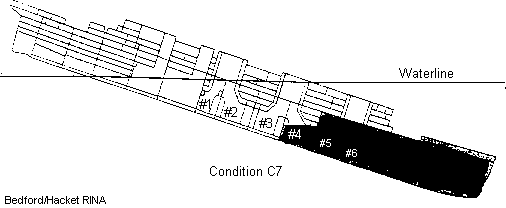
To set the stage for the break-up, we reference the Hacket/Bedford paper. They modeled and simulated the sinking using their extensive knowledge and the company's archives on Titanic. They concluded that Titanic reaches a critical point when the front six watertight compartments are flooded and the seventh (#4 boiler room) is about half full. At that point the ship's design is compromised and it tips up to begin the final plunge. This point occurred about 20 minutes before the ship disappeared.
From the paper, the figure marked Condition C7 shows the ship in the process of beginning the final plunge. The break-up occurred about this time. #1 funnel was inundated and the collapsible boats were floated off the bridge area. Water is moving up the corridors and beginning to flood the compartments for #2 and #3 boiler rooms.

Referring to the Gibbs & Cox finite element analysis of the stress (see figure 1), it points out the tremendous pull stress being exerted on the ship's upper structures and the compression stress of the keel. This model, however, stops after filling the first six compartments. It doesn't follow through to stress
conditions after Titanic began the final plunge. While the paper states no conclusion, the discussion refers to the expansion joints several times and leads the reader to believe they are significant.

Of note, the inch thick steel sides of Titanic are the strength of the ship's design. The lower ship's structure of the keel, the watertight bulkheads, the decks between them, and the interior pillar system also make for a strong structure. This structure provides the current stern with most of it's form and appears relatively intact aft of the engine room. The decks above the watertight bulkheads show far more movement and damage.
Keying on the compression stress indicated in the simulation, and applying that to the model in the Hacket/Bedford paper, we create a new Condition 8 indicating the start of the break-up. The single point failure of the hull, namely the buckling of the keel near the current tear, relieves much of the compression stress on the keel and transfers it to the sides. The side shell plate is compelled to bow outward as the keel length shortens. This is supported by William Garzke, an American naval architect and shipwreck forensic specialist in writings for Titanic International's issue #25 of "Voyage".

At this point, we can apply the potential forces of the ship's mass diametrically opposed to the ship's design. The weight of the bow section is pulling perpendicularly downward. Buoyant forces are pushing up on the broad bottom of the ship, trying to right the stern. The sides try to remain rectangular.
The sum total of the bow's weight pulling down the sides is focused on the ribs immediately aft of the buckle. This yanks the ribs off the side of the tank top and produces a 90 degree sheer to the connections for the lower deck structures. The upper decks pull downward, still attached to the shell plate.
Condition 9 indicates the bow and stern sections separated by 10-20 feet. The bow is slowly gaining momentum as it drops. The sterns interior structure is trying to right itself, levered by the weight of the stern out of water. The transfer of downward pull sets up stresses that, in effect, unzip the shell plate from the tank top going back to the forward engine room.

Condition 10 shows the 'zipper' effect extending back to the turbine room or beyond. The overall shell plate attempts to maintain a rectangular shape as steel plates will have very little stretch. The arch that inherently tries to occur along the upper edges is translated to an inward bow of the upper decks.

Condition 11 shows stress on the shell plate at a critical point where they begin to break up. The #1 boiler room is forced upward into the falling upper decks and the center section of the ship grinds itself up, spilling out the single ended boilers. The rapid flooding of the turbine room smashed the condensers and allows us to find interior sections of the condensers in the debris field.
The stern is left low in the water at the head as the bow begins the trip to the bottom. With the watertight compartments compromised back to the dynamo room, it fills in only minutes to allow the stern to settle and tip up so quickly that many survivors didn't notice an interruption in the sinking process.
This process also allows the stern to be more gradually lowered into the water. In a top down break, all models and simulations show the stern flopping down into the water, as seen in the Cameron movie. The splash and wave produced would have been enormous, but survivor accounts don't indicate this.
As the stern nosed in, it rotated nearly 180 degrees to starboard. If the starboard shell plate broke-up after the port side, an extra pull from the sinking bow may have started the turn. Separating the shell plate farther on the starboard side may have caused more rapid flooding on that side, producing a list which is translated into a roll as the ship tips up.
Partial attachment of the port shell plate prevented it from falling off and possibly pulling off the upper decks as the ship tipped up. The starboard shell plate probably fell off near the surface, yanking off a portion of A-deck. The loss of stability from the shell plate allowed the starboard portions of B and C decks to be caught in the current, flipping them up and back over themselves. As the stern dropped, it righted itself and the large flap of port shell plate produced a counter-clockwise spin.
On impact, the port shell plate, already held out by the current, splays out to it's current position. The lower decks maintain their general shape, much as the bow behaved. The upper decks, yanked to and fro by the uneven loss of weight from the fragmenting shell plate, flop randomly on the system of pillars and give us the "chaotic" appearance we see today.
Conclusion
A top-down break requires a number of single point failures working together and plays into the strength of the ship's design. A bottom-up break works against the strengths of the ship's design. A top-down break should have left the stern afloat longer, and the front of the stern should appear more as the rear of the bow section appears today. That is not the case. A bottom-up break is more likely to leave the stern of the ship looking as it was discovered in 1985.
The proof may lie in further examinations of the keel sections in the debris field. A consistent pattern of downward damage along the edges of the tanktop may provide compelling evidence.
On a sad note, if the theory above is right, then for the engineers in the lower engine spaces, the end was more violent than we can imagine. The steel structures around them came crashing down around them as the sea blasted in.
Implosion damage
Much of the damage to the stern section is attributed to implosion damage. Implosion means that the external pressure of the water overcomes the internal air pressure and structures collapse inward.
This is easy to do in the sea. For every 32 feet of depth, sea water exerts on additional atmosphere (15 pounds per square inch) of pressure. What this means is that as the poop deck was about 1/3 submerged, the center of the after well deck was over 60 feet (20 meters) underwater, with a pressure of 2 atmospheres. That's 30 pounds per square inch or more than 2 tons per square foot. If the ship is air filled, then the decks are crushed inward by the weight of the water.
This also means that the ship was suffering implosion damage in the middle of the stern section before the poop deck was fully submerged. This would have added to the rumbling sound heard by survivors.Big ships die a horribly noisy death.
Remarkably, the damage to the forward half of the stern section was caused during the break-up, the rapid flooding that followed, and the final impact, not implosion damage. True implosion damage is surprising limited to the well deck (that wasn't supported by the watertight bulkheads) and only the outer edges of D, E, and F-decks, mostly on the starboard side. But this damage on the outer fringe severed the right angle connections with the sides along the well deck area and the sides splayed outward on impact, making the stern look far worse than it is. The interior structure from D-deck down to the keel held together well.
The interior cabins are another story. As the near vertical stern sank, the water raced up the decks, bulldozing the interior walls. In the areas of the cargo hatches, the water blasted down the shafts and stairs, smashing the lightweight structures between the decks. In the Angus photo view down the #6 cargo hatch, a large amount of random interior wall plating can be seen strewn about the edges of the shaft.
The safes to the assistant purser's office were found in the debris field. They found their way out of the ship from 3 decks within and moved through 3 rows of cabins to find their exit to the seafloor.
The poop deck was peeled up either because water scooped under it during sinking or due to a final blast of air forced out from the lower decks by rapid flooding. The latter can often be seen in footage of ships sunk by U-boats. The poop deck peeled up as far as the aft end of the 3rd class public rooms and folded back on itself, skewed a bit to starboard. The docking bridge juts out from under the folded poop deck in the broken starboard aft corner. At least one of the forward cranes was thrown off the stern some 50 feet (15 meters) aft of the final resting place on impact.
The stern impacted rudder first, but not at the steep angle mentioned in the "Titanic - Anatomy of a Disaster". The poop deck was already tilted up and probably back, but the wreck shows A and B-decks around the mast tilted slightly to fore and a little to port, hence the mast is tilted slightly fore and to port.
The center propeller is totally buried. The outboard props and the 'wings' to the propeller shafts were sheered from the ship and are bent upward at nearly 20 degrees, leaving the props visible almost at the level of the G-deck portholes. The starboard prop blade still sports the '401' hull number for Titanic from Harland & Wolff.
After this,the stern and the bow had completely different journeys. The bow fell on the groundwith a great force ,although the speed was not so high.The stern had air inside it.This air,on going down the water became highly pressurized.This triggered an explosion and the trapped air came out.According to survived passengers,there was big explosion,after which a lot of cork came out of the sea.The cork covered the section of the ship,which had the compressed air.This explosion could be as powerful as T.N.T. So,the stern is totally tattered,whereas the bow is relatively better off.

