
Please excuse me while I pick my jaw off the floor.
Rated:

Posted on: 12/2/99
Sega had a lot to prove to American audiences with the launch of its Dreamcast console system. For one, many gamers were disappointed with the way Sega handled the Saturn in the US, and most felt cheated in the end. In addition, most of the Sonic games released over the past several years have either been barely average or missed the mark completely. Ironically, Sonic Jam — a compilation of 16-bit Sonic games released on the Saturn — was the best of the bunch. All this has changed with the launch of the Sega Dreamcast, however, which brings a fabulous new Sonic game with it. Granted, Sonic Adventure does contain its share of flaws, some of which are pretty major. But when this game is at is best, it provides one of the most exhilarating gaming experiences ever.
| |
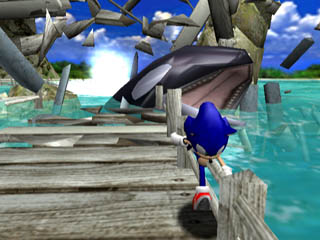
| Sonic Adventure has some of the fastest graphics you will ever see on a television screen! | |
To start, Sonic Adventure has a terrific story line told through the adventures of six characters, each of which have unique abilities, objectives, theme songs, and endings. Sonic is the main star of the game, so obviously the game revolves around him, and his story is what holds the game together. The basic story line goes like this: The evil Dr. Robotnik (referred to as "Eggman" by Sonic and company) has unleashed a horrific beast known as Chaos and, with the help of the seven emeralds, plans to take over the world...again. It’s up to Sonic to try to reach each emerald before Robotnik, who will feed them to Chaos upon retrieval. Each time Robotnik feeds Chaos an emerald it causes the beast to transform in dramatic fashion, becoming an even more deadly opponent as a result. Naturally, it’s also Sonic’s job to destroy a capsule filled with animals at the end of each level, but Sonic fans could have easily predicted that one. What Sonic fans may not be able to predict is that the rescued animals will actually play an important part in the A-Life mini-game (more on that later).
The story is told and advanced through a series of cut-scenes. Most of the game’s cut-scenes use the regular game engine, but there are some nicely done full-motion-video (FMV) sequences as well. The only problem is the player cannot skip them, which is especially bothersome if a particularly long scene has already been viewed. It also doesn’t help that the voice-overs in these scenes are horrible, making the voice acting in the Resident Evil series seem like a well-done Shakespearian play. Some of the voices, like Dr. Robotnik’s and E-102's, are quite good, but the rest of the characters have very annoying voice-overs, with Tails and Big the Cat being the most painful. There is an option to switch the American voices to Japanese, a delightful alternative, since English text is displayed on the screen during the cut-scenes.
As mentioned before, there are six different characters (seven if you count "Super Sonic") you can play as in the game: Sonic, Tails, Amy, Knuckles, and the two new characters, Big the Cat and a robot called E-102 Gamma. Initially, you can only play as Sonic, but as you encounter the other characters in the game they will become selectable. Each character has their own set of level objectives and a corresponding story line, which will sometimes conflict with the other ones, but pieces together in the end. For example, Big the Cat must use his trusty fishing rod in each level to fish for his pet frog that keeps running away. Froggy, as Big calls him, will also make an appearance in the other character’s games, and is a vital component to the Chaos beast itself.
So what types of gameplay possibilities does the Dreamcast’s superior capabilities give Sonic Adventure? Well, a little bit of everything. Sonic has all of his old moves intact, with a few new variations. The blue hedgehog can now execute a homing attack, which is basically a spin attack that targets enemies or objects after the jump button is pressed a second time. There is also a new and improved spin-dash move, in which Sonic curls up in a little ball and takes off with an insane amount of speed.

| |
| Amy helps out a bird in need of assistance. | |
Let’s not forget the other characters. The rest of the characters have unique abilities that aide them in their unique quests. Knuckles, for example, is able to dig underground at a certain point in the game. He can also fly and climb up the sides of buildings and mountains. These special abilities let him search the levels more thoroughly for the shattered pieces of the Master Emerald, which his mission entails.
There are several different types of items that each character can collect to improve his or her abilities temporarily or permanently. As usual for a Sonic game, there are invincibility, high-speed-shoes, and shield power-ups that affect the character’s ability for a limited amount of time. There are also, as any Sonic fan could have guessed, a ton of rings scattered throughout the levels, with the collection of the hundredth ring adding an extra life.
What makes things interesting, though, are the level-up items. These items have a lasting impact on the character for the remainder of the game. Some characters must find the level-up items to make it through certain levels. Sonic, for instance, would be unable to complete the later levels if not for the "light speed dash" level-up item. This item lets Sonic travel on a path of rings suspended in mid-air — an absolute necessity to complete the game.
The game itself is composed of many different elements and gameplay experiences. Each character starts out in an "Adventure Field," which serves to take the player from one level to the next. It also provides a safe haven where the character can freely explore and talk with a variety of non-player characters. However, at some points in the Adventure Field a boss character will pop up and must be defeated before progressing.

| |
| Here's one of the two new characters, E-102 Gamma. | |
What Sonic fans, or platform fans in general, will enjoy the most are the "Action Stages." These stages, as the name suggests, are where the real action of the game takes place. Here, the classic Sonic gameplay elements have successfully translated into 3D. You’ll find plenty of loops, speed bursts, beautiful scenery, and a wide assortment of enemies and obstacles to spin attack. Again, each character has a different mission and level objective, so these stages will be different depending on the character you’re playing as, and not all of the levels will be open to every character. A quick example is the Twinkle Park Action Stage: In this stage, Sonic needs to make his way quickly through the level to destroy a capsule at the end filled with animals. Yet, when playing this same level as Amy there is no capsule to destroy, and you take an entirely different route through the level while trying to avoid capture by one of Robotnik's robotic henchman. The five extra playable characters have fairly short games, consisting of five or fewer levels. You’ll need to play through the game with all of them if you want to unlock Super Sonic, who will provide the true ending after he defeats the final boss.
Sonic Adventure has a ton of mini-games. These range from snowboarding/sandboarding to Amy’s amusing "Hedgehog Hammer" game, which is similar to whack-a-mole. Once you play through these in the main game, they are selectable from the main menu. You can then choose the individual mini-game you want to play.
Perhaps the most involved mini-game in Sonic Adventure is the Chao A-Life game; it could have received a game of its own due to its rather involved nature. Throughout the game, there are areas that act as nurseries where tiny Chao eggs are found and hatched. Once hatched, these tiny creatures, which resemble water drops, can be raised to your liking and pitted in races against other Chao. Your Chao will depend on you for love, food, and proper development.
As mentioned, the animals rescued in the game will play a part in the Chao mini-game. Every time you rescue some animals and return to the Chao raising area, the animals are released and can be combined with your Chao. This element changes the appearance and characteristics of your Chao, and they take the appearance of the animal (or animals) you combine them with, along with any associated behaviors.

| |
| Check out Sonic's new homing attack! | |
Still, this doesn’t even begin to scratch the surface of the A-Life game. If you have a VMU (an absolute must if you plan to get the most out of Sonic Adventure), you can transport one of your Chao creatures into the VMU to play yet another mini-game. This time, however, you don’t have to depend on your Dreamcast to supply the action, because you can simply detach your VMU from the controller and have a fun time interacting with it there. I won’t go in depth about this feature, but it is a necessity if you plan to win any of the Chao races. I should also mention that the VMU is useful for downloading and uploading Chao on the Internet.
Unfortunately, Sonic Adventure is far from perfect. As mind blowing and fast as the graphics are, camera problems, slowdown, and bad collision detection detract from the overall experience. One or more of these flaws will most likely lead to your character’s demise every so often — never a good thing. To be fair, most 3D games contain some type of camera or collision detection problem, and Sonic Adventure has been greatly improved since its Japanese release. Certain characters also have problems picking up objects, specifically E-102 and Knuckles, but this is a relatively minor flaw. Finally, I did like most of the music in the game, but I could have done without some songs (Tails' theme song being one of them).
As far as replay value is concerned, you’ll find a great deal with all the characters, mini-games, emblems to collect, and Internet options (Chao downloads and uploads, patches, contests, chat, etc.). Yet, the actual game is fairly easy, and I don’t see anyone having serious trouble completing it. Most bosses can be beaten on the first try, and only the Egg Viper and Perfect Chaos bosses provide much of a challenge. Nevertheless, it will take skill, patience, and practice to obtain all 130 emblems.
After all is said and done, this is one of the most enjoyable games I have ever played. I really enjoyed the presentation and each of the individual story lines. I even felt moved at certain parts of the game, although the bad voice acting was a little distracting. The graphics, flaws and all, are perfect for showing off what the Dreamcast has to offer, and the music backed up each breathtaking moment. Sega has finally delivered the goods — thanks in large part to Sonic Team and the game's producer, Yuji Naka — and any video game fan would be foolish to miss out on this excellent game.
Supports:
- VMU (recommended)
- Jump Pack
- Modem