
1-0 Reviews
Miles Davis
|
Albums:
|

|
Links:
Miles Davis
Official site Sony: Miles Davis Davis at Sony Archive of Miles Discussion list, with archives |
|
Albums:
|
|
Links:
Miles Davis
Official site Sony: Miles Davis Davis at Sony Archive of Miles Discussion list, with archives |

|

|
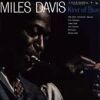
Kind of Blue1959 |
Classic album wherein Davis makes the definitive statement on modal jazz.
One of a handful of albums in jazz history that practically everyone agrees is great, Kind of Blue is actually a transitional album for Davis. He enlisted pianist Bill Evans to aid him in making a kind of timeless, impressionistic jazz based on modes rather than the standard chord changes of bop. Evans' smooth, stream-of-consciousness style pervades this album to the effect of near-ambient textures and dreamlike weightlessness. The group here, including John Coltrane, Cannonball Adderly, Paul Chambers, and Jimmy Cobb, had never played the pieces before the recording, and this date is widely recognized as the greatest example of group improvisation in jazz history.
Representative tracks
All Blues: This muted-Davis melody is practically required listening. The simple, 6/8 blues offers ample space for the band to blow freely. The distinct intro-figure by Evans was, like most of the album, developed only moments before the recording.
|
|
|
|
Personnel:
Miles Davis:
John Coltrane:
Cannonball Adderly:
Bill Evans:
Paul Chambers:
Jimmy Cobb:
Wynton Kelly: |
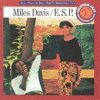
E.S.P.1965 |
First album by Davis' classic 60s quintet, featuring Wayne Shorter, Herbie Hancock, Ron Carter, and Tony Williams.
Davis was famous for his restlessness with groups and styles. In the 50s, he had gone through bop, cool, orchestrated jazz with Gil Evans, and modal approaches on Kind of Blue and Milestones. With this group, he would take pure jazz as far as he could, pushing the envelope harmonically, rhythmically, and compositionally. The players Davis assembled were much younger than him, with drummer Tony Williams only 19 when this was recorded. Their fresh approaches coupled with Davis' need for change formed one of the greatest jazz groups of all time.
Representative tracks
E.S.P.: Tune co-written by Wayne Shorter, who would make the greatest compositional contribution to the group throughout their career. Driving hard bop with angular melody, minimal comping, and a furious solo from Davis.
|
|
|
|
Personnel:
Miles Davis:
Wayne Shorter:
Herbie Hancock:
Ron Carter:
Tony Williams: |
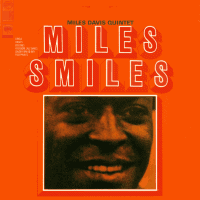
Miles Smiles1966 |
Second album from Davis' celebrated 60s Quintet, recorded after a year of touring with the group.
Davis and company had spent more than a year playing together, and this album documents an incredible chemistry among the players. The tunes are more abstract and aggressive and the playing straight to the point. The muscle-y pulse supplied by drummer-wunderkind Tony Williams runs through all the quintet's releases, but is especially dominant here. His unique ride patterns and high-hat use is the primary reason why this music so easily led to the rock and funk music Davis would make a few years later. Restless and driven.
Representative tracks
Footprints: Classic Wayne Shorter tune influenced by the modal experiments of Davis during the preceding years. The rhythm section constantly shifts time signatures while soloists blow effortlessly. Modern jazz---Wynton Marsalis would pay hommage to this music throughout his career.
|
|
|
|
Personnel:
Davis, Shorter, Hancock, Carter, Williams |
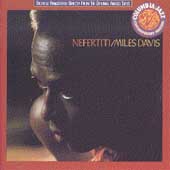
Nefertiti1967 |
Last acoustic jazz album made by Davis before the electric experiments of '68, and the full-blown jazz-rock of '69 and the 70s.
Davis and the the other members of this quintet had become very interested in what was going on in music outside of jazz. Though they had not yet begun to incorporate electronics or guitars into the group, the sound here is quite anxious, as if Davis was ready to move on. With titles such as "Riot" and "Madness," it was clear that the conscious of the group was very much a part of the times. Again, Tony Williams and Wayne Shorter seem to be the stars of this group, leading by the stick and pen respectively. Shorter's title tune, in particular, is a jazz classic.
Representative tracks
Nefertiti: Anxious, weary tune that simply repeats the melody over and over, without an improvised solo by Davis, Shorter, or Hancock. The real star is Tony Williams, who wriggles under the horns in a kind of nervous commentary to the melody.
|
|
|
|
Personnel:
Davis, Shorter, Hancock, Carter, Williams |
The Complete In A Silent Way Sessions1969 |
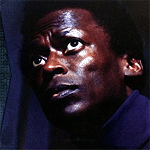
This boxed set release details a six-month stretch in 1968-69 when Miles Davis' interest in rock and funk music, and new recording techniques would spawn an unprecedented direction for the jazz artist. He spent months in the studio rehearsing on tape, midwifing his ideas. Beginning in late 1968, Miles was a painter using one canvas to try and retry his masterpiece, continually repainting over areas where, though the ideas were fresh and the colors vibrant, the concept was yet immature.
As a palette, Miles chose only the best primaries from two continents. In between gigs in England, he saw Dave Holland's band opening for Bill Evans, and asked him to join his group. Elsewhere, when it became apparent Herbie Hancock was going to have trouble making a recording date, Tony Williams recommended the young Boston native Chick Corea as a replacement. This quintet (Davis, Shorter, Williams, Holland and Corea) produced the first tunes on this release in September 1968. Gradually, John McGlaughlin, Joe Zawinul, Joe Chambers and Jack DeJohnette were added to complete the recordings on this set. Part of the mystique surrounding this album, for me, has always been that it seemed to come out of nowhere, like a beacon of uncanny originality and visionary foresight. Apparently, it did have roots, and while the music will always be some of my favorite from Miles, I can't honestly say that seeing the blueprints for his magic translates to the same sheer joy as did the end results. But, it's still magic music, and it's still Miles. The worst thing you could ever say about a set like this is that it's almost too educational, and of course, that's not really a criticism, is it?
Representative tracks
Frelon Brun: This tune, recorded in late '68, offers a glimpse at the revolutionary sounds ahead. Williams wastes no time in hammering out a hard funk break from the kit, and Corea had apparently already learned the importance of the repetitive chordal vamp to this music. Davis takes a short solo, as if testing the waters, which is followed by Shorter's seemingly more confident strides in funky acid soul. The music actually ends up closer to what the band played after Bitches Brew than anything on In a Silent Way.
|
|
|
|
Personnel:
Miles Davis:
Wayne Shorter:
Herbie Hancock:
Joe Zawinul:
Chick Corea:
John McLaughlin:
Dave Holland:
Tony Williams: |
The Complete Bitches Brew Sessions
1998 |
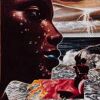
Landmark album from Davis wherein he embraces rock and funk, and alienates many critics and fans.
Although Davis' previous album, In A Silent Way, had used electronics and tape loops, he still managed to shock the jazz community with this double album. Where he had merely flirted with rock rhythms and volumes before, there was no hiding his new interests here. Band members include John McGlaughlin, Chick Corea, Jack DeJohnette, Dave Holland, Joe Zawinul, Bennie Maupin (on ever-present bass clarinet), Lenny White, Billy Cobham, Airto Moreira, and Steve Grossman, all of whom would go on to the all-star ranks of jazz fusion in the 70s and afterwards. The music is a dark, wild blend of rock, soul, and freeform jazz. Imagine Coltrane's Ascension with tighter structures and rock rhythms. The many players here manage not to crowd the sound, and conjure an atmosphere of jungle haze crossed with a modern chic.
Representative tracks
Bitches Brew: Foreboding intro, with sinister organ, echo-trumpet, crashing percussion, and tonal-cluster keys, eases listener into one of Davis' slinkiest grooves. Had fusion remained so dark, it could never have acquired its rather vapid reputation. Skewed art, but art nonetheless.
|
|
|
|
Personnel:
Davis, Shorter, Corea, Zawinul, McLaughlin, Holland
Bennie Maupin:
Larry Young:
Harvey Brooks:
Jack DeJohnette, Lenny White, Charles Alias:
Don Alias, Airto Moreira, Jimmy Riley, Jumma Santos: |
Live at the Fillmore East (March 7, 1970): It's About That Time2001 |
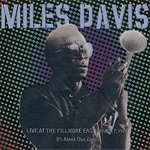
Official release of an oft-bootlegged performance of Davis' "lost quintet." Almost all the music being played was unreleased at the time, and unlike anything ever produced by jazz musicians. Most of the tunes performed at this Fillmore date (not to be confused with another release, Miles Davis at Fillmore: Live at the Fillmore East, recorded in June of the same year) were from the landmark Bitches Brew LP. Although Bitches Brew had been recorded the previous summer, it wouldn't be released until a few weeks after this performance.
The applause is polite, but hesitant, and the two or three guys who wanted more at the end may have been anomalies, because it was pretty obvious the band had left it all onstage after the last number. Representative tracks
Directions (disc 1): The first set begins as Holland, DeJohnette and Corea vamp to a furious funk groove. Heavy bass and some well-placed exotic percussion kick things off, and by the time Davis enters, the brew is already quite hot. Miles' playing seems to be aiming straight for the jugular while Holland takes the straight and steady, and when Shorter comes in, he leads DeJohnette and Corea on a path so ridden with turbulence and strife, it derails the entire tune. About five minutes in, it becomes impossible to remember that most of these same musicians had produced something like In a Silent Way, only a year earlier.
|
|
|
|
Personnel:
Miles Davis: trumpet
|
Live-Evil1971 |
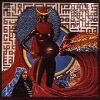
Double-disc set released in 1971, that details two sets at The Cellar Door, Washington, DC, in December of 1970, and two recording sessions completed earlier in the year. The session stuff generally finds Davis in full mystical mode, as if starting from “Nefertiti” and working his way through Messiaen and who knows what rootless, exploratory concept of what makes a jazz ballad. The live stuff is a different animal entirely, and is arguably as close as Davis ever got to actual integration of rock and funk into his music. The beats are there, and the bass is right up front, but there is something else.
On paper, you can see how the players would probably sound good: Davis, the ringleader, on his horn, often with the wah-wah and other assorted aggressive filtration; Keith Jarrett, a holdover from the Bitches Brew touring band, on electric piano; Jack DeJohnette and Airto Moreira as the rhythm makers, also from the Bitches Brew band; Gary Bartz on soprano and alto sax, and Michael Henderson, fresh from Aretha Franklin’s band, on bass. A pretty nice lineup, and then there was the last minute addition of one John McLaughlin on guitar – these performances were probably fated to be special, as this kind of apparently offhanded, yet rather essential, arrival (Bartz later said that the group had never played with McLaughlin before this date) generally signals good things to come.
Representative tracks
Sivad: Begins as hard funk, but soon transforms into a blues lament (again recalling Hendrix), stretching out the hazy vamp for Davis, McLaughlin and Jarrett to take a chorus or six. Conversely, “What I Say” just stays with hard funk. The groove is faster than the former tune, and is superficially less “evil”, though I would add that any tune featuring Davis’ screech hits can never really be all that nice. Henderson lays down an assured ostinato, and DeJohnette plays the rock beats like he invented the stuff. Jarrett wastes no time in launching a solo. The tune also features one of two drum solos by DeJohnette on the record, both of which are great examples of a mixture of abstract jazz exploration and sheer rock pummeling.
|
|
|
|
Personnel:
Davis, Shorter, Corea, Zawinul, McLaughlin, Holland, DeJohnette, Moreira
Gary Bartz:
Steve Grossman:
Herbie Hancock, Keith Jarrett:
Khalil Balakrishna:
Michael Henderson, Ron Carter:
Billy Cobham: |
