|
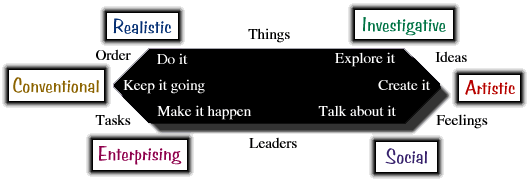
Read your 3 highest score definitions below to find your
personality type and possible careers that fit your personality
type. Use the above table to see where you fit into the personality
table. Usually people tend to be on one side or the other.

|
Realistic People deal with things more than ideas or
people. They like working with their hands, physical activity,
and outdoor working environments. They enjoy repairing,
building, the outdoors, and athletics.They want concrete
tangible work and not abstract problems. They are practical,
shy and emotionally stable and value traditional concepts.
They enjoy careers related to engineering, skilled trades,
agricultural, technical and some service fields. Examples
of realistic careers include: park ranger, draftsperson,
surveyor, rancher, and military and law enforcement. |

|
Investigative people are analytical, disciplines. curious,
and cope with life and its challenges through intelligence
and rational problem solving. They enjoy classes or activities
involving charts, graphs, numbers, or formulas. They enjoy
abstract work and complex activities dealing with facts,
details, and principles. They prefer activities requiring
analytical and scientific abilities and tend to be independent
and original. They dislike repetitive activities and value
objective information. They often pursue careers in the
physical or biological sciences such as in meteorology,
geology, medical technology, medicine, and psychology. |

|
Artistic people rely on feelings and imagination more
than facts and perceive self as expressive, original,
intuitive, nonconforming, introspective, and independent.
They like to communicate ideas artistically through writing,
music, drama, art, entertaining. They enjoy drawing, photography,
reading, going to theaters and galleries. They dislike
structured or routined activities. They pursue careers
in such areas as art, music, drama, literature, journalism,
public relations, architecture, advertising, writing,
and interior design. |

|
Social people are interested in helping and working
with others. They are sensitive to and concerned
about the needs of others. Such adjectives as enthusiastic,
insightful, cooperative, and generous are often used to
describe them. They value social issues and interpersonal
relations over mechanical or scientific pursuits. They
like to work with people; curing, developing or enlightening
others. They enjoy entertaining, attending conventions
and doing community service. They are understanding, helpful,
and idealistic. They have great concern for the welfare
of others. Careerwise, they are often found in athletics,
teaching, counseling, social work, and similar social
service settings. |

|
Enterprising people are adventurous, dominant, persuasive,
and action oriented. They perceive themselves as self-confident,
popular, and social. Possessing strong verbal and leadership
skills, they are often successful in obtaining organizational,
economic, or political goals. They enjoy working
with people, influencing, managing, leading, and persuading.
They involved in political activities, competitive
sports, leading groups. They are aggressive, popular,
self-confident, sociable. They dislike science, systematic
thinking and ambiguous problems. They are attracted
to money, power, and material possessions. In choosing
work, they often select careers in sales, management,
politics, marketing and small business administration. |

|
Conventional people are practical, neat, organized,
and work well in structured situations. They prefer work
environments with clear chains of command. They enjoy
working with data and things, record keeping, writing
reports, making charts and graphs, operating office machines.
They like activities requiring accuracy and attention
to detail, and use organizational and mathematical skills
to solve problems. They dislike ambiguous situations and
intense interpersonal relationships. They value material
possessions and status. They enjoy careers related to
accounting, data processing, finance, and office management. |
|