 |
|
|
|
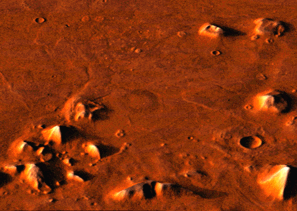
The Face on Mars was identified on Viking frame 35A72 by Dr. Tobias Owen, who is now professor of astronomy at the University of Hawaii. The same frame, covering approximately 34 by 31 miles - also shows many other features that could be artificial.
These clusters around latitude 40 degrees north in the region of Mars known to astronomers as Cydonia, and were photographed from an altitude of more than 1,000 miles with relatively poor resolution. A casual glance reveals only a jumble of hills, craters and escarpments. Gradually, however, as though a veil is being lifted, the blurred scene begins to feel organized and structured - too intelligent to be the result of random natural processes. Although the scale is grander, it looks the way some archaeological sites on Earth might look if photographed from 1,000 miles up. The more closely you examine it, the more it is apparent that it really could be an ensemble of enormous ruined monuments on the surface of Mars. |
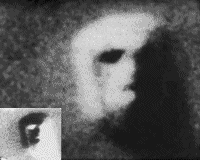 |
For a long while after the 1976 Viking photographs, NASA and other scientific authorities continued to disseminate what one researcher calls "the bogus claim that the Face is a trick of light and shadow". This notion began to be challenged seriously only when Vincent Di Pietro, a computer scientist and former NASA consultant, discovered another image of the Face on frame 70A13.
 |
This second image, which had been acquired 35 Martian days later than the first one and under different lighting conditions, made possible comparative views and detailed measurements of the Face. |
Complete with its distinctive Sphinx-like headdress, it is now known to be almost 1.6 miles long from crown to chin, 1.2 miles wide and just under 2,000 ft. high.
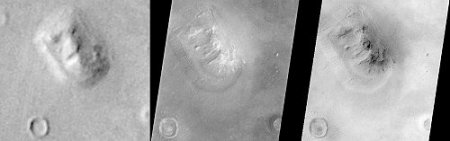
This figure shows the earlier Viking image plus the new image oriented similarly and scaled to comparable size. It also shows the same new image as a negative to simulate the partial reversal of light and dark areas between the two images.
From this viewing angle with this lighting, the resemblance to a face is rather poor in these initial images from the Mars Global Surveyer. The object would still look much like a humanoid face if the viewing angle were from above and the lighting angle were from the low west. This would reproduce the conditions for the older Viking images. The higher viewing angle would allow us to peer over the nose bridge to the east side in the new image as we could in the older image, allowing us to see that both sides of the face are reasonably symmetric. This symmetry is near impossible to see in this new image alone. Moreover, as the middle image best demonstrates, the brightness of the sunlight washes out details on the east side that can be seen in the Viking image, such as the continuation of the mouth. While it is, of course, to soon to reach a verdict, one possibility to consider is that this feature is natural and only accidentally looks like a face under specific conditions. The Alien Exchange will continue to cover this controversial story as the images come in.
 |
