|
| |
A Page on Architeuthis dux or
The Giant Squid

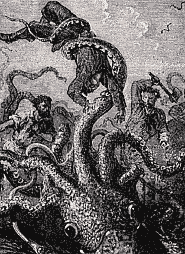 |
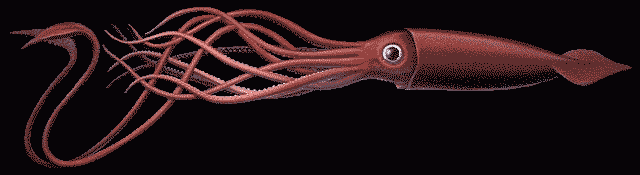
How big does it get? Up to 18 m (59
ft)
Up to 900 kg (1,980 lb, nearly 1 ton) |
A Picture of a Giant Squid Specimin
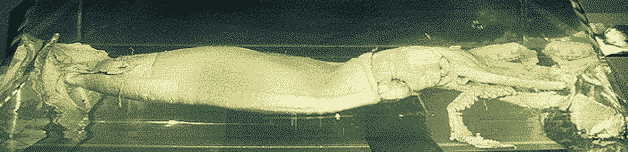
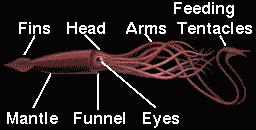 |
Head: houses a complex brain. Eyes:
largest in the animal kingdom. They
can grow to 25 cm
(10 in.) in
diameter--about the size of a
volleyball.
Fins: relatively small in this species. They
help balance and maneuver the
huge animal as it swims.
Mantle: the main body. This muscular sac
contains most of the organ
systems.
Arms (8): studded with two rows of
suckers.
Feeding tentacles (2): missing in this
specimen.
Funnel: a multipurpose tube used in
breathing, jetting, squirting ink,
laying eggs, and expelling waste. |
|
|
 There is an octopus in this photo, can you find it???? There is an octopus in this photo, can you find it????
MMMMMMM donuts 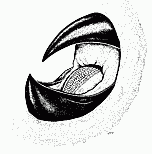
Download a file of a moving squid here
The Vampire Squid
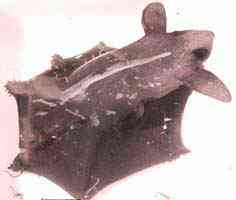 |
1.Arms a.Arms II are retractile filaments.
b.Cirri present over arm length;
suckers present only on distal half
of arms.
c.Suckers without cuticular lining. 2.Fins
a.Two pairs of fins present during
ontogeny.
3.Spermatangia a.Receptacle (deep sac) for
spermatangia located
anterior to each eye in
females.
4.Gladius a.Gladius with broad median field
and broad conus.
5.Siphuncle ? a.Visceropericardial coelom
extends posteriorly as a
slender duct, possibly a
remnant siphuncle.
6.Photophores a.Large circular, lidded organs
present posterior to each
adult fin ("fin-base" organs).
b.Numerous small organs
distributed over ventral
surfaces of mantle, funnel,
head and aboral surface of
arms and web ("skin-nodule"
organs). Two patches on
dorsal surface of head look
like aggregrated small
photophores but are
photoreceptors (Herring, et
al., 1994).
c.Unidentified organ(s)
produce luminescent
clouds consisting of
discrete glowing particles
(Hunt, 1966).
d.Arm-tip organs (Hunt,
1996). |
All info was obtained from the Smithsonian Natural History Web Home Page
Another squid link.....
Cephalopoda -
this page is way beyond me, but you might understand it
|