 |
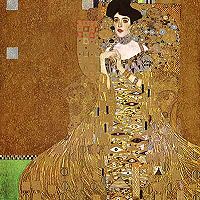
Portrait of Adèle
Bloch-Bauer
(1907)
Österreich Galerie, Vienna
When
Klimt came back from his visit to Ravenna, he brought back with him its
mosaic-Byzantine style. It is this portrait that epitomizes this
style in his "golden" period. The effect is kaleidoscopic, where
the woman is encased in glittering gold, dotted with coutless geometric
figures.
It is very typical of Klimt to paint lavish ornamentation,
specially behind the human figure, sometimes making it difficult to discern
where the foreground begins and ends. Noteable in this painting is
the eye-pattern on the dress of Adèle, which Klimt borrows from
Egyptian art. One of Klimt's trademarks is the position and
detail of the hands. Note how lovingly detailed the fingers are clasped.
Scholars say this is Klimt's way of showing intimacy. It shouldn't surprise
us that Adèle was one of Klimt's lovers.
Klimt painted several paintings of Adèle, who is
also said to be the model for Judith I which now hangs in the main
exhibit of this gallery. |
