 |
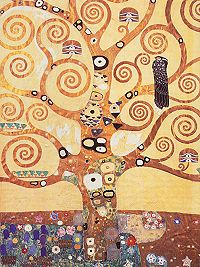
The Tree of Life
(1905-1909)
Österreichische Museum für Angewandte Kunst, Vienna
Klimt
did not only do canvass and cardboard but murals as well. The dining
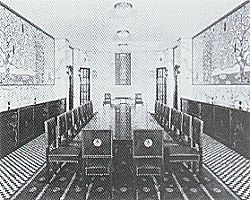
room of the Palais Stoclet is decorated with circular branches from the
Tree of Life. The mural runs the entire length of the walls with
the Tree of Life in the center. The branches spread outward to reveal
two other important paintings entitled Fulfilment, and Expectation.
The tree is depicted to grow out from the earth on a garden
covered with flowers. In this painting, Klimt uses geometric figures:
circles, triangles and stars. He also uses a favorite ornament of
his - the egyptian eye. It is everywhere on the branches of the tree.
|
The dining room of the Palais Stoclet
shows the Tree of Life on both walls.
|
Just like Klimt, he has to infuse some irony in his work.
Several crows sit on the branches of this painting. In this close-up, a
crow is perched on the right of the tree, very near the trunk. The
crow symbolized death, and it is indeed ironic for a symbol of death to
be sitted on the tree of life. But one has to understand the works
of Klimt to appreciate this "irony". Klimt wants to depict a never-ending
cycle of life and death -- a theme the recurs very often in his work.
Scholars say that this tree of life is the same "tree
of knowledge" spoken of in the book of Revelation. One wonders at the parallelism:
that this continuous cycle of life and death is depicted in this painting,
just as the book of Revelations speaks of death and rebirth. |
