 |
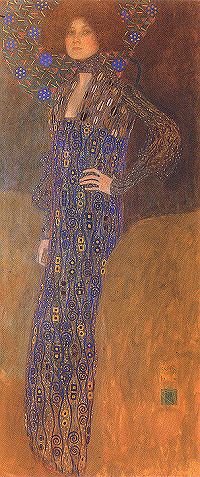
Portrait of Emilie Flöge
(1902)
Historisches Museum der Stadt, Vienna
It
was no secret that Klimt had many lovers, one of which was Adèle
Bloch-Bauer whom he painted several times. Records show that he also
had a number of illegitimate children with his lover. But it was
Emilie Flöge the he spent twenty-seven years of his life with.
Despite the length of time together, however, Klimt never got around to
formalizing his union with Emilie.
In 1902, Klimt painted this portrait of her. There
is no symbolism here; in fact, there seems to be a painstaking effort to
paint her with so much vivid realism. Notice how both hands take
a very natural position: the left hand perched on the hip, and the right
hand’s fingers slightly folded. It is very typical of Klimt’s portraits
to show loving detail and character. In this case, Emilie’s hands
express some tension. Tie that up with the restraint in her face
hinting us of some mystery. Putting those elements together, Klimt
paints a very enigmatic portrait of her.
Technically, Françoise Ducros, analyzes the painting
this way:
"The network of informal lines and motifs of the dress, where
blue and green shine with gold, is handled with extreme finesse, as are
the aureole of colors and abstract forms which frames the face and thick
hair..."
Although it is one of the more appealing portraits Klimt
has painted, it doesn’t seem to have pleased Emilie nor her family and
it was sold to the Historisches Museum in 1908.
Emilie and her sister, it should be told, ran an avant-garde
fashion shop, called the Casa Piccola, near the Secession Building.
Aside from painting, Klimt kept himself busy by also designed clothes for
the fashion store. |
