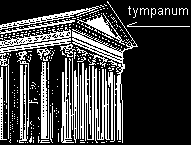
The
tympanum is the recessed, usually triangular face of a pediment within
the frame, made by the upper and lower cornices.
-
Merriam Webster Dictionary
|
|
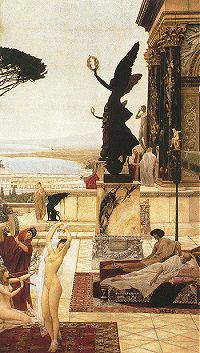
Theater at Taormina
(1886)
Burgtheater, Vienna
The
construction of the Burgtheater was just about to be completed in 1886
but it had yet to be decorated. Gustav, his brother Ernst, and Franz Matsch
were commissioned to paint scenes from the history of theater. They were
supposed to paint these scenes on both the tympanum and the stairway ceilings
of the newly constructed theater.
While painting, however, Klimt developed a different style
compared to his two colleagues. At that time, he became interested in realism
so much that he did his paintings with photographic precision. No
doubt the style of Hans Makart, a great painter of that era, was
a great influence to Klimt.
This realism also stemmed from his childhood where he
would spend hours studying antique vases in the Imperial Museum.
In fact many of his latter works show vases painted with so much detail.
The Theater in Taormina, which adorned the Burgtheater,
presents such precision, as does the painting of the Burgtheater itself
which he later painted. The items to watch for in this painting are
the detail of the carpets; the pillars of the building on the right; and
the hazy mountain in the distance. All were done with so much realism
you'd think it was taken by a camera.
The detail of the carpets is so exquisite. Notice
how he is able to maintain the weave despite the perspective. The
pillars tend to shimmer, reflecting light, as if there was something cylindrical
actually in front of you. And the mountain in the background tends
to vanish and blend into nothingness, very much like viewing a landscape
on a hazy day. These, Klimt had to use his imagination, because the
Theater at Taormina was in ruins when he painted it.
|
In the 3rd century B.C., the Greeks built
the theater on a hilltop in Taormina, in Sicily, Italy, using the amphitheater
style. Eventually the Romans took over it and remodeled it to their
style of architecture and culture. They added a front entrance which
was richly decorated with groups of four columns. These columns separated
the royal entrance from the side doors.
The Romans of that time had a thing for position and power;
the royal entrance was used only by important people, segregating the ordinary
people. Klimt captures this front entrance with the columns and the probable
activities going on in front of the theater. |
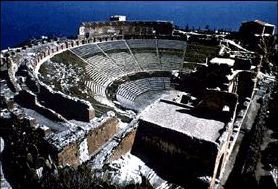
The
ruins of the amphitheater in Taormina.
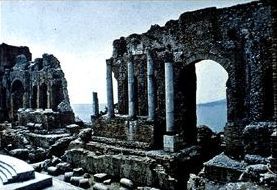
The
remains of the front entrance added by the Romans is one of the best preserved. |
|
