
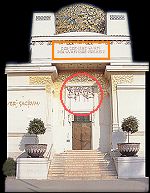
 The Secession Building
|
The Secession Building
In
1898 the second Secession exhibition took place in the then newly constructed
Secessionist Building called Ver Sacrum -- "Sacred Spring". It was
designed by Josef Maria Olbrich inspired from a sketch made by Klimt.
The building was supposed to be the embodiment of the secession's ideology
and artistic dreams. The architecture is likened to that of an antique
temple composed of simple geometric elements one on top of the other --
which, at that time, went against Classical academic composition.
High above the entrance of the building (boxed in orange
in the picture) is a slogan which reads:
"Der zeit ihre kunst
der kunst ihre freiheit"
which translates as
"To the Age its Art;
to Art its Freedom."
The inscription signified the secessionist's desire to
break with the past. The building's unique architecture showed this, and
the works inside showed this as well.
|
|
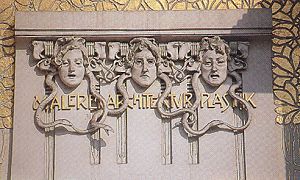 Gorgon heads above the doorway
Right above the doorway are three gordon heads (encircled
in red in the picture). Every patron had to walk under these gorgons when
entering the building. This served as a warning to the patrons that
they had to look at things in a different way. Going back to Greek
mythology, everyone who looked at the Gorgons turned to stone. But Perseus,
used a polished shield to look at Medusa's reflection so he could get near
enough to decapitate her. It was only Perseus who appreciated her
power because he was to only one who lived to do so. Likewise, the
gorgons here reminded the visitors that the art they were going to see
was going to be different, and in order to appreciate this art, they had
to view it in an extraordinary way.
Inside the building were moveable partitions so that the
secessionists could enalrge or reduce space as needed. The Ver Sacrum
also became the name of the secessionists newspaper. |
|
