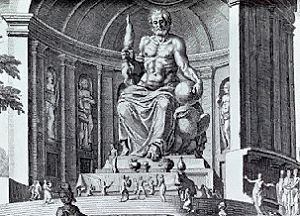
Zeus's image was represented in
sculptural works as a kingly, bearded figure. The most celebrated of all
statues of Zeus was Phidias's gold and ivory colossus at Olympia.
|
 |
Zeus
In
Greek mythology, the god of the sky and ruler of the Olympian gods. Zeus
corresponds to the Roman god Jupiter.
Zeus was considered, according to Homer, the father of the gods and
of mortals. He did not create either gods or mortals; he was their father
in the sense of being the protector and ruler both of the Olympian family
and of the human race. He was lord of the sky, the rain god, and the cloud
gatherer, who wielded the terrible thunderbolt. His breastplate was the
aegis, his bird the eagle, his tree the oak. Zeus presided over the gods
on Mount Olympus in Thessaly. His principal shrines were at Dodona, in
Epirus, the land of the oak trees and the most ancient shrine, famous for
its oracle, and at Olympia, where the Olympian Games were celebrated in
his honor every fourth year. The Nemean games, held at Nemea, northwest
of Argos, were also dedicated to Zeus.
Zeus was the youngest son of the Titans Cronus and Rhea and the brother
of the deities Poseidon, Hades, Hestia, Demeter, and Hera. According to
one of the ancient myths of the birth of Zeus, Cronus, fearing that he
might be dethroned by one of his children, swallowed them as they were
born. Upon the birth of Zeus, Rhea wrapped a stone in swaddling clothes
for Cronus to swallow and concealed the infant god in Crete, where he was
fed on the milk of the goat Amalthaea and reared by nymphs. When Zeus grew
to maturity, he forced Cronus to disgorge the other children, who were
eager to take vengeance on their father. In the war that followed, the
Titans fought on the side of Cronus, but Zeus and the other gods were successful,
and the Titans were consigned to the abyss of Tartarus. Zeus henceforth
ruled over the sky, and his brothers Poseidon and Hades were given power
over the sea and the underworld, respectively. The earth was to be ruled
in common by all three.
Beginning with the writings of the Greek poet Homer, Zeus is pictured
in two very different ways. He is represented as the god of justice and
mercy, the protector of the weak, and the punisher of the wicked. As husband
to his sister Hera, he is the father of Ares, the god of war; Hebe, the
goddess of youth; Hephaestus, the god of fire; and Eileithyia, the goddess
of childbirth. At the same time, Zeus is described as falling in love with
one woman after another and resorting to all kinds of tricks to hide his
infidelity from his wife. Stories of his escapades were numerous in ancient
mythology, and many of his offspring were a result of his love affairs
with both goddesses and mortal women. It is believed that, with the development
of a sense of ethics in Greek life, the idea of a lecherous, sometimes
ridiculous father god became distasteful, so later legends tended to present
Zeus in a more exalted light. His many affairs with mortals are sometimes
explained as the wish of the early Greeks to trace their lineage to the
father of the gods. |
