The Beethoven Monument
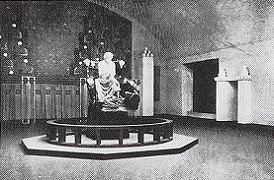
The central room
|
Joseff
Hoffmann, who designed the room built specially for the frieze, based his
arrangement on the model of the antique sacred temples. A visitor,
upon entering, would leave the everyday world and cross into one of culture.
The exhibition space was divided into three naves, lit by subdued ceiling
lighting. There was a central room which could be seen by wide openings
in the walls. There, in that central room, sat the semi-nude statue
of Beethoven sculpted by Max Klinger. It would seem that Beethoven
was enthroned very much like Zeus, sitting, concentrating, showing a countenance
of interior strength. The statue was surrounded by meaningful iconography
rendered in rich materials, bronzes and marble in various colors in the
tradition of ancient temples.
Before reaching that central room, however, the visitor
would have to transverse a room with roughcast walls decorated with Klimt's
Beethoven Frieze. It is said that this frieze was Klimt's visual
expression of Beethoven's Ninth Symphony.
On the day of the inauguration, Gustav Mahler came in person to conduct
a performance of the unfinished last movement of the Ninth Symphony. |
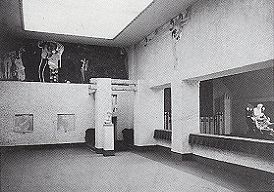 The transverse room
|
|
|
