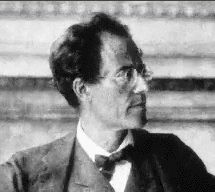
 Gustav Mahler
|
 |
Gustav Mahler
(1860-1911)
Austrian
composer and conductor, whose works mark the culmination of postromantic
development of the symphony and were a major influence on such 20th-century
composers as the Austrians Arnold Schoenberg and Alban Berg.
Mahler was born July 7, 1860, in Kalischt (modern Kalištè),
in what is now the Czech Republic. He studied at the Vienna Conservatory
and in 1880 became assistant conductor at Bad Hall, Austria. He subsequently
held posts as a conductor of opera in several central European cities.
In 1897 he became artistic director of the Imperial Opera in Vienna. Through
his efforts Vienna attained world prestige as an operatic center in the
ensuing decade. In 1907 Mahler went to New York City, where he conducted
at the Metropolitan Opera from 1908 to 1910 and with the New York Philharmonic
in 1910-11. He died in Vienna on May 18, 1911.
Of Mahler's symphonies, the unnumbered Das Lied von der
Erde (Song of the Earth, 1908) and four of the nine numbered symphonies
include solo voices with or without chorus. The song cycles Kindertotenlieder
(Songs on the Deaths of Children, 1902) and Des Knaben Wunderhorn (The
Boy's Magic Horn, 1888) exist in alternate versions with piano or orchestral
accompaniment; Lieder eines fahrenden Gesellen (Songs of a Wayfarer, 1883)
is orchestrally accompanied. Mahler also composed songs for voice and piano
and left an unfinished tenth symphony.
In his symphonies, he was the heir of the German composer
Ludwig van Beethoven and Richard Wagner and the postromantic Austrian composer
Anton Bruckner. Mahler's use of choral and solo vocal music in the symphony
completes the implications of Beethoven's similar procedure in his Ninth
Symphony and also achieves a musical and dramatic union akin to that sought
by Wagner in his music dramas.
Using the freedom that allowed Wagner and Bruckner to
push almost to the limits of the traditional system of keys and chords,
Mahler remained within that system, but he altered its basic premise so
that most of his symphonies end in a key different from the initial key.
As did Wagner and Bruckner, he employed vast orchestral resources; but
his orchestration anticipated the 20th century in its emphasis on the color
of individual instruments and small combinations of instruments, and its
inclusion of unusual instruments such as the mandolin and harmonium. Likewise,
he foreshadowed the 20th-century concern with counterpoint. |
