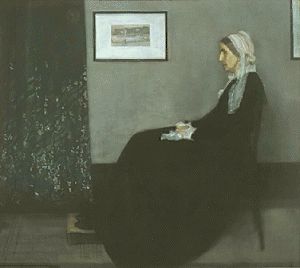
Whistler's Mother
One of the best-known paintings
by American artist James Abbott McNeill Whistler, Arrangement in Black
and Grey No. 1: The Artist’s Mother (1871, Musée d’Orsay, Paris,
France), known more simply as Whistler’s Mother, demonstrates his characteristic
style and reveals his European influences. Whistler lived in Europe for
most of his life and incorporated many impressionist techniques into his
work. In Whistler’s Mother, for example, he used monochromatic colors in
the stark representation of his mother—a style similar to the unglorified
portrait paintings of French impressionist painter Edgar Degas. In addition,
the two-dimensional format of the composition recalls the similar flattened
style of the works of French impressionist painter Claude Monet.
|
 |
Impressionism
Impressionism,
movement in painting and music that developed in late 19th-century France
in reaction to the formalism and sentimentality that characterized academic
art and much 18th- and early-19th-century music. The impressionist movement
is often considered to mark the beginning of the modern period in art and,
to a lesser degree, in music.
Impressionism in painting arose out of dissatisfaction
with the classical and sentimental subjects and dry, precise techniques
of paintings that were approved by the Académie des Beaux-Arts in
Paris and done in the studio. The Académie traditionally set the
standards of French art and sponsored the official Paris Salon exhibitions,
which reflected and popularized them. Rejecting these standards, the impressionists
preferred to paint outdoors, choosing landscapes and street scenes, as
well as figures from everyday life. Their primary object was to achieve
a spontaneous, undetailed rendering of the world through careful representation
of the effect of natural light on objects. The foremost impressionists
included Edgar Degas, Claude Monet, Berthe Morisot, Camille Pissarro, Pierre
Auguste Renoir, and Alfred Sisley.
The impressionists were concerned more with the effects
of light on an object than with exact depiction of form, because they believed
that light tends to diffuse the outlines of the form and reflect the colors
of surrounding objects into the shadows. The academic painters had defined
and modeled form by graduating shadings of tones and using black and brown
for shadows. The impressionists eliminated minor details and suggested
rather than defined form. They preferred the primary colors—red, yellow
and blue—and the complementaries—green, purple, and orange. They achieved
effects of naturalness and immediacy by placing short brushstrokes of these
colors side by side, juxtaposing primary colors so that they would blend
when viewed at a distance and contrasting a primary color (such as red)
with its complementary color (green) to bring out the vivid quality of
each. Thus the impressionists achieved a greater brilliance of color and
luminosity of tone in their paintings than the blending of pigments before
use would ordinarily produce. |
