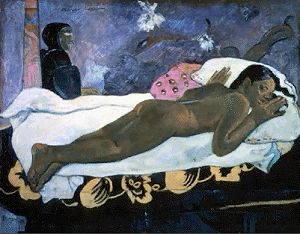
Spirit of the Dead Watching
Characteristic of the artist’s
later work, Spirit of the Dead Watching (1892) by French painter Paul Gauguin
was inspired by his life in Tahiti and the Marquesas Islands. A rhythmic
line and unique color palette permeate Gauguin’s style, while his subject
matter reflects his interest in dreams and the unconscious. An early artist
in the postimpressionist and symbolist schools of painting, Gauguin experimented
with coloring and helped provide the basis for 20th century art movements,
such as fauvism and expressionism.
|
 |
Symbolism
In
literature, symbolism was an aesthetic movement that encouraged writers
to express their ideas, feelings, and values by means of symbols or suggestions
rather than by direct statements. Symbolist writers, in reaction to earlier
19th-century trends (the romanticism of novelists such as Victor Hugo,
the realism and naturalism of Gustave Flaubert and Émile Zola),
proclaimed that the imagination was the true interpreter of reality. They
also discarded rigid rules of versification and the stereotyped poetic
images of their predecessors, the so-called Parnassians. Important precursors
of symbolist poetry were the American writer Edgar Allan Poe and the French
poet Gérard de Nerval.
In the visual arts, symbolism has both a general and a
specific meaning. It refers, in one sense, to the use of certain pictorial
conventions (pose, gesture, or a repertoire of attributes) to express a
latent allegorical meaning in a work of art (see Iconography). In another
sense, the term symbolism refers to a movement that began in France in
the 1880s, as a reaction both to romanticism and to the realistic approach
implicit in impressionism. Not so much a style per se, symbolism in art
was an international ideological trend that served as a catalyst in the
development away from representation in art and toward abstraction.
Inspiration was found initially in the work of the French
painters Pierre Cécile Puvis de Chavannes, Gustave Moreau, and Odilon
Redon, who used brilliant colors and exaggerated expressiveness of line
to represent emotionally charged dream visions, often verging on the macabre,
inspired by literary, religious, or mythological subjects. |
