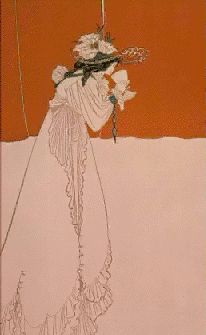
Isolde
Isolde is an illustration by the
late 19th-century English painter and graphic artist Aubrey Beardsley.
The Art Nouveau style can be seen in the use of decorative line, stylized
figure, and flat space. Beardsley did a large number of illustrations for
magazines and books. His use of dramatic darks and lights worked very well
in the graphic medium.
|
 |
Art Nouveau
Art
Nouveau, literally new art, a complex and innovative European art
movement of the last two decades of the 1800s and the first decade of the
1900s. It found expression in a wide range of art forms—architecture, interior
design, furniture, posters, glass, pottery, textiles, and book illustration—and
was characterized by its devotion to curving and undulating lines, often
referred to as whiplash lines. The term Art Nouveau is derived from Maison
de l'Art Nouveau, a Paris shop opened in 1896 by the dealer Siegfried Bing.
Art Nouveau had its roots in the Arts and Crafts movement
in England (founded in 1861 by the designer William Morris), which vehemently
rejected the shoddiness of some mass-production techniques. Art Nouveau
took up and elaborated the Arts and Crafts manifesto, calling for the creation
of a completely new style and a devotion to handicrafts. Art Nouveau borrowed
motifs from sources as varied as Japanese prints, Gothic architecture,
and the symbolic paintings of the 18th-century English poet and artist
William Blake to create a highly decorative style with strong elements
of fantasy.
The earliest examples of Art Nouveau are usually considered the work
of the English architect Arthur Mackmurdo, particularly a chair designed
in 1882 and an engraved frontispiece for a book (Wren's Early Churches)
of 1883, both of which exhibit the sinuous flowing lines that were to become
hallmarks of Art Nouveau. The fabric designs sold by Arthur Liberty in
his famous London shop (founded 1875) and the illustrations of Aubrey Beardsley—particularly
those for the periodical The Yellow Book (1894) and for Salomé (1894)
by the English writer Oscar Wilde—carried English Art Nouveau to its height.
Annual exhibitions of the Arts and Crafts Exhibition Society, beginning
in 1888, helped disseminate the style, and a new magazine, The Studio (founded
1893), helped spread it to Europe.
Art Nouveau first appeared in Belgium in the work of the
architects Victor Horta and Henri van de Velde; their designs for townhouses
featured elegantly twining wrought-iron staircases, balconies, and gates.
Charles Rennie Mackintosh, a Glasgow architect, practiced a spare, austere
version of Art Nouveau style in his interior design, furniture, glass,
and enamel work. In France, the style was most evident in the work of the
architect Hector Guimard (particularly the exotic Parisian Metro subway
entrances, 1898-1901), the glassmaker Émile Gallé, the furniture
designer Louis Majorelle, and the poster artist Alphonse Mucha. It was
also fashionable in interior decor, notably at Maxim's Restaurant in Paris.
In Munich, as the Jugendstil (German for "youth style"), and in Vienna,
as the Sezessionstil (German for "secession style"), it permeated applied
art and magazine illustration and reached a peak in the paintings of Gustav
Klimt and the furniture and architectural designs of Josef Hoffmann. In
the United States, the leading figure was Louis Comfort Tiffany, whose
shimmering Favrile-glass vases and stained-glass lampshades were fantasies
of iridescence. In Spain, Art Nouveau had perhaps its most original practitioner,
Antoni Gaudi; his highly idiosyncratic Güell Park and Casa Milá
Apartment House in Barcelona have no straight lines and give the impression
of being natural organisms that have sprung from the earth. |
