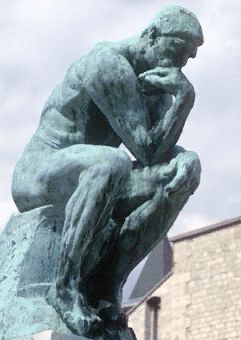
The Thinker (also known
as The Contemplator)
The bronze sculpture The Thinker,
by French artist Auguste Rodin, was originally intended to crown the Gates
of Hell, a monumental entrance to the Musée des Arts Décoratifs
in Paris. Inspired by the Inferno of Italian poet Dante Alighieri and the
volume Flowers of Evil by French poet Charles Baudelaire, the sculptural
program for the Gates of Hell reflected a deeply pessimistic view of human
life and happiness. The Gates were never completed, and the pieces created
for them—including Rodin's The Thinker and The Kiss—are now exhibited separately
as independent works.
|
 |
Auguste René
Rodin (1840-1917)
French
sculptor, who imbued his work with great psychological force, which was
expressed largely through texture and modeling. He is regarded as the foremost
sculptor of the 19th and early 20th centuries.
Rodin was born in Paris on November 12, 1840, the son
of a police official. He studied art in a free school for artisans and
on his own at the Louvre, because he was refused admittance to the École
des Beaux-Arts. For many years he worked for other sculptors, including
Ernest Carrier-Belleuse. Rodin collaborated in the early 1870s with a Belgian
artist on architectural sculpture for the Bourse in Brussels. In 1875 he
traveled to Italy, where he was profoundly influenced by the treatment
of movement and muscular action in the works of the Renaissance sculptors
Donatello and Michelangelo.
For Rodin, beauty in art consisted in the truthful representation
of inner states, and to this end he often subtly distorted anatomy. His
sculpture, in bronze and marble, falls generally into two styles. The more
characteristic style reveals a deliberate roughness of form and a painstaking
surface modeling; the other is marked by a polished surface and delicacy
of form. Rodin produced several important sculptures between about 1858
and 1875, including notably the Man with the Broken Nose. He initially
gained recognition in 1877, however, when his male nude figure The Age
of Bronze was exhibited at the Salon. This work aroused controversy because
of its extreme realism and provoked accusations that Rodin had made plaster
casts from living models. The exhibition in 1880 of his nude statue, St.
John the Baptist, which stressed the human qualities of his subject, increased
Rodin's reputation. In the same year he began work on the Gates of Hell,
a sculptured bronze door for the Musée des Arts Décoratifs
in Paris. The door represented chiefly scenes from The Inferno, the first
section of Dante's Divine Comedy. Although Rodin did not complete the Gates
of Hell, he created models, or studies, of many of its component sculptures,
all of which were acclaimed as independent achievements. Among these works
are The Kiss, Ugolino, The Thinker, Adam, and Eve. In 1886 he completed
The Burghers of Calais; this sculpture is a monumental bronze group in
which the historical figures are represented with great psychological differentiation.
Rodin also produced numerous portraits, which reveal the
emotional states of their subjects. They include numerous portraits, full
figures of the French writers Honoré de Balzac and Victor Hugo and
of the French painter Jules Bastien-Lepage; and busts of the French artists
Jules Dalou, Carrier-Belleuse, and Pierre Puvis de Chavannes. Rodin died
at Meudon, near Paris, on November 17, 1917. A number of his works can
be found in the Musée Rodin, Paris, and a Rodin museum is located
in Philadelphia.
|
