PERSEUS
(Per)
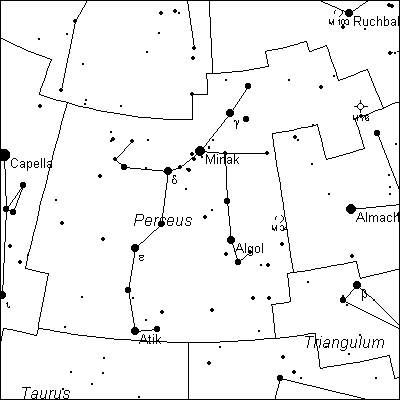
PERSEUS
(Per)
Generalities: it is a beautiful constellation of the northern sky. It is characterized by some stars that are bright enough and by beautiful open clusters. The Milky Way transits in its inner. Its transit at midnight takes place in November.
Origins and mythology: Perseus, in the mythology, is the hero that killed Jellyfish. Moreover, Perseus saved Andromeda from the sea monster to which the young girl had to be sacrificed to soothe Neptune's anger, and after this deed heroic Perseus married Andromeda. The two constellations are in fact close to each other. The star Algol represents Jellyfish's head instead.
Stars: Perseo shows five stars under magnitude 3 and other seven stars under magnitude 4. The brightest star (alpha) is Mirfak, of white-yellow color, 570 light-years far. The star beta (Algol) is a complex multiple system, characterized by varying brightness that cyclically oscillates in few days for mutual eclipse of the stars forming it. Algol has always been considered a diabolic star and is traditionally called "devil's star".
Table of stars brighter than magnitude
3.5
| Star | Proper name | Magnitude | Spectrum | Color | Distance (light-years) | Notes |
| Alpha | Mirfak | 1.80 | F5 | white-yellow | 620 | |
| Beta | Algol | 2.12 (variabile) | B8 | white | 95 | |
| Zeta | Atik | 2.85 | B1 | blue | 1100 | |
| Epsilon | 2.89 | B0.5 | blue | 680 | ||
| Gamma | 2.93 | G8 | yellow-orange | 110 | ||
| Delta | 3.01 | B5 | white-blue | 326 | ||
| Rho | 3.2 (variabile - max) | M4 | red | 196 |
Other objects:
the most beautiful object of the constellation is the double cluster "acca-chi",
which borders on Cassiopea. It consists in two rich and bright open clusters,
already visible with naked eye, under dark skies, and that already through
binoculars appear as a swarm of crowded starlets .
M34 is also a nice open cluster
present in Perseus. In this constellation there is then a planetary nebula
catalogued by Messier, but rather weak in reality: M76.

