The great royal tent stood at a
safe distance from the battlefield. Inside knelt the aged
Brian Boru, High King of Ireland. He was deep in prayer. With
all his heart he begged God for an Irish Victory in this
great battle against the Norsemen. All his life he had fought
these cruel invaders. Now he faced them once more at Clontarf
in a lst mighty effort to drive them from his land.
It was Good Friday morning. To
fight on such a holy day was not King Brian's wish. But the
Norsemen had forced the battle. Before the fighting began
Brian had ridden among his troops. Holding high a great cross
he reminded them that it was a holy day ; a day on which
Christ had died for all men. They were fighting, he told
them, for their faith and country against paganism and
slavery. With bowed head he joined them in a prayer, asking
God to give them strength in the fight ahead. Then, leaving
his son Muchadh in charge of the army, he retired behind the
Irish lines.
As he knely now in his tent he
could hear the wild war cries of his troops as they charged
into battle. Above the clash of sword on shield rose loud
shouts in the strange Norse tongue. From the door of the tent
his servant viewed the field and reported to the king the
course of the battle. The fighting was fierce, he told him.
As yet no side seemd to have the better of the struggle.
Again and again Murchadh led the attack, swinging a great
sword in each hand. Fearlessly he charged against the mighty
Norsemen who were covered in heavy armour. All through the
day the fierce battle raged. Hour after hour King Brian
prayed on bended knees and listened to the din of the deadly
struggle.
It grew late. Suddenly a cry of
delight broke from Brian's servant and he rushed to the tent
with the joyful news. The Norse ranks were broken. They were
in full retreat ; running towards their ships which lay
anchored in the bay. But the tide was at flood. ; the ships
were far from shore, well beyond reach. The Norsemen were
trapped. With wild war cries the Irish troops fell upon them.
Many were struck down as they fled. Others, in their heavy
armour were driven into the sea and drowned.
Among the lucky few who escaped
was a Norse chieftain, the mighty Brodir. With a number of
mail clad troops he fought his way through the Irish lines
and got safely from the battlefield. As they fled, they
passed the royal tent. There, unguarded, kneeling the High King
of Ireland, giving thanks to God for the victory. Bursting
into the tent, Broshir swung his great two-edged battle-axe,
and with a mighty stroke he slew the aged king.
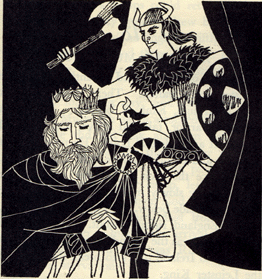 The slaying of King Brian by the
Norse warrior Brodhir.
Brian's servant escaped from the
tent and quickly ran tot he nearest group of soldiers. Tears
flowed from his eyes as he told them of their beloved kin'd
death. In black anger they followed Brodhir and his men who
had escaped into a little wood nearby. A ring of men was
drawn around the wood. A signal was given and they slowly
advanced.
As the trapped Norsemen turned to
fight branches were flung upon them to entangle their arms
and weapons. Then, before they could free themselves, the
Irish troops rushed upon them and struck them down.
The Norsemen were defeted, but
there was little rejoicing in Ireland. The beloved High King
was dead. The monks of swords came and bore away his body.
From Swords it was carried in a great funeral to Armagh and
laid in the cathedral there. All Ireland mourned for Brian
Boru. He was one of our most noble kings and will always be
remembered as the man who ended the power of the Norsemen in
Ireland.