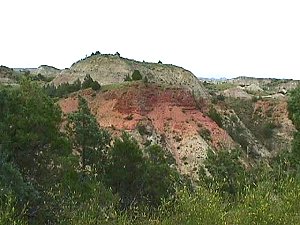
North Dakota Badlands
Theodore Roosevelt National Park, July 1999
FALL 1999
North Dakota Badlands
Theodore Roosevelt National Park, July 1999
Dr. Howard
September 1, 1999
BIOSPHERE
Part of the earth that supports life. Extends from floor of ocean (~36,000 feet) below surface to top of highest mountains (~30,000 feet above sea level).
Most living things concentrated in much more narrow band extending from about 660 feet below surface of ocean to ~20,000 feet above sea level
REPRESENTATION OF BIOSPHERE
Biosphere =intersection of land (lithosphere), air (atmosphere), and water (hydrosphere).
Lithosphere (soil) provides inorganic nutrients.
Atmosphere provides O2and CO2 and other gases.
Lakes, Rivers, etc. provide water.
Life in the Biosphere sustains itself because it depends on renewable resources and because it recycles virtually all matter.
ECOSYSTEMS
All systems that consist of organisms, their environment and all of The interactions between them. Because the Biosphere is so massive and complex since it is a planet - wide ecosystems, ecologists generally limit their view to smaller ecosystems such as biomes, or even much smaller systems such as "chickweed corridor", a cornfield, a river, etc.
ABIOTIC (NONLIVING AND BIOTIC (LIVING)
FACTORS OF ECOSYSTEMS
1. ABIOTIC FACTORS - NONLIVING FACTORS
Physical and chemical components such as rainfall, temperature, sunlight, air and inorganic nutrients from soil.
2. BIOTIC FACTORS - LIVING FACTORS
Includes fungi, plants, animals, and microorganisms
LIMITING FACTORS
Although organisms are affected by a variety of factors in their surroundings, one factor known as the limiting factor usually outweighs the others in determining growth. Limiting factors vary according to the ecosystem.
RANGE OF TOLERANCE
All organisms are finely tuned through adaptations to their abiotic environment and operate within a range of physical and chemical conditions known as the range of tolerance.
Although the range of tolerance is sometimes wide, most organisms thrive within a narrow realm of susceptible conditions known as the optimum range.
Outside the optimum range is the zone of physiological stress, where survival is possible but difficult. Outside the zone of physiological stress is the zone of intolerance where organisms die.
DIFFERENCES BETWEEN LIVING AND NONLIVING THINGS
All living things show the following characteristics during some phase of their lives:
Organization:
Living matter consists of structures organized in a particular relationship. The smallest unit of life is the cell; i.e. the cell is the simplest unit of living matter that can carry on all activities necessary for life. Cells may vary from the simple prokaryotic cell to the more complex eukaryotic cell. While life itself emerges at the cellular level, all life has a chemical basis. Subatomic particles combine to form atoms, atoms combine to form molecules, molecules combine to form macromolecules and organelles, and these latter structures comprise cells.
Growth:
Growth is a property of all living organisms. Growth is essentially the conversion of nutrients acquired from the environment into the specific substances of an organism’s body.
Reproduction:
Reproduction is responsible for the perpetuation of living things. Reproduction is possible because of the transmission of information by DNA which is the hereditary material that codes for the structure and function of the new organisms. Reproduction may be asexual in simple organisms but is sexual in complex organisms (plants have both). In asexual reproduction, the organism duplicates its DNA and then divides into two new cells with one complete set of DNA going to each cell. Sexual reproduction involves the union of sperm and egg to form a zygote which develops into the new organism. The offspring are the products of the DNA of the mother and father and not a duplicate of either.
Ability to Respond to Stimuli:
Living things respond to stimuli in their external and internal environments. The nervous system and muscular system of animals allow them to respond to changes in light, sound, chemicals, temperature, pain, etc. Plants also respond to stimuli, i.e. plants grow toward light, their roots grow toward water, etc.
Capacity to Evolve:
Living things have the capacity to evolve. Over long periods of time, the variations that result from sexual reproduction and mutations provide diversity in the genetic material of a species. Those characteristics and behaviors that enable living things to survive in a given environment are selected for through natural selection. These living individuals that have inherited adaptive characteristics are able to reproduce and produce more offspring; eventually those individuals make up more of the population. This provides evolution of a species.
Metabolism:
The sum total of all chemical reactions necessary to sustain life is called metabolism. As noted above, living things convert nutrients into cellular structures during growth. This requires energy and is part of the metabolic reactions that occur continuously in all cells. Metabolism also involves the chemical processes necessary for reproduction and maintenance.

September 3, 1999
Dr. Howard
SOIL
There are different definitions of soil according to one’s background. Archeologists, for example, look at soil as records of the past while earth scientists think of the soil as the skin or rind of the earth and may think of soil as simply dirt that must be cleaned.
In this class, we will use the basic definition of most agronomists which is that soil is the "unconsolidated cover of the earth, made up of mineral and organic components, water and air and capable of supporting plant growth." (P. 1, Kohnke) Although we will discuss the functions of soil in detail, obviously a primary function is for growing crops which, in turn, provide food for many living things including the animals raised on these crops.
Although most of us probably at this point lean toward the definition of soil as dirt, Kohnke has a very poignant definition of soil we should not forget: "Humans, who eat these crops and the meat from the animals raised on these crops, are truly a product of the soil and reflect in their bodies--and minds--the health or poverty of this land."
Now that we have a working definition of soil, let’s first talk about what soil does and thus, why it is so important, what it consists of, and then how soil is formed. There are five primary functions of soils (Weil):
1. Medium for plant growth
As a medium for plant growth soil provides physical support, i.e. anchors the roots, provides water to the plants, provides air for the plants, and furnishes the minerals for plant nutrition.
2. Recycling system for nutrients and organic wastes
Soil plays a vital role in the recycling of nutrients. As we will discuss later in the semester about biogeochemical recycling, nutrients are not made (except for artificially synthesized ones) but are constantly recycled from plant and animal wastes. The presence of living organisms in soils permits them to connect the mineral nutrients in organic wastes to inorganic forms that can be reutilized by plants and animals. Plants and animals return carbon to the atmosphere as C02 which will again become an aspect of plants and animals through photosynthesis. This constant recycling of elements will be discussed in much more detail later in the course.
3. Habitat for Soil Organisms (ref Weil)
A handful of soil may be home to billions of organisms, belonging to thousands of species (ref Weil). What makes life possible for so many organisms in such a small space is the vast numbers of niches and habitats that are present. Diatoms, roundworms and rotifers swim in H20-filled pores and tiny insects and mites travel in air-filled pores.
4. Engineering Medium
Soil supports roads, buildings and all kinds of structures. Strength and stability varies among soils and thus, engineers must have an understanding of the properties of various soils.
5. Regulator of Water Supplies
Nearly every drop of H20 in our rivers, lakes, estuaries and aquifers has either traveled through the soil or flowed over its surface. Soil is responsible for purifying and cleansing the H20, as well as varying the flow of H20 i.e. the slow flow of H20 through soil may prevent flash floods.
THE GENESIS OF SOILS (ref Weil)
Five factors Influence the Formation of Soils:
1. Type of Parent Material
2. Climate which causes weathering of parent material
3. Biota--Living Organisms--plants, microorganisms, soil animals
4. Topography - slope, landscape
5. Time - period of time since parent materials become exposed to soil formation
Parent Material
The original source of soil is rock. The solid unweathered material of the Earth’s crust rock is a mixture of minerals and through the weathering process, rock is broken down into its constituent minerals, which together with organic material form soil.
The weathering of rocks to minerals and then minerals to the elements of which they are comprised provides the necessary nutrients for plant growth.
TYPES OF ROCKS
Igneous Rocks
Created by the cooling and solidification of magma which is molten rock. The molten rock is part of the mantle (asthenosphere) of the Earth’s surface.
Igneous rock can form when the magma solidifies underground (intrusive) or when the magma rises through the lithosphere (eg during volcano formation) and solidifies on the Earth’s crust (extrusive).
In general, there are considerable differences in the composition of igneous rocks. The reason for this is not known, but it is thought to be due to differences in the following:
1) Composition of magma
2) Different plate tectonic events and
3) The fact that one mineral changes to another at discrete temperatures during the cooling and solidification of the magma.
RELATIONSHIP OF LITHOSPHERE AND ASTHENOSPHERE
Lithosphere is divided into plates that move through the phenomenon known as plate tectonics. These plates move around on the asthenospherewhich is magma or molten rock.
EXAMPLES OF IGNEOUS ROCKS
Intrusive
Granite is formed from the solidification of magma underground and it is the most abundant intrusive rock.
Granite is comprised of feldspar and quartz. (Quartz weathers to sand and does not contain many plant nutrients while feldspar weathers to clay which contain lots of plant nutrients)
Extrusive
Basalt forms from the solidification of lava (magma) that reaches Earth’s surface. Basalt contains lots of iron, magnesium and calcium
Igneous rock comprises only 1/4 of the earth’s actual surface although most of the crust is igneous. This is because sedimentary rock overlays about 3/4 of the igneous crust. Much of the sedimentary rock covering North America was deposited in prehistoric seas and lots of American soil is derived from this type of rock.
SEDIMENTARY ROCK
Formation of Sedimentary Rock
Sedimentary rock may be formed from:
1) lithification of sediment
2) precipitation from solution or
3) consolidation of the remains of plants or animals.
REFERENCES
1. Brady, N.C. and Weil, R.R. The Nature and Properties of Soils (12th Ed.) . Upper Saddle River, NJ: Prentice Hall, 1999.
2. Harpstead, M.I., Sauer, T.J., and Bennett, W.F. Soil Science Simplified (3rd Ed.) . Ames, IA: Iowa State University Press, 1997.
3. Kohnke, H. and Franzmeier, D.P. Soil Science Simplified (4th Ed.) . Prospect Heights, IL: Waveland Press, Inc., 1995.
4. Plaster, E.J. Soil Science and Management (3rd Ed.) . Albany, NY: Delmar Publishers, 1997.
 Click here to go to the Fall 1999 Page!