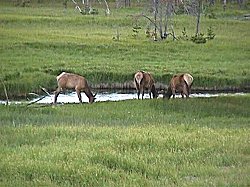
Grazing Elk,
Yellowstone National Park, Wyoming, July, 1999
FALL 1999
Grazing Elk,
Yellowstone National Park, Wyoming, July, 1999

November 1, 1999
Dr. Howard
Key evolutionary advances:
One of the 16 phyla of worms. Annelida means ringed and refers to the series of rings or segments that make up the body. Both the body wall and many of the internal organs are segmented. Segmentation is important because it provides the opportunity for specialization of body regimens and facilitates locomotion since each segment has its own muscles.
One of the classes in the Phylum Annelida is the common earthworm. Earthworms burrow in soil and it is their rings of muscles that allow them to do this. Different patterns of contraction allow movement.
Worms burrow in soil to get food (partially decayed plant matter) and for protection. Earthworms swallow large quantities of dirt as they burrow in the soil and loosen the soil, improving drainage and making it easier for air and roots to penetrate. Furthermore, as earth passes through the worm’s digestive tract, minerals and ground finer and plant matter is shred and partially digested, promoting production of humus.
There are three classes of annelids. The common earthworm belongs to the class Oligochaeta. The characteristics of this class will be discussed. In regard to the digestive system, the esophagus is modified to form a crop for food storage and/or a gizzard for grinding food. Also present are an intestine with digestive enzymes and a mouth and rectum. Earthworms have a closed circulatory system consisting of a dorsal vessel which carries the blood anteriorly and ventral vessel which carries the blood posteriorly. Capillaries connect the two major vessels. There is no specialized heart, and circulation occurs through contractions of the blood vessels themselves. The blood of most species contains hemoglobin. A brain is present at the anterior end of annelids. A solid ventral nerve cord passes from the anterior to the posterior of each worm. Segmental nerves connect a variety of sex organs to the ventral nerve cord to the body.
Jointed appendages and exoskeleton. Arthropods use jointed appendages as wings, legs, antennae and mouth parts. Arthropods also have a ridged external skeleton known as a exoskeleton. The exoskeleton, made of chitin, provides places for muscle attachments. There is one problem with chitin. It cannot support great weight and as a result it must be thicker in large insects so there is a limit to how big an arthropod can be. Most arthropods are about a millimeter in length, although larger ones may be seen.
Other characteristics of arthropods
There are numerous subphyla and classes of arthropods. One class includes the horseshoe crab, another includes the centipedes, another the millipedes, another their arachnids, and the insects. One should remember that the spiders which are classified as arachnids have four pairs of appendages. The class Insecta includes approximately a quintillion (a billion) members. There are two hundred million insects for each human being. Distinguishing characteristics of insects include the following:
One feature that sets the insects apart from all other invertebrates and most vertebrates is their ability to fly. This ability is made possible by the following characteristics of insects (Ref. Pechenik ):
The insect nervous system consists of a brain and a ventral nerve cord two which are attached numerous nerves throughout the body. Insects may undergo complete or incomplete metamorphosis.
Deuterostome development and endoskeleton. There are two major kinds of coelomate animals. The way the anus and mouth develop determines whether they are protostomes or deuterostomes. Without going into detail, in protostomes positional information is the key to the developmental fate of embryo cells while in deutoerstomes groups of cells move around during development to form new tissue associations. The term echinoderm means spiny skin and refers to an endoskeleton composed of hard plates just beneath the delicate skin. In adults the endoskeleton forms a hard shell around the animal.
Other characteristics of echinoderms:
It should be noted that all echinoderms are bilaterally symmetrical and larvae, but radially symmetrical as adults. Adult echinoderms have a five part body such as is seen in a starfish. The nervous system of echinoderms consists of a central ring of nerves from which five branches arise. Although there is no brain, echinoderms are capable of complex response patterns. Echinoderms have a water vascular system which aids in their movement. This system is composed of a central ring canal from which five radial canals extend into the arms. From each radial canal tiny vessels extend into thousands of hollow tube feet. At the base of each tube foot is a fluid filled muscular sack that acts as a valve. When a sack contracts its water is prevented from re-entering the radial canal and is forced into the tube foot, extending it and permitting it to attach to the ocean bottom, pull against the tube feet and move across the ocean floor.
References
1. Brusca, R. C. and Brusca, G. J.: Invertebrates, 1990. Sinauer Associates, Inc., Sunderland, MA.
2. Johnson, G. B.: The Living World, 2nd Edition, 2000. McGraw-Hill Co., Inc., New York
3. Pechenik, J. A.: Biology of the Invertebrates, Ed. 3, 1996. McGraw-Hill Companies, Inc., New York.
4. Ruppert, E.E. and Barnes, R. D.: Invertebrate Zoology, 1994. Saunders College Publishing, New York.
November 5, 1999
Dr. Howard
Phylum Chordata
Other Characteristics
Which chordates may be vertebrates or invertebrates the large majority are vertebrates. In these animals the notochord becomes replaced by a backbone. Basic characteristics of the various classes of vertebrates will be considered below.
There are numerous classes of fishes. Of the nearly 20,000 living species of fishes 18,000 species are bony fishes which comprise the class Osteichthyes. They have a skeleton of real bone like humans. Goldfishes, guppies, tunas, trout, bluegills, bass, catfish, sailfish, eels, cods are all bony fishes. Other characteristics of this group of fishes include the following:
Shape - is one of those adaptations of fish that have evolved that determine where fish live and what their life type entails. For example, streamlined fish like torpedo-shaped fish ship through water more easily than bulky fish. These fish live in open water far out at see and are long-distance travelers, swimming many thousands of miles a year. They are usually predators and chase down their prey. Butterfly fish have thin, flat bodies that let them slide between aquatic plants.
What do fish eat? Depending on the species, they eat phytoplankton or other animals (other fish, insects, crustaceans, clams, and worms). Adaptation - teeth of fish are adapted to their diet. Sharks (not a bony fish but a cartilaginous fish) are described as super predators because of their keen senses. They can smell for more than one mile in distance, hear for 1000 feet, detect objects 100 feet away and see objects 50 feet away.
Predators for fishes are jellyfish, garter snakes, herons, eagles, otters, sea lions, bears, and humans. Adaptation such as color, shape and behavior keep fish from being eaten.
Class Amphibia
There are 3 orders of amphibians. Frogs and toads comprise the order with the largest number of living species. Other well known amphibians - salamanders and newts-are found in another order. The term amphibia means "both lives" and refers to the fact that these animals straddle the boundary between an aquatic and terrestrial existence. The larval forms live in water and the adult live on land. The change from a larval form to an adult is known as metamorphosis and entails loss of gills and development of lungs. (Some amphibians such as certain salamanders keep their gills and do not develop lungs). The lungs of many amphibians are poorly developed and they "supplement" breathing with their lungs with "breathing" through their skin which is coated with mucus. Most amphibians need to keep their skin from drying out and therefore live in damp places or have adaptations to prevent this. For example, some frogs that live in dry places and spend six months hiding more than three feet beneath the ground.
Other characteristics of amphibians include:
What do amphibians eat and what eats them? Generally, they eat insects, other arthropods and earthworms, although larger ones eat larger animals. They, in turn, are generally eaten by reptiles or large birds.
Class Reptilia
Characteristics of reptiles include:
What do reptiles eat? In general, lizards eat insects or plants. They are eaten by larger reptiles, birds, and small mammals and destroyed by man. Snakes are carnivores and eat worms, insects, amphibians, birds and small mammals, except for larger ones which eat larger prey. Predators for snakes include a variety of birds like hawks, eagles and owls. Turtles, which usually live in or near water, eat both plants and animals (fish, clams, jellyfish), while land-dwelling tortoises eat mostly plants and some insects. Baby turtles may be eaten by birds and fish but adults are well protected against mose enemies, except for big sharks and humans. Predators for young tortoises and tortoise eggs include raccoons and foxes. Man is the predator for larger tortoises, crocodiles and alligators eat fish, frogs, birds and small mammals such as rodents. Larger ones may eat larger mammals which come to the water to drink. Man is the predator of crocodiles and alligators.
Class Aves
Characteristics of this class include:
Class Mammalia
Characteristics of this class include:
References
1. Hickman, C.P., Roberts, L.S., and Larson, A.: Animal Diversity, 2nd Edition, 2000. McGraw-Hill Company, Inc., New York.
2. Johnson, G. B.: The Living World, 2nd Edition, 2000. McGraw-Hill Co., Inc., New York.
 Click here to go to the Fall 1999 Page!