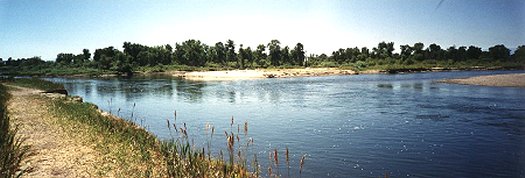
Head Waters of the Missouri River,
Three Rivers, Montana, July, 1999
FALL 1999
Head Waters of the Missouri River,
Three Rivers, Montana, July, 1999

Dr. Howard
November 8, 1999
The ecological relationships between plants and animals may be beneficial or harmful to one or both members. Antagonistic relationships include predation and parasitism in which one organism eats another or lives on another. Relationships that are beneficial to both members of the partnership are called mutualism and we have already examined examples of these such as the combination of an alga and a fungus in lichens and the formation of mycorrhizae.
Herbivory: Plants and Animals That Eat Them
Herbivory has occurred for ~450 million years and natural selection has driven this intricate contest. While plants have evolved on enormous array of mechanical and chemical defenses against the animals that eat them, herbivores similarly evolved a series of adaptations for digesting these plant have defenses.
Plant Defenses
Plant defenses that deter herbivory include:
Examples of external structural defenses include the obvious sharp spine of the cactus which repel mammals or the presence of dense needle-like trichromes or granular hairs in a variety of crop plants which impede insects or entrap them in the sticky exudates.
The most important plant defenses are complex polymers or inorganic crystals that make plant cell walls indigestible to animals; their substances are collectively termed digestibility reducers. For example, cellulose and hemicellulose are complex polysaccharides comprising 80-90% of the dry weight of plants. Omnivores and carnivores digest them incompletely if at all. In order for herbivores to digest them, they need the presence of microorganisms inside to help the break them down. Another example is silica which is completely indigestible to animals. Some plants like horsetails accumulate silica in such quantities that their digestion is impossible.
Plants produce a large variety of toxins which are poisonous unless a herbivore has a defense against them
Examples of Toxins
Present in magnolias, buttercups, poppies-
Effects include inhibition of DNA & RNA synthesis, inhibition of mitosis
Hydrogen cyanide made of H, C and N which are common elements in nature but very toxic in this form- Yet HCN is so toxic to cellular respiration that it cannot exist free in healthy plant or animal cells. Plants combine cyanide with other molecules in cells and as long as it is intact, there is no problem, but it can be released when herbivores crush parts of the plant. Roses, sunflowers and about a 1000 other plants contain HCN. HCN is able to kill animals in relatively small quantities because it blocks the enzyme cytochrome oxidize which is important in cellular respiration.
It should be noted that a given plant species has several to many protective devices , not just one or two. For instance, a legume might have trichromes as a seedling, tough leaves and lignified wood as an adult, young foliage loaded with cyanogenic glycosides and terpenoids, and seeds provisioned with toxic AAs and alkaloids.
Countermeasures of Animal to Plant Defenses
Herbivores have mechanical, biochemical and behavioral countermeasures to plant defenses.
Examples of mechanical countermeasures are first of all, mouth parts that let animals rupture the cell walls of plants. Herbivores that browse on short foliage or fruits like deer have low-crowned teeth while grazers like the horse and elephant have high crowned teeth.
Insects have a variety of mouth parts sure as the chewing mouth parts of grasshoppers whose mandibles cut the corner off and mash pieces of foliage. True bugs pierce the plant epidermis with a beak and then suck plant foods to avoid toxic seed coats and trichromes.
The intestinal tracts of certain animals are modified. Cattle and sheep known as ruminants for example have a 4 - Chambered stomach and the first 2 parts of the stomach known as the rumen are filled with microorganisms that help in digestion. Cows are able to swallow plants initially with minimal chewing. The food gases to the rumen where the microorganisms digest it. The ruminants frequently regurgitate the food, known as curd, re-chew it and re-swallow it. This exposes new surfaces for the microorganisms to digest. Eventually the food is degraded enough to be passed on to the other parts of the stomach and eventually the intestine. It should be noted that the numbers of organisms in the rumen of these animals is enormous. Accordingly to Howe, a milliliter of sheep rumen contains 16,100 x 106 bacteria, 106 flagellates, and 3.3 x 10⁵ ciliated protozoans. There are 6 liters of fluid in the rumen.
Despite all the microbial activity, it is still difficult to digest plants and certain parts of plants like silica are totally indigestible. One of the other mechanisms that animals use to facilitate digestion is retaining the food for long periods of time. Domestic cattle take up to 80 hours to process plants.
Small plant-eating vertebrates use other mechanisms to handle plant digestion. Rabbits, for example, digest only 7-9% of the cellulose in plants that they eat for the first time, but they re-ingest their own feces (coprophagy) which permits them to reprocess the food for more efficient absorption.
Some small animals have physiological constraints on these process for digesting plant fibers and they have to use other mechanisms such as restricting their diets. Birds that eat plants, for example, have to eat only fruits, seeds and buds that are relatively fiber- free. Herbivorous insects also limit their diet although most of these also have long guts which harbor microorganisms that aid in digestion. Some herbivorous insects feed on only one or a few species of plants all their lives.
Herbivores must use chemical mechanisms to counterattack plant toxins. These mechanisms consist of enzyme systems that act to detoxify the plant poisons. The insects have generalized enzyme systems that protect against a wide variety of toxins while others have specific systems that detoxify only the toxins of the limited number of plants they consume.
An example of the generalized system is the mixed-function oxidase system which are membrane -bound enzymes that detoxify several poisons i.e. they are nonspecific. They are also inducible which means they are made on exposure to the toxin. These characteristics of non-specificity and induction make them especially useful to herbivorous animals that eat a large variety of plants.
Mutualism
Symbiotic mutualisms are when organisms that live in close physical contact help each other. Nonsymbiotic mutualisms exists when species help each other but do not live together. There are three important nonsymbiotic mutualisms.
Pollination
The flowers of angiosperms attract insects and other animals with a wide variety of colors, shapes and scents. Similarly, these animals possess characteristics specifically morphological characteristics and physiological characteristics that permit them to pollinate specific flowers.
There are numerous examples of colors, shapes or scents that flowers use to attract animals. These combination of characteristics are known as pollination syndromes. Examples are seen below.
Pollinators
Animals that act as pollinators have morphological and physiological attributes that allow this process to occur. For example, long, retractable tongues allow hummingbirds to use long tubular flowers. Bees possess body hairs on their backs which catch pollen grains and are brushed off onto stigmas of flowers. Physiological necessity drives many of the most efficient pollinating agents. For example, a five gram hummingbird uses eighteen calories per minute while hovering in front of flowers. This high metabolic rate forces hummingbirds to feed on hundreds of flowers every day, obviously, making them good pollinators. Plants in turn return the favor by offering copious sugar-rich nectar to entice them. Plants that attract insects with lower metabolic needs are able to invest less energy and produce lower quantities of nectar.
References
Howe, H. F. and Westley, L. C: Ecological Relationships of Plants and Animals, 1988. Oxford University Press, New York.
Dr. Howard
November 12, 1999
Although lakes and ponds are quite similar in the animals and plants that they support, emphasis in this lecture will be on ponds.
Origins of Ponds
Ponds may be formed in several ways. Many ponds were formed by depressions left in the ground as a result of the movement of glaciers. Ponds may also be formed by rivers in several ways. One example is the formation of what is known as an oxbow pond. In this situation the river possesses a bend so sharp that it almost doubles back on itself, then veers in the opposite direction to form a looping oxbow. The outer back of the oxbow is gradually eroded by the river which eventually cuts through to the other side of the loop further downstream and isolates the large bend. Beavers may create ponds. Strong winds can create depressions in the soil that fill with water that fill ponds. Obviously, man is always creating new ponds.
Characteristics of Water
Various chemical and physical properties of water account for its behavior in fresh water environments. Each water molecule contains two atoms of hydrogen and one of oxygen joined by covalent bonds. Weak hydrogen bonds connect the hydrogen atom of one water molecule to the oxygen atom of a neighboring molecule. Hydrogen and oxygen atoms are quickly and constantly forming and breaking weak hydrogen bonds with nearby oxygen and hydrogen atoms. This accounts for water’s viscosity and the surface tension.
Water can be frozen into a crystalline structure. Water molecules pack more densely as they cool causing them to become heavier and sink. However, at 4oC water reaches its highest density. When the surface water of fresh water environments reach 4oC the lake/pond does a complete turnover. This turnover then becomes completely mixed. This turnover replenishes lakes.
As water cools further toward the freezing point of 0oC, its molecular structure expands, becomes less dense, and is transformed into the highly organized crystal lattice. Ice is lighter than the slightly warmer water beneath it and, as a result, it floats. This unusual property of water accounts for the fact that ponds and lakes freeze from the top down instead of the bottom up.
Water temperature responds slowly to a rise or fall in the temperature in the surrounding environment. As a result, water moderates the temperature of the surrounding area keeping the local temperature warmer longer into the fall and cooler in the spring.
Water transmits light and, as a result, light can be transmitted to plants underneath the surface.
POND PLANTS
Plants present in a pond include algae on the tiny plants and the macrophyles or large plants. Plants in a pond serve several purposes. They obviously use sunlight to create the organic matter that supports the pond and provide homes to numerous animals.
Algae
Algae are the chief source of production for the pond. Algae present in ponds include diatoms, blue-green algae, and green algae. Diatoms are unicellular algae that consist of silica-containing shells with intricate and delicate patterns. Examples of diatoms include Asterionella, Fragilaria, Tabellaria, and Navicula. Much of our fossil fuel supply was formed from diatoms. Diatoms occur in highest numbers during the spring and early summer.
Blue-green algae bloom in mid to late summer because of their preference for warm water. They form spores during the winter. Green algae assume many shapes. Some are crescent-shaped with others, like Spirogyra, are filamentous. Among the green algae are members that act like microscopic animals but contain chlorophyll. Among these green algae are Euglena, which has a minute eyespot and propels itself with a flagellum, and Volvox which also has an eyespot, 2 flagella, and consists of up to a thousand cells. Following are pictures of various algae found in ponds.
Macrophytes
These include the large plants of the pond and consist of the bryophytes (mosses and liverworts) and tracheophytes. Differences between these two groups were discussed in earlier lectures.
Macrophytes grow in four distinct habitats in a pond. These habitats differ in the depth of the water present which obviously influences differences in light, speed of current, clarity of the water, and type of soil present. Various types of plants grow where their needs for these requirements are met. Moving from the center of the pond to the shoreline, the four major habitats of macrophytes include: open or deep water zone, submergent zone, floating-leaved zone, and emergent zone. A representation of where these zones lie in a pond can be seen in Figure 3-10: Major Plant Zones of a Pond in Caduto, Pond and Brook. (handout)
Plants at Waters Edge
Sphagnum moss-spongy green moss with tiny spore cases on slender stalks.
Variety of Ferns
Jewelweed - Leaves covered with sheet of tiny bubbles when held under water and reflect silvery sheen from leaf surface. Flowers of jewelweed form seed capsules which snap open when touched and throw seeds several feet.
Emergent Plant Zone
Plants rooted in shallow water but tops rise above surface of water.
Common cattail - three to nine foot stiff plant with yellowish club-like spikes of tiny male flowers extending directly above brownish cylinder of female flowers. Male flowers fade after pollen is shed, leaving bare stalk. Found throughout most of the U.S. Most parts of plants are edible and were used by early colonists and Indians as food. Provides habitat for red-winged black birds and other marsh birds as well as muskrats.
Variety of sedges and rushes - sedges and rushes must be distinguished from each other and grasses. Grasses have round stems that a re usually hollow. The stems are jointed with leaves attached at the joints. If you eye the stem from above, leaves appear to be growing opposite one another all the way down the stem. The stems of rushes are round and often hollow. The leaves of rushes are flat. The stems of sedges differ from rushes and grasses in that they have three edges.
Some shrubs grow with their roots in the water. An example is buttonbush which is usually 4-6 feet tall, possesses somewhat purplish young twigs, and leaves in whorls of threes and fours. Also possess small, whitish tubular flowers in ball-shaped clusters. In addition to ponds, it is seen in lakes, shores of rivers, marshes, shrub swamps, and forested wetlands.
Farther out is rise in pond floor where water is shallow. Examples of plants here include pickerelweed, arrow arum, and arrowhead. These plants all are similar in that they have arrow-shaped leaves but certain characteristics help differentiate them. The veins of pickerelweed run parallel to each other and pickerelweed has many small, showy, purple tubular flowers that are borne on a single terminal spike. Arrow arum has an unusual flower and three main veins that radiate from the center of the leaf. Arrowhead has white flowers in sets of three and fans like veins that run parallel to the leaf edge.
Floating-Leaved Zone
The leaves of these plants float on the surface of the water. Spadderdock or yellow pond lily have fleshy heart-shaped leaves up to 16 inches long with a single five or six-petaled flower. White water lilies have large, showy white flowers on large round pads with deeply cut, V-shaped notches. The leaves of lily pads decrease water currents and create calmer water. Many insects, snails, fresh water sponges, and other animals live underneath the leaves and frogs and insects rest on the leaves. Some of the tiniest floating plants which actually may be located throughout the pond are the duckweeds. They are nourished directly from the water through hanging roots which are a habitat for algae and protists. Duckweeds provide food for waterfowl.
Pond Animals See list on p. 81 of Caputo, Pond and Brook.
EXAMPLES OF PLANT AND ANIMAL ADAPTATIONS FOR AQUATIC LIFE
Gas Exchange
1. Exchanges of gases through external tissues - amphibians, immature insects, zooplankton, submerged plants.
2. Gills - there are various types of gills.
3. Internal lungs - reptiles, amphibians, mammals.
4. Habitat preferences - insects such as stoneflies and mayflies live in fast-running, well-aerated water.
5. Stomata - gas exchange pores on leaves of floating, leaved aquatic plants located on the top of leaves; terrestrial plants have stomata on underside of leaves.
Staying Put in the Current
1. Flattening to minimize current exposure.
2. Streamlining to decrease resistance to current.
3. Current avoidance, e.g. hiding under rocks.
4. Grasping devices.
Osmotic Balance
Water moves from an area of less solute to more solute. Since the cellular fluids of freshwater animals in more concentrated than the water that surrounds them, water tends to flow into the animals. As a result, the animals must have a mechanism to get rid of excess water. Examples of these mechanisms include the following: waterproof body surfaces, i.e. reptiles and water excretory organs, i.e. contractile vacuoles in protozoans, kidneys in fish.
Repsonses to Changes in the Environment
Hibernation - Virtually all amphibians and most reptiles hibernate under mud or under leaf litter during the winter.
Aestivation - Response to extreme heat and drought similar to hibernation; many amphibians aestivate.
Reproduction - Some animals such as protozoans and crustaceans form resting eggs or cysts that can hatch upon exposure to water after years of dormancy. Asexual reproduction allows many plants and animals to become quickly established. Many organisms time their breeding such that new babies emerge when optimal environmental conditions exist for survival.
CHEMICAL RECYCLING IN FRESHWATER ENVIRONMENTS
As in all ecosystems, recycling of elements is essential. Following is an example of an analysis of various analytes in a man-made lake in Prince George’s County, Maryland and an explanation of the recycling processes of these elements. All chemical analyses were completed using the Limnology Field Test Kit manufactured by LaMotte Company, Chestertown, MD.
CHEMICAL ANALYSIS OF LAKE (1,3, 4)
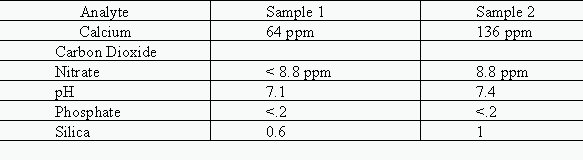
The following chemicals were analyzed using the LaMotte system. The first value represents a sample taken from "gunky", turbid water with obvious algae present and the second sample from clear water by an area surrounded by sand and rocks. The specific procedures used will not be discussed due to space limitations but it should be noted that all values were within the normal range defined by the kit.
Calcium (4)
Calcium is an essential constituent of water because it plays a role in the structure/function of both plants and animals. It is a major component of the cell walls of higher aquatic plants and plays a functional role in the membrane selective ion transport of most algae. It is an important constituent of the supporting structures of many animals such as the bony tissues of fishes and the shells of mollusks.
Calcium is leeched from practically all rocks and is most prevalent in waters associated with deposits of limestone, dolomite, and gypsum. The difference in calcium levels in my two samples was probably related to the rocks present in the area of the second sample.
Carbon Dioxide (PLEASE NOTE: see pages 220-21 from Wetzel, Limnology.)
Nitrogen (5)
Nitrogen plays a fundamental role in the metabolism of all organisms. The sources of molecular nitrogen and its numerous compounds into lakes include:
1) fixation of molecular nitrogen from the atmosphere;
2) influents to lakes including groundwater;
3) precipitation on the lake surface; and
4) fixation in the lake and its sediments.
On the other hand, nitrogen compounds are lost from lakes through
1) effluents,
2) denitrification in the lake, and
3) formation of permanent sediments
. The wide variety of nitrogen compounds entering lakes, in turn, provides several different mechanisms/pathways by which these various compounds can be recycled between the organic and inorganic states.
The ultimate source of nitrogen in the biosphere is the molecular nitrogen of the atmosphere. While molecular nitrogen is the most abundant component of the atmosphere, it cannot be used by living things in this form and its conversion to usable forms as well as its reconversion to atmospheric molecular nitrogen is largely dependent on a series of reactions involving bacteria. Before atmospheric nitrogen can be converted to usable organic compounds in lakes, it must first be dissolved at the surface of lakes. This molecular nitrogen, now present in lakes, is then converted to ammonia, a form that can be incorporated into phytoplankton, through a process called nitrogen fixation. Nitrogen-fixing organisms in lakes include the bacteria Azobacter; blue-green algae such as Anabaena; and the photosynthetic purple bacteria including Rhodospirillium rubrum, Rhopseudomonas spp., Rhodomicrobium vannielii, and in all probability, Chromatium. Nitrogen fixation also occurs by bacteria on the leaves of certain aquatic plants (3).
While nitrogen fixation is certainly significant in freshwater systems, as mentioned above, other inorganic and organic nitrogen compounds may also be used as nitrogen sources. For example, ammonia may enter lakes from precipitation or through lake influents. Furthermore, ammonia is the major nitrogenous end product of the bacterial decomposition of organic matter and is an important excretory product of the numerous invertebrate animals in the aquatic system. This ammonia is primarily present as ammonium ion and is readily assimilated by plants (5).
Ammonia may undergo a series of oxidation reactions whereby it becomes more and more oxidized passing through intermediate products to nitrite and finally nitrate. Oxidation to nitrite occurs predominantly by bacteria of the genus Nitrosomonas, while oxidation of nitrite to nitrate is accomplished in large part by Nitrobacter, another group of bacteria. It should also be noted that nitrate is also a common form of inorganic nitrogen entering water from drainage basins, groundwater, and precipitation.
While it is not conclusive, evidence suggests that some aquatic plankton forms prefer ammonia as a nitrogen source and others prefer nitrate. In view of the great variability in the ratio of ammonia nitrogen to nitrate nitrogen in lake waters, and the variability in the preferences of these components for different plankton, it has been speculated that these differences may help determine the make up of phytoplanktonic populations (3).
The nitrogen cycle is much more complex than is presented here but nonetheless this provides an overview. It is absolutely essential, however, to mention the process of denitrification in which nitrite, through the activity of bacteria, is returned to the atmosphere as molecular nitrogen, thus closing the loop.
As noted above, my test kit detected nitrate which was within normal limits.
pH (4)
The pH of the solution is a measure of its hydrogen ion concentration. The pH of most natural waters falls in the range of 6.0-8.0. The majority of natural waters have a somewhat alkaline pH because of the presence of the carbonate and bicarbonate systems discussed under carbon dioxide. My pH values were typical of those of freshwater lakes.
Phosphorus (3,4)
Phosphorus is most likely to be the limiting element in lakes, thus limiting biological productivity, unless, as is often the case, human intervention has disrupted the natural balance of this element. The natural source of phosphorus in water is from leeching of phosphate-bearing rocks and from organic decomposition. Quantities are greater in waters derived from sedimentary rocks. Phosphorus is present in several soluble and particulate forms, including organically bound phosphorus, inorganic polyphosphates, and inorganic orthophosphates. Phosphorus is removed from water by all phytoplanktonic organisms and sediments. The distribution of phosphorus throughout lakes is variable and complicated and dependent on the oxidation-reduction status of the sediments and iron that are present. My samples were consistent with regard to concentration of phosphate and reflect the lack of eutrophication due to human influence in this man-made lake.
Silica (3,4)
Silica may be present in many forms in lakes. Since silica is extremely common as a constituent of igneous rocks, quartz, and sand, the major source of silica in natural waters is from the decomposition of aluminosilicate minerals in the drainage basin from which the waters flow. Silica may also enter the water from lake sediments.
Because silica is important as a major nutrient for diatoms, the dominant phytoplanktonic organism in lakes, a silica cycle occurs in bodies of water that contain diatoms. The growth of diatom blooms removes silica from lake waters. Death of the diatoms results in the loss of silica to the water; it is not known if this latter process involves enzymatic autolysis or simple decomposition processes.
The increased amount of silica in sample 2 was probably related to the presence of sand in this region.
References
1. Amos, W.H. 1969. Limnology: An Introduction to the Fresh Water Environment. LaMotte Chemical Products Company, Chestertown, Maryland.
2. Caduto, M.J. 1990Pond and Brook: A Guide to Nature in Freshwater Environments. University Press of New England, Hanover, New Hampshire.
3. Hutchinson, G.E. 1975A Treatise on Limnology. Vol. 1, Geography, Physics, and Chemistry (Part 2. Chemistry of Lakes). John Wiley & Sons, New York.
4. Lind, O.T. 1979. Handbook of Common Methods in Limnology, 2nd Ed. C. V. Mosby Company, St. Louis, Missouri.
5. Wetzel, R.G. 1983. Limnology, 2nd Ed. Saunders College Publishing, Ft. Worth, Texas.
 Click here to go to the Fall 1999 Page!