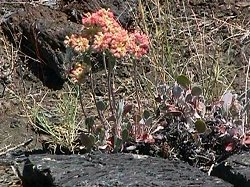
Desert Buckwheat
Craters of the Moon National Monument, Idaho
July, 1999
FALL 1999
Desert Buckwheat
Craters of the Moon National Monument, Idaho
July, 1999

Mrs. Wende
November 22, 1999
I. Introduction
The name, desert, means deserted or unoccupied. Deserts are areas of extreme heat and dryness. They are also called arid regions. These areas receive 10 inches (25 cm) or less of precipitation per year. In some deserts, evaporation of precipitation is greater than the amount of rainfall! Most precipitation in deserts occurs in brief intervals and is unpredictable.
1. Hot Deserts
Most "hot" deserts are the low-latitude deserts (see below). In the summer, temperatures here may soar to over 120o F during the day. (Record: 136.4o F, recorded in Libya and San Luis Potsi, Mexico) However, the temperature drops drastically when the sun goes down. Without clouds, the surface heat radiates back out into space. The temperature can be up to 50o F under the hot daytime surface.
2. Cold Deserts
This environment is found on mountain peaks and near the poles. Cold air does not hold much water vapor; therefore, the driest deserts on Earth are in Antarctica, where some places haven’t received any rain for over 4 million years! (They do receive some moisture when snow melts on nearby mountains and runs off into the areas.) Life forms here are pretty much limited to algae, bacteria and some small nematodes. When it is extremely cold, even these organisms go into a state of suspended animation until it warms up.
B. Where deserts are found
About one-third of the Earth’s land mass is either desert (arid) or semi-desert (semi-arid -- receives 10-20 inches precipitation annually) These semi-arid areas are also known as steppes, and are really transition zones from the arid areas to more humid climates.
1. Low latitude deserts
These dry climates are found between latitudes of 15o - 30o, both north and south of the equator. (30o N = Tropic of Cancer; 30o S = Tropic of Capricorn) In the northern hemisphere, they form an almost unbroken ring around the planet, including the southwestern United States, northern Mexico, all of Africa from its western coast across the Arabian peninsula, and northern India. In the southern hemisphere, it includes the western coast of South America, western Africa, and Australia, a continent that is almost 40% arid and much of the rest is semi-arid.
These desert areas are formed as the result of distribution of prevailing winds and air pressures. Hot, moist air rises at the equator, looses its moisture, as tropical rains, as it moves away from the equator. This cooler air then compresses and sinks, is warmed as it falls. Lacking moisture, it does not form clouds, therefore allows maximum sunshine and hot, dry, air.
Examples of these deserts are the Sonora and Mojave Deserts in the United States, Chihuahuan Desert of the United Stated and Mexico and the Sahara Desert.
2. Middle Latitude deserts
Most of these deserts are found in the deep interiors of land masses, away from oceans and other large bodies of water, frequently separated from the water by large mountain ranges. As air masses flow from ocean to the mountains, much of their moisture is lost. The remaining air masses which then make it over the mountains, is quite dry, lacking precipitation. These areas are known as rain shadow deserts. They are much cooler areas than the low latitude deserts.
Examples of these deserts include the Great Basin Desert of the United States (Utah, Nevada and other areas up to British Columbia) and the Gobi Desert in China.
Actually, the largest desert on Earth isn’t found in either of these two categories -- it’s found in Antarctica. Large desert regions are also found in Greenland, Canada and Siberia.
Most people think of the desert as a desolate place of weird rock formations and/or waves of shifting, drifting sand. Although plant and animal life isn’t as dense in deserts (biomass of under 220 pounds/acre vs. 220,000 pounds/acre of biomass found in a tropical rain forest), the life forms that do inhabitant and survive here are interesting individuals based on adaptations they’ve made in order to survive.
The scarcity of water is the primary factor in fewer life forms being present. Water is usually present in larger amounts only during shorts periods of time, usually spring. At this time, there may even be enough collected water present to form temporary lakes or ponds, called playa lakes. The flat, basin areas of deserts are called playas.
Plants and animals that do survive the harsh life in deserts frequently have unusual physical characteristics that allow their adaptation. We will look into some of these adaptations.
A. Desert Animals
1. Types
2. Adaptations and survival
Animals are more susceptible to temperature extremes than plants. Animals receive heat directly by radiation from the sun, and indirectly by heat conduction from rocks and soil and by convection from the air.
Biological processes of animal tissue can operate only within a given narrow temperature range, whether the animal is endothermic or exothermic. This temperature range is exceeded in many hot deserts 4-5 months of the year. This, in addition to the lack of water, present a most inhospitable atmosphere for animals. Animals that do survive do so by a variety of mechanisms of adaptation.
B. Desert Plants
1. Types
2. Adaptations and survival
Plants adapt to living in the extreme dry heat of deserts by using physical and behavioral mechanisms, much like animals. They are differentiated into different groups based on how they adapt.
C. Desert Varnish and Lichen Crust
Desert varnish and lichens are not symbiotic; you will never find them together on rocks or boulders.!
C. Food webs
III. The Future of Desert
Deserts are our most delicate ecosystems. With sparse vegetation and little moisture to hold its topmost layers in place, it is susceptible to displacement by the gentlest of breezes. When water does come, it usually easily disrupts the topography, creating gullies and arroyos and uprooting shallow-rooted vegetation. Wind erosion can transport tons of soil quickly, transforming the area dramatically. Conversely, humans now use the desert as farmland, growing extensive crops with the aid of irrigation. The expense of this procedure and the massive amounts of water used have raised issues with whether or not the practice is sound environmentally. The highest per capita use of water in the US is found in Idaho, where the central and southern parts of the state, mostly Great Basin desert, are heavily irrigated in order to raise grain and potatoes.
A. History and Civilization
For thousands of years, nomads have roamed the great deserts of the world, eeking out existence. In the last two centuries, these nomadic tribes have "settled down" and are attempting to create agricultural communities in semi-arid areas of the world. Additionally, in developed nations as the United States, cities are being built in the desert, bringing with them all the "necessities" of urban living. As a result of these practices, deserts are both being destroyed and created, diminishing the amounts of water available.
B. Desertification
This is the process of the expansion of desert-like conditions moving into non-desert areas. The process can happen naturally, but the term is most frequently used to describe situations in which there is a rapid alteration of non-desert land into desert-like conditions based on human activities. It usually takes place at desert margins, like the one along the lower Sahara, the Sahil. It is mainly the result of inappropriate land use, overgrazing by livestock and prolonged droughts.
With global warming, more and more of our land masses will assume semi-arid conditions. This may well be a major environmental concern within the next 50 years.
REFERENCES
1. "Perspectives on Land Use History of North America: A Context for Understanding Our Changing Environment". Sisk, Thomas D., Ed. Biological Science Report USGS/BRD/BSR-1998-0033. September 1999.
2. "The Way Nature Works". Rees, Robin, Senior Executive Editor. Macmillan, 1998.
3. "The Desert Grassland". McClaren, Mitchel P. and Van Devender, Thomas R., Editors. University of Arizona Press, 1995.
4. "Earth: An Introduction to Physical Geology". Tarbuck, Edward J. and Lutgens, Frederick K. 5th Edition. Prentice Hall, 1996.
5. "World Builders: Biomes". California State University, Los Angeles. http://curriculum.calstatela.edu/
6. "The Desert Environment" A. R. Royo, June 1999 http://www.desertusa.com/desert.html
 Click here to go to the Fall 1999 Page!