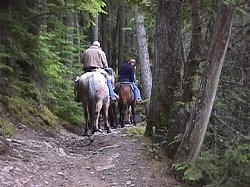
Horse Trail,
Glacier National Park, Montana
July, 1999
FALL 1999
Horse Trail,
Glacier National Park, Montana
July, 1999

Dr. Howard
November 29, 1999
The deciduous forest biome in the U.S. extends over major parts of at least 15 states. Obviously, deciduous forests occur in other parts of the world with similar climates including western Europe and mid-China.
As with other biomes, the deciduous forests are characterized, first of all, by the vegetation. The types of animals that thrive best in deciduous forests are those best adjusted to various aspects of the plants. Thus, climate and soil control vegetation and vegetation supports animal life through the food and habitat that it provides. For example, herbivores feed on leaves, twigs and wood. Other animals may eat fruits, nuts and seeds; others, roots and tubers; others, dead organic matter and others, insects borne in or on trees. Animals are obviously adapted to be able to consume their particular type of food. Seed-eating birds (e.g. cardinals and sparrows) have a thick short bill to break seed while woodpeckers have a sharp, chisel bill to drill and probe. Animals are also adapted to live in trees. For example, birds of deciduous forests have a small foot span to clasp fine stems, while birds of the coniferous forests have larger feet to clasp thick twigs or stiff, long needles. The bushy tail of the tree squirrel serves as a parachute and balance unlike that of the prairie ground squirrel or prairie dog.
There are actually a lot of different types of deciduous forests depending on variabilities in climate in this biome but first we will review general characteristics.
GENERAL CHARACTERISTICS
Deciduous forests do well in eastern North America for several reasons:
PATTERNS AND STRUCTURE OF DECIDUOUS FORESTS
Stratification
Deciduous forests are arranged in a vertical pattern referred to as stratification. The tallest form the canopy. Under the canopy are the smaller trees such as sassafras or dogwood which comprise the understory. Below the understory is a shrub layer which overlays the herb layer of ferns and wildflowers. Stratification allows all these plant forms to coexist. In spring, green ascends from the ground upward. This provides sufficient sunlight for all plants to grow.
Types of Trees
Although there are many types of deciduous forests (see below), each of these will generally be characterized by mostly needle-leaved trees, mostly broad-leaved trees, or a mixture of both of these. In general, the pattern from far North to deep South is evergreen needle-leaved trees, deciduous broad-leaved trees, and mixed deciduous and evergreen broad-leaved trees.
The type of trees obviously depends upon temperature and precipitation (as well as soil, discussed below) which varies across eastern North America. Annual precipitation generally decreases both northward and westward and the growing season is shortest in the northern states and Canada and longest in the South. For reasons previously discussed (cold temperatures reduce rate at which organisms can function, needles reduce water loss due to transpiration, needle-leaf species fill themselves with "botanical antifreeze," short growing season), needle-leaved trees become dormant over the long winter and do not lose their leaves. The growing season exceeds 200 days per year from southern New Jersey to the deep South and the temperatures and rainfall are sufficiently high to support broad-leaved species. Furthermore, due to several reasons including the longer growing season, these trees drop their leaves as they have sufficient time to regrow them. Since the growing season lasts essentially all year in southern Florida, the broad-leaved trees maintain their leaves and remain evergreen.
Indicator Species
The species that are most abundant and conspicuous in any specific type of deciduous forest are the indicator species. As will be discussed below, the indicator trees of the oak-hickory forest are oaks and hickories which comprise over 90% of the species. Indicator animals of the oak hickory forest include blue jays, wild turkeys, and squirrels. Indicators of certain habitats obviously are adapted to survive under the environmental conditions of the habitat. Some plants and animals can tolerate a wide variety of habitats and, thus, are not considered indicator species. The red maple, for example, survives in all types of eastern forests. It should be noted that plants are generally considered better indicator species because of their lack of mobility.
Soil Characteristics
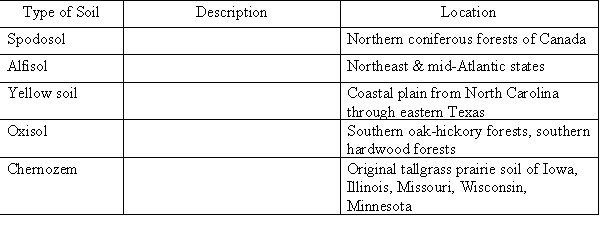
As has been extensively discussed, soil is the combined effect of geology, rainfall, temperature, vegetation, and animal life. Several soil types are found in eastern North American forests and determine what type of vegetation grows there.
Succession in a Forest
The development of a forest and its changes in species composition and community structure and function is known as ecological succession. Primary succession is succession that begins in areas previously unoccupied by organisms, while secondary succession occurs on sites previously occupied by organisms that have been disturbed by humans or by natural forces such as fires, etc.
Virtually all of our forests have regrown from abandoned farmland during the past hundred years or so. There are only a few tracts of virgin forest (forest that has never been cut or affected by human activity) left.
In secondary succession of abandoned farmland, the following typical stages would occur:
DETAILS ABOUT SPECIFIC DECIDUOUS FORESTS
Oak-Hickory Forest
The dominant species of this forest are seen on the accompanying sheets. Oak-hickory forest occupy the driest environment of any deciduous forest. The typical location in central Atlantic states includes southeastern Ohio and western West Virginia. In general, however, these forests occur west of the Mississippi valley across Mississippi into the western slopes of the Appalachian mountains. Average annual precipitation is 40-45" and precipitation is 20-40% greater than potential evapo-transpiration. The mean annual temperature is 45-70o F. The mean July temperature is 70-85o F while the mean January temperature is 10-55o F. Soils are Mollisols and accumulate organic matter in the upper horizon. Leaching occurs with accumulations of iron- aluminum silicates although not to the extent of more moist ecosystems. All of the dominant tree species are mast or nut-bearing species which provide food for birds, rodents, and undulates. Characteristic animals include turkeys, squirrels, whitetail deer, and rodents. Most of the dominant plant species are also fruit and seed producers during their developmental stages.
Mixed Oak (Oak Chestnut) Forest
The dominant species of this forest are seen on the accompanying sheets. This forest occupies the Blue Ridge and Appalachian ridges and valleys. The Beech-Maple forest is found to the north of the mixed Oak forest while a variety of southern forest ecosystems such as oak-hickory borders it on the south. The average annual rainfall is 40-50" and the available moisture is 40-60% more than the evapo-transpiration. The mean annual temperature is 45-55o F; the mean July temperature is 70-78o F, and the mean January temperature is 35-45o F. Soils include Mollisols, Ustols, and Ultisols. The organic layer is deeper than the previous forest because of slower decomposition. Originally the American Chestnut was one of the dominant species of this ecosystem; however, the fungus Endothia parasitica was detected in the early 1900's and triggered massive ecological changes in North America. The fungus destroyed about 3.5 billion American Chestnut trees within a 45-year period. Although at one time the American Chestnut comprised up to 80% of the canopy in many areas of the U.S., today only a few trees survive in places like Michigan. Today the Chestnut Oak is one of the dominant trees in this ecosystem. This ecosystem also possesses a shrub layer consisting of azaleas, blueberries, huckleberries, and laurel. There is no distinctive animal life in this ecosystem although a variety of animals may be seen here.
SEASONAL CHANGES IN A "TYPICAL" DECIDUOUS FOREST
Spring is the beginning of the growing season and numerous changes. Flowers open, leaves open, birds return, and insects and animals of all kinds suddenly reappear. Colorful flowers may be seen on cherries, dogwoods, magnolias, and rhonodendrums. These flowers and early spring wildflowers are pollinated by a wide diversity of insects including bees, wasps, flies, butterflies, moths, and numerous others. Frogs and salamanders actively court and lay eggs at night. Many species of mammals are more frequently seen in spring than in other seasons; these include squirrels, opossums, raccoons, woodchucks, and others.
During summer, the growing season is at its maximum. Growing of new leaves, flowering, attracting pollinators, and fruiting is completed. Birds are busy raising their spring broods
Autumn begins the approaching dormancy of winter. The most dramatic change, of course, is the changing of the color of leaves and subsequent falling of leaves. What exactly triggers leaves to fall? Almost 20 factors determine when leaves will. Temperature, day length and moisture are most important. Although snow buildup and cold temperatures are undoubtedly part of the reason leaves fall in winter, drought or lack of water may actually be more of a problem. At low temperatures, plants have a hard time absorbing the water they need to maintain broad leaves which tend to lose a lot of water. Trees also have a tough time carrying out photosynthesis in cold temperatures. How do leaves turn color and fall? During fall, trees grow a layer of cells, called the abscission layer, between the twig and the leaf stem. This layer cuts off the leaf’s supply of water and nutrients so the leaf begins to shut down production. Chlorophyll is used up and disappears from the leaf. This reveals yellow and orange pigments that have been present in the leaf all year long, but were hidden by the chlorophyll. Later, some of the sugars in the leaves of trees such as oaks and maples are made into reddish pigments. Once completely shut down, leaves fall, breaking off at the abscission layer.
ADAPTATIONS OF PLANTS AND ANIMALS IN DECIDUOUS FOREST
Plants
Spring wildflowers can appear as if by magic, complete with leaves and flowers in only a few days. How? By forming their leaves ahead of time, underground. When the time is right, they push a rosette of tightly packed leaves up through soil and open up to form plants. Dandelions do the same thing.
Small plants close to the ground have broad, thin, non-overlapping leaves which makes them good at gathering light in shady conditions and lets them survive in shady forest floor. A lot of plants undergo hardening which prepares them for winter.
Animals
As mentioned above birds, monarch butterflies, and other animals migrate. Some mammals, such as the eastern chipmunk, woodchuck, black bear and various bat species enter various degrees of hibernation.
Concomitant with the falling of leaves is the commencement of another cycle of decomposition by the bacteria, fungi, protozoans, and soil-dwelling animals previously studied. Additionally, flocks of birds, Monarch butterflies, and Red Bats begin their southward migration.
References
E-NATH 215 Deciduous Forest Ecosystems, USDA, Fall 1998. Course instructor: Dr. Gary R. Evans, USDA/Agricultural Research Service.
Kricher, J.C. and Morrison, G. Ecology of Eastern Forests. (Peterson Field Guide Series) Boston: Houghton Mifflin Company, 1988.
Smith, R.L. Ecology and Field Biology, 5th Ed. Menlo Park, CA: Addison-Wesley Educational Publishers, 1996.
 Click here to go to the Fall 1999 Page!