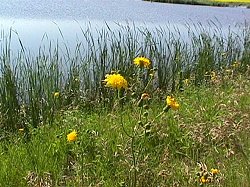
Prairie Pothole,
Central North Dakota, July, 1999
FALL 1999
Prairie Pothole,
Central North Dakota, July, 1999

Dr. Howard
December 6 and 10, 1999
Definition:
Political issues have resulted in a debate over the precise definition of wetlands. The Fish and Wildlife Service defines wetlands as "lands transitional between terrestrial and aquatic systems where the water table is usually at or near the surface or the land is covered by shallow water. For purposes of this classification, wetlands must have one or more of the following three attributes:
As Tiner discusses, this definition does not specify the duration of flooding, but suggests that the saturation should be sufficient to be reflected in either:
While hydrophytes will be discussed below, hydric soil, will be considered here.
Hydric Soils:
There are several characteristics that indicate the presence of hydric soils. The first is poorly drained soils. The second characteristic includes the redoximorphic features. Water and flooding isolate the soil from atmospheric oxygen which activates several biochemical process that result in an anaerobic, reduced system rather than an aerobic, oxidized system. The reduced subsurface layer is grayish (sandy soils) or bluish grayish, or greenish (glayed) due to iron depletion. The subsurface layer also possesses a low oxidation - reduction potential and contains several reduced products such as ferrous and manganous salts, sulfides, etc. as well as products of the anaerobic decomposition of organic matter. As a result of these redoximorphic features, the color of hydro soils shows a characteristic pattern. A matrix pattern predominates with reduced iron converting to its gray form rather than its rusty oxidized form and reduced manganese appearing as black nodules. (Color is not a good indicator of sandy soil). The fourth characteristic of hydric soils is the accumulation of organic matter due to slow rates of decay because of lack of oxygen.
Hydrophytes:
Hydrophytes are defined as "plants growing in water or on a substrate that is at least periodically deficient in oxygen (anaerobic) due to excessive water content "(Ref. Tiner). It should be noted that most plants cannot live in wetlands because they cannot tolerate the low levels of oxygen present because the levels lead to root anoxia. On the other hand, the hydrophytes that do live in wetlands must have adaptations that enable their survival in low oxygen conditions. Examples of these adaptations include 1) presence of stomata on the upper air-exposed surface rather than the underside surface as seen in aerial plant leaves; water lilies, for example, have these stomata on the upper side. Another adaptation is the development of adventitious roots or roots that occur in locations specifically above the round and usually extend from the stem in plants such as alders and willows. A third example of an adaptation is the development of air spaces known as aerenchyma in roots and stems which allow diffusion of oxygen from the leaves into the roots; flood - tolerant wetland species respond to flooding by increasing aerenchyma development. Up to 60% of the plant body of wetland species may be aerynchyma. Wetland plants also have reproductive strategies to and in their survival. Many plants including spadderdock and arrowhead have bright flowers that attract insects that aid in pollination. Wind helps in the pollination of several wetland grasses including wild rice. Furthermore the grains in wild rice may also fall straight down from the top of the plant to the mud below and germinate the following year. The buoyant seeds of arrow arum are carried in and out with the tides and thus dispersed over a large area. Specific types of hydrophytes in wetlands will be discussed later.
Types of Wetlands:
Wetlands may be classified in several ways. Tiner initially divides them into Tidal and nontidal wetlands. Tidal are those influenced by ocean - driven tides and are located near costal areas. Nontidal wetlands are influenced by other hydrologic forces such as surface - water runoff, river floods and ground water. These develop along floodpains, isolated depressions surrounded by upland, in areas with seasonal high water tables, etc.
"Marshes are open grasslands adjacent to lakes, pons and rivers, flooded by a foot or more of water through most of the year." (Ref. Tiner)
Cattails, common reed, wool grass, soft stemmed bulrush, sweet flag, cut-grass, bluejoint, reed canary grass, pickleweed and arrow heads.
"Along the coastal plain from New Jersey south, marshes called savannas, glades and Carolina bays can be found. These marshes often are surrounded by dense forests, and their openness provides a welcome break in the landscape for people and animals alike." (Ref. Tiner).
High bush bludeberry, St. John’s-wort, broomsedge, Virginia meadow beauty, three-way sedge, Canada rush, bog rush, and bladderswort. Drier savannas typically have more woody plants present, including pitch pine, inkberry, bayberry, sheep laurel, feterbush, chokeberries, northern wild raisin, and leatherleaf." (Ref. Tiner)
"Wet fields called wet meadows are found throughout the Northeast. These fields are seasonally flooded for varying periods or saturated near the surface due to local high water tables. Some wet meadows occur along streams and lakes, while others develop in depressions or river valleys maintained as open land by human intervention." (Ref. Tiner).
Sock sedge, sweet flag, reed canary grass, blue-joint, bent-grass, marsh marigold, blue vervain, New York ironweed, swamp milkweed, small white-flowered aster, skunk cabbage, marsh fern, sensitive fern, silky dogwood, arrowwoods, multiflora rose, blackberry. (Ref. Tiner)
"Fens are variably mineral-rich peatlands that develop in areas of groundwater discharge and along rivers, streams and lakes in glaciated Northeast. They are most abundant in northern New England and upstate New York, predominantly in limestone regions, but they also occur as rare habitats in the Berkshires of western Massachusetts and Connecticut. Fens are usually surrounded by an acidic landscape, and they may lie adjacent to a bog." (Ref. Tiner).
The type of hydrophytes varies according to the type of fen.
"Bogs are one of the more familiar wetland in North America, where they form an important part of the boreal landscape. They are mostly permanently saturated, nutrient-poor peatlands dominated by shrubs of the heath family (shrub bogs) or by evergreen trees (forested bogs) growing in peatmoss-based organic soils. Precipitation may be the only source of water for some bogs (ombrothrophic bogs), while other bogs are fed by precipitation, nutrient-poor surface waters, and seepage." (Ref. Tiner)
Carnivorous plants, the purple or northern pitcher plant, sundews, orchid family, cotton-grasses, white beak-rush, the purple flowering bog aster and the yellow-flowering bog goldenrod.
"Wetlands dominated by woody plants less than 20 feet tall are considered shrub swamps. Shrub bogs growing in nutrient-poor conditions on peat soils are one type of shrub wetland, while other shrub swamps develop in richer sites on either mucky soils or hydric mineral soils. Shrub swamps occur over a wide range of water regimes, from permanently flooded to temporarily flooded or seasonally saturated." (Ref. Tiner).
Buttonbush, water-willow, alders, willows, arrowwoods and dogwoods.
Dominated by deciduous trees are the most common wetland type in the Northeast, especially from central New England south. Deciduous trees lose their leaves in the fall. These swamps occur mainly in depressions of variable size that are either isolated or drained by a small stream. They are usually flooded extended periods (more than two weeks) during the year, and the soils are variously saturated when not exposed." (Ref. Tiner)
Although the specific types of hydrophytes varies according to the type of hardwood swamp, red maples are usually the predominant species in all types.
Functions of Wetlands:
Wetlands maintain a variety of naturally occurring process including the following:
Wetlands improve a variety of pollutants including nitrogen, phosphorus, pesticides, heavy metals and others through 3 processes. The first process is sediment trapping. The pollutants become bound to soil particles, and as the water flows through a wetland, the soil particles drop out and the pollutants become locked up in the sediment. The sediments can bind to plant roots. The pollutants are taken up by the plants and converted through the metabolic processes of the plant to less toxic chemical forms and recycled.
Many wetlands store flood waters after several storms and this reduces the severity of flooding. The drained waters are slowly released from the wetland.
Groundwater provides a source of water for agricultural and industrial use as well as for drinking water. Some wetlands temporarily store water before it moves through the soil into the groundwater. The plants and soil organisms of the wetlands act as water filters by binding and converting pollutants to less harmful forms.
Wetlands are essential for the survival of several plants and animals. These plants and animals depend on wetlands for some stage of their life cycle. Among these animals are fish and a variety of shellfish including clams, mussels, oysters and scallops. Coastal salt marshes provide the habitat for 2/3 of the commercial shellfish harvested in the United States. Commercially harvested foods include wild rice, cranberries and blueberries.
Animals Present in Wetlands:
Examples of Invertebrates- see accompanying sheet.
Amphibians:
Salamanders: Blue-spotted Salamander, Spotted Salamander, Marbled Salamander.
Toads and Frogs: American Toad, Spring Peeper, Wood Frog, Green Frog, Bull Frog.
Reptiles:
Snakes, Northern Water Snake, Copperhead.
Turtles: Snapping Turtle, Painted Turtle, Wood Turtle.
Birds:
Canadian Geese, Wood duck, Mallard, Canvasback, Great Egret, Great Blue Herring, Sandpiper, Laughing Gull, Osprey, Common Tern, Barred Owl, Ruby Throated Humming Bird, Pileated Woodpecker, Tree Swallow, Marsh Wren, Song Sparrow, Bobolink, Red-eyed Vireo.
Mammals:
Moles, Shrews, Squirrels, White Footed Mice, Beaver, Muskrat, Opossum, Raccoon, Gray Fox, Otters, Deer, Bears, Bats, Moose.
Adaptations of many of these animals were discussed in the animal lectures.
Reference
Tiner, R. W. : In Search of Swampland. Rutgers University Press, 1998. New Brunswick, NJ
 Click here to go to the Fall 1999 Page!