
|
|
|
|
 |
 |
 |
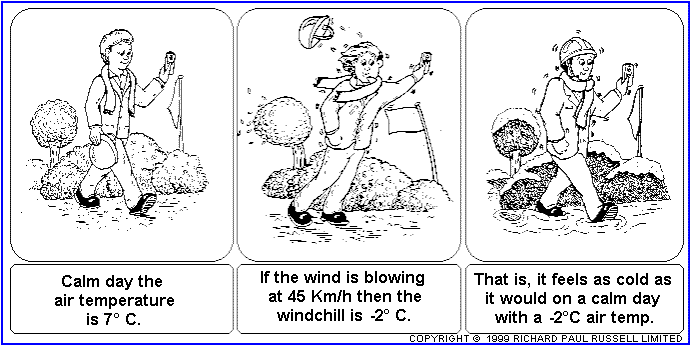
Wind chill factors are supposed to measure the effect of the combination of temperature and wind speed on human comfort. The windchill described here was developed around the time of World War II, partly to provide an easily calculated index for battlefield planning. It was used to determine risk factors when operating outdoors under various conditions, and gives a very rough idea (in easily understood terms) of potential problems caused by the combination of wind with cold. It is important to remember that these do not have the same effect on inanimate objects, or even on other animals or on plants. Nor is this effect felt by humans who are sheltered from the wind. There is nothing "exact" about windchill: it is an approximation or estimate.
Wind chill factors can be expressed as an equivalent temperature on either the Celsius (°C) or Fahrenheit (°F) scale, or in units of power per unit area.
Wind chill factors are often published as tables. There are 2 tables on the second page of this set of pages. The tables cover the two scales mentioned above, and have a brief explanation of their values.
There are some good discussions of the history and use of wind chill factors on the Internet. Check out the ones by Environment Canada or National Weather Service (USA) Canada.
The variations in various tables that have been published may be the result of use of different formulas for heat loss or different assumptions for skin temperature or calm wind speed, though many are round-off errors from conversions among the various units used along the way. During 2000 there was a movement to "correct" the windchill to more realistic numbers. This prompted the total change in these pages suring October 2001. The Metric calculations were provided by Environment Canada and the Imperial by the National Weather Service in the United States. Please see the links above to learn EVERYTHING you need to know about wind chill.
Lastly, I would like to thank Gene Nygaard, Richard Paul Russel Limited, and Bob Rilling at the NCAR Atmospheric Technology Division for the use of their graphics, calcluations, and explanations. I could not have even started this page without the information I obtained from their sites. I also want to thank Bryan Ruby, of the National Weather Service who provided the JAVA equation that made the Imperial portion of the front page calculator work properly.
