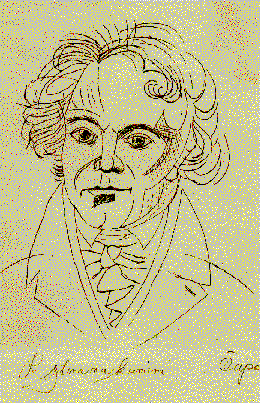
Senefelder, Prague, Lithography

senefelder
A few words about Senefelder's life and invention. (Necessity is the mother of invention &Blessing in disguise)
senefelder takes the liberty of briefing you on Alois Senefelder's hard life and ingenious invention made 200 years ago in Prague.

Alois Senefelder (the full original name Aloys Johann Nepomuk Franz Senefelder) was born in Prague on November 6 1771 in RytĄ©sk ulice (Knights' Street, if translated), where the old municipal market was then and a modern hypermarket is now.
His father was an actor at the Royal Theatre of Munich and was playing at Prague at the time of the birth of his son. Young A. Senefelder attended the grammar school in Munich and received a scholarship of 120 florins a year for his diligence, which enabled him to study jurisprudence at Ingolstadt. The death of his father in 1791 forced him to cease his studies in order to help supprot his mother and a family of eight sisters and brothers.
Then the sleeping genes woke up and his play "Connoiseur of Girls" gained landslading success and brought him a royalty of 50 Guldens. Well done. However, it had not been until the death of his father, who strongly opposed this kind of carreer of his son, that he could dedicate himself to the theatre in full.
Then printers dishonoured the deadline for printing his play "Mathylde von Altenstein" and his publisher Leutner did not manage to present the work at the Lipziger Fair, which in turn plunged him in crippling debts. And this is the very moment when his stubborn obsession to be able to multiply his works independently of professional printers began, exactly as the proverb "Neccessity in the mother of invention" goes.
Not unlike any inventor he experimented with any material he could take hold of: wood, metal, pastry, stone.... using mechanical and/or chemical processes. The stone he used as colour slab might be the cheaper option to metal plates, he thought one day.
The perpetual state of haste and permanent financial weakness were the factors that would have played against him, but not this time. On the contrary: they would be the the essential ingredients in place to bring about the greatest invention in the printing technology in the coming two centuries, just as the proverb "Blessing in disguise" goes. There was the above mentioned stone with the laundry list he scribbled on it with greasy ink, and a bottle of somewhat exhausted solution of nitric acid and gum arabic beside, for wanting to spare some money he did not buy a new and strong mixture. The original idea was to etch the stone deep so that a reasonably high relief might be formed and enable printing.
BUT. The acid was quite weak and he did not let it work enough long and at that he impatiently applied the printing ink on the stone, before it had completely dried up, while still slighly damp and wet. And the copy was very fine. Delighted, he went on to study the surface of the stone in detail and he was a very keen observer indeed.
He was taken by surprise because there was almost no relief from which a copy could have been made. Obviously, other forces of nature than sheer mechanical ones were at play here: he immediately recognized the revolutionary KISS procedure, he was so desperately looking for, and called it chemical printing ("Chemischer Druck"). As Henry Cliff puts it in exact terms, printing from a flat surface is dependent upon the natural aversion of grease for water. The design is drawn on the grained surface of the stone with greasy inks or crayons, and the whole surface is than damped. The grained surface helps to hold the water while the ink repels it. The whole stone is then rolled up with a printing ink which sticks to the greasy drawing, but not to the wet surface of the untouched stone. Lithography differs from the other printing processes in that the impression is taken from completely flat surface.
In relief printing, parts of the surface of the block are cut away and these parts, which do not take the ink, make the white lines and patches in a design. The fact that the word "etch" is used for one of the processes in lithography might lead one to suppose that lithography, too, is some form of intaglio process, but it is not. The process is planographic, this is to say, the image forms part of the surface of the stone upon which it is drawn.
The first lithographs were drawn upon a fine-grained limestone called Kelheim stone, found only in one or two quarries in Bavaria (Solenhofen), the same as I use in my work.
The process became very popular early in the nineteenth century, and many of the great painters and engravers of the time made lithographs, including Goya, Daumier, Bonington, Gavarni, and others. It has been used by artists in this century as well: Picasso, Braque.

In Senefelder's autobiography (introduction to "Lehrbuch") his desire is expresses the invention "may bring to mankind manifold benefits and may tend to raise it upon a noble plane, but may never be misused for an evil purpose.
May the Almighty grant this! Then blessed be the hour in which I made my invention."

senefelder's pedigree:
Alois Senefelder
.....
Sysel
.....
Schmidt
Klimovic
senefelder

senefelder To the front page where the rest of the offer and lithographic postcards of Prague are.