|
Aprile Directed by Nanni Moretti Starring Nanni Moretti, Silvio Orlando, Silvia Nono Distribution: none *** / B+ |
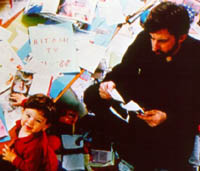 |
It takes a certain amount of hubris to assume that your personal life is sufficiently captivating in order to make a semi-autobiographical film, but Nanni Moretti's observant, essayist humour enchants and delights in Aprile, a joyful if somewhat awkward picture which juxtaposes two elements -- the intimate (the birth of his first child) and the intellectual (his political musings on the state of contemporary Italy). It's the former which succeeds to a much greater degree than the latter, endlessly charming the audience as Mr. Moretti shows a keen eye for observant social humour (not to mention a few incredibly witty visual gags) and serves as an eminently likeable onscreen presence. As warm and sweet-natured as the baby material (and, indeed, the entire personal section of the flick, which touches upon his filmmaking ambitions -- he wants to make a musical -- and even brings his wife Silvia Nono into the fold to play herself) is, as a film buff, I found Aprile to be the most engaging when Mr. Moretti, as the movie-aware person that he assuredly is, casts his comic gaze on contemporary cinema: his in-film synopsis of Michael Mann's Heat, while technically accurate, is laugh-out-loud funny, while his take in Kathryn Bigelow's Strange Days is both utterly hysterical and unforgettable (and this from someone who enjoyed the sci-fi film!). That he can bring up Kiarostami's name up at one particular point in the picture and get away with it illustrates his tremendous sense of comic timing. Aprile is a genuine gem of a feeelgood comedy.
|
The Silence Directed by Mohsen Makhmalbaf Starring Korshid Normatava, Nadereh Abdelah Yeva Distribution: New Yorker Films *** / B+ |
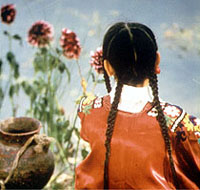 |
The grandeur of Mohsen Makhmalbaf's The Silence is derived not from its airy plot, but its majestic spectacle of images and sounds that create an exquisite, entrancing atmosphere. This is a picture of gentle beauty whose attentiveness to vivid colouring and visual composition don't dissuade it from the simplistic ritual of gazing admiringly at the curve of a girl's chin, the fullness of her lips. The story, such that it is, is fleeting -- while his mother frets about an impending eviction from their home, Korshid, a blind 10-year-old, works as a tuner for an instrument maker -- but the resultant innocence of the journey is perfectly attuned to the context of the boy's perspective; the film's chaste self-presentation allows us to savour his world with a strange purity. Korshid's blindness, of course, figures significantly in the storytelling, compelling Mr. Makhmalbaf to create a wonderful tapestry of sounds lovingly layered one on top of the other (the picture's Beethoven elements, particularly the boy's "orchestration" sequence, are perhaps a bit too obvious, but they nonetheless work against all odds), but not at the detriment of the visuals -- a certain serenity is achieved from the repeated shots of Korshid gently being woken (as in Martin Scorsese's Kundun), and a tranquil shot of animals wading in the river with Korshid, his mindful young female companion Naderah, and a group of musicians sitting in silence on the waterfront is one of immense delicacy. In comparison, the pressing dilemma of Korshid's domestic plight registers, but doesn't cast a pall over the sweet core of the film, where a boy can be led astray by a pleasant tune or a beautiful voice.
|
The General Directed by John Boorman Starring Brendan Gleeson, Jon Voight Distribution: Sony Pictures Classics *** / B |
The competent workmanship by Mr. Boorman and the lovely black-and-white cinematography by Seamus Dessy doesn't disguise the fact that this reality-based story is ultimately a very conventional tale about the rise and fall of a lovably irascible thief, and his evasion of the law in flamboyant, crowdpleasing fashion -- at heart, Irish gangster Martin Cahill (Brendan Gleeson) is just a big charming lug, albeit one who can play hardball: the film includes the now-obligatory scene of inventive violence (see Casino and vices, for example). Indeed, in its basic outline, this Irish gangster film resembles the traditional Mafia flicks to such a degree that it even references them at one point. While the picture's standard elements (clever, charming criminals with doting families; dastardly, vicious police) are so familiar that it's a struggle to get very emotionally involved with the characters, it's all depicted with a light-hearted, playful touch (the jovial score helps underline the comic aspects of their episodic crime sprees) which make the proceedings easy to swallow, although the comic mugging gets dull pretty quickly. What's perhaps the most unusual and interesting aspect about Cahill's life is also the one which is most unexplored by the film -- his ménage-a-trois relationship between he, his wife, and her sister. Perhaps it's just me, but I would've liked to have seen a little less of rascally Cahill flouting the law and upstaging the police, and a bit more about this curiousness.In attendance: director John Boorman, actor Brendan Gleeson
|
Life Is Beautiful Directed by Roberto Benigni Starring Roberto Benigni, Nicoletta Braschi Distribution: The Miramax Express **** / A |
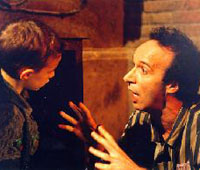 |
While Theo Angelopoulos' Eternity And A Day was the Palme D'Or winner at Cannes this year, the vast majority of the press and attention focused on runner-up Life Is Beautiful from Italian director-star Roberto Benigni, recipient of a celebrated ten-minute post-screening standing ovation (which the Toronto response rivalled). Much has been made of the contentious decision of making a WWII-set tragicomedy about such a sensitive topic as the Holocaust, but unsurprisingly the brutality of the concentration camps are awfully softpeddled, limited to a few scant references to showers, hints of physical abuse and a fuzzy, seemingly-obligatory shot of stacked corpses (even the hated Nazi swastika scarcely makes an appearance). I'm left a tad curious about whether or not the original, pre-Harvey cut of the film which swept the Italian Film Awards earlier this year addressed the horrific ordeal in more detail, yet for the spirit which the fablesque picture aims to capture, it ultimately matters little -- what remains is genuinely touching and effectively disarming, and a more authentic, gritty approach would be an impediment and even, to some degree, needlessly gratuitous. While the latter half of the picture, focusing on part-Jewish waiter Guido (Mr. Benigni) and his family interned in a concentration camp (Guido's survival tactic for his young son Giosué is convincing him that their incarceration is all a big game), allows for many comic moments, what's never missing is the sense of pathos involved -- there's real poignancy and heartbreak amidst the chuckles as we watch the father desperately attempting to shield his boy from the terrors and dangers awaiting them. With its intense focus on the tragic dilemma of the child (a perspective which is perhaps too narrow -- the mentionless disposal of an uncle character who factors prominently in the film's first half seemed oddly flippant), Life Is Beautiful succeeds in eliciting a great deal of emotion, and scenes of simple eloquence -- there's an echo to Seventh Heaven in a disconnected moment between Guido and wife Dora (Nicolleta Braschi) -- are rendered particularly affecting. In spite of it all, the picture is -- dare I say it -- often very funny, and occasionally uproariously so: one scene involving Guido's translation aptitude is as outright hilarious as anything that's likely to be seen on the big screen this year. While the flick's controversial concentration camp-set latter half, though heartfelt and thoroughly moving, is decidedly more dour than its first half (the claim has often been made, perhaps not unreasonably, that the picture feels like a fusion of two disparate halves, although I admired the wonderfully magical transition), the opening hour of the picture contains a huge amount of levity and charm that left me enjoying myself considerably -- the early scenes of courtship between Guido and Dora, as traditional and familiar as they are, struck me as more effective and played better than the film's latter (and admittedly more tricky) material. Guido's winning comic wooing of the upper-class schoolteacher creates a genuine sense of whimsy and is often lushly romantic, and the film's early scenes of physical comedy and absurd hijinx are a truly remarkable showcase for Mr. Benigni's performing skills -- at moments, I felt like I was gazing through a portal in time, watching glimmers of Charlie Chaplin.In attendance: director/star Roberto Benigni, actor Nicoletta Braschi
|
Permanent Midnight Directed by David Veloz Starring Ben Stiller, Elizabeth Hurley, Maria Bello Distribution: Artisan ** ½ / C+ |
 |
While Permanent Midnight does a pretty good job addressing a profession which doesn't lend itself to a cinematic depiction -- writing -- like this year's Fear And Loathing In Las Vegas, the picture's focus is easily more on the protagonist's drug addiction than it is on his trade. However, unlike the hallucinatory viewpoint of the Gilliam film, David Veloz's flick is far more sober, judgemental, and traditional -- one which unequivocably lets the audience know where its position on recreational drug usage is. Despite overtures to the contrary, it's not a particularly harrowing film at all (though for some reason one injection scene prompted half of a row to simultaneously exit the screening, presumably to flee for cover) as it follows the rise and fall of screenwriter Jerry Stahl in 1980s Hollywood. (One of the fun parts of the movie is to watch the fictional euphemisms employed for "Alf" and "Moonlighting", two of Mr. Stahl's top credits.) It's a fairly sketchy look at his life, leaving many gaps and many questions and completely skipping out the critical phase of his junkie life, which prompts me to wonder whether or not his own involvement in the project resulted in a tempering and soft-peddling of the material. In any case, while the lack of downfall scenes leave a somewhat unfulfilled sense, what I found more distressing was the glaringly cheap tactic to use Kitty (Maria Bello), an obvious fictional plot device employed so that Jerry Stahl (Ben Stiller) can recount his tale in flashback format, not only as surrogate audience but also as the picture's ultimate emotional core. There's actually very little in the flick which gets one emotionally involved with the characters, although some of it is rather amusing. Mr. Veloz's direction is competent, utilising a couple of stylistic techniques (dissolves, etc.) to good effect, but many scenes don't inform as much as they appear to aim for, and the picture's supporting characters are all thin and disposable (Janeane Garofalo continues to impress, though -- she can bring down the house with one deadpan look -- and Peter Greene is, of course, perfectly cast). A watchable, digestable take on drug addiction that provides little new insight and breaks no ground.In attendance: director David Veloz, actors Ben Stiller, Elizabeth Hurley, Maria Bello, author/subject Jerry Stahl, producer Don Murphy
