|
Elizabeth Directed by Shekhar Kapur Starring Cate Blanchett, Geoffrey Rush, Christopher Eccleston Distribution: Gramercy Pictures *** ½ / A- |
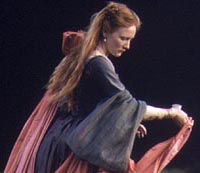 |
The opening title cards convey such an immediate sense of charged urgency and exhiliration that they reminded me of no less than Richard Loncraine's audacious intro to Richard III, but while these two films both focus on British monarchs, the distinction between them is clear: while one focuses on an aggressive male tyrant who ambitiously smashes his way to the throne and defiantly (and vainly) battles to the end, Elizabeth addreses a passive young lady who inherits the throne and passively struggles against an onslaught of dangers which confront her. However, this is far from a timid film -- scenes are filled with such electricty and tension that in many ways this plays more as a political thriller than stodgy costume drama (although Alexandra Byrne's designs are indeed stunning.) A lavish, rich production, this marks acclaimed Shekhar Kapur's (Bandit Queen, among many others) first English language feature, and his elaborate, almost operatic sense of excess works effectively in this film -- the final shot is a spectacularly bold and risky one which catapults the picture to giddy new heights. He's immensely aided by a magnificent performance by Cate Blanchett in the central role, who not only resembles the historical figure and reinforces the talent demonstrated in Oscar & Lucinda opposite Ralph Fiennes (here, she acts opposite brother Joseph, making this a strikingly curious string of projects for her -- maybe she'll line something up against the Baldwin clan next), but dominates the screen to such an extent that her fellow actors (including such notable talents as Geoffrey Rush, Christopher Eccleston, and so forth) are left as diminished as the subservient characters they play to Her Highness. (Kathy Burke once again impresses as Queen Mary.) The film's political, royal, and sexual intrigue is fascinating material (I'm now tempted to read up on it a bit more), although the narrative does become somewhat convoluted, particularly during the stretch run; still, it's a muscular, breathtakingly powerful piece of work.
|
Finding Graceland Directed by David Winkler Starring Harvey Keitel, Johnathan Scaech, Bridget Fonda Distribution: none * ½ / D+ |
The scenario presented in Finding Graceland -- a driver who winds up on a journey with a strange man claiming to be Elvis Presley -- immediately leads one to conclude that a resultant film would be classified into one of two extremes: clever, or wretched. This production decidedly falls into the latter category -- this is dire, torturous junk which embraces mawkish, shlocky sentimentality while employing would-be Elvis-related humour. The is-he-Elvis-or-isn't-he? is played by Harvey Keitel, whose resemblence to Presley is laughably nil, and the Johnathan Scaech is the straight guy -- unfortunately, wooden and lifeless doesn't make for a particularly engaging audience surrogate in this mismatched buddy road movie. The depth of complexity of the utterly predictable, obvious screenplay is such that it uses the damaged convertible employed in the film to represent our protagonist's scarred psyche, and never succeeds in establishing any genuine interest as to whether or not the hitchhiker is indeed long-lost Elvis: its typical unfunny device for creating doubt is along the lines of "Oh yeah, well, only Elvis would know this! (insert obscure Elvis trivia here)" Of course, while Mr. Keitel's complete lack of resemblence to The King shatters even the slightest bit of belief in his delusion, the critical problem here is that the audience is supposed to want to believe that he might really be who he claims; that's never achieved here. As is convention in this genre, the mismatched pair bicker, come to a mutual understanding, and after much adventure, help each other grow and/or heal from the experience -- this is all conventional stuff which the picture's screenplay doesn't dare deviate from, but what's interesting is that the film's showstopping scene occurs in midstream instead of at the conclusion -- a performance of "Suspcious Minds" by Mr. Keitel's "Elvis" which lacks any combustable element and left me wondering why the observers in the film burst out into rapturous applause. The least sub-par element of the film (what kind praise!) is Bridget Fonda as a Marilyn Monroe impersonator -- when gussied up, she at least vaguely resembles the sex symbol, and at least gets to give her facial muscles a good workout -- if you didn't know what she was doing, you'd think she had a tic.
|
Desert Blue Directed by Morgan J. Freeman Starring Brendan Sexton III, Kate Hudson, Christina Ricci Distribution: Samuel Goldwyn Co. *** / B |
I missed Morgan J. Freeman's first film, the 1997 Sundance-winning Hurricane (later re-titled Hurricane Streets for some inexplicable reason -- I hope it wasn't the good ol' Disaster Film Title Dodge move again, à la Hard Rain née The Flood) when it came and disappeared from Toronto theatres, so I didn't quite know what to expect when approaching his follow-up feature, Desert Blue. What I found was a charming, warm-hearted film of surprising emotional intimacy, one which transcends its familiar quirky smalltown tale elements to strike a note of resonance. Set in the remote desert speck of a town called Baxter Beach, California, proud home of the World's Biggest Ice Cream Cone, the picture introduces several unsubtle anti-big business gestures -- not only is the Empire Cola truck spill the catalyst for the flick's events, trapping snooty vacationing TV starlet Skye (Kate Hudson) and her father (John Heard) in town with the locals, but it was the same soft drink corporation who suceeded in thwarting Blue's (Brendan Sexton III, reteaming with Mr. Freeman) late father's dream of a local water park -- but the plot, as airy and unsubstantial as it is, isn't critical here: the flick's story essentially serves simply as a platform for its cast of characters. Mr. Freeman succeedes in creating a strong sense of community with its characters, who are all fleshed out beyond their quirky idiosyncratic signatures to become interesting, watchable people. (It helps that the ensemble cast includes some notable young talents -- the ever-ubiquitous Christina Ricci as an explosives enthusiast, Casey Affleck as a brash dirt bike racer, as well as Mr. Sexton III, Ms. Hudson and several others.) In its basic plot elements, Desert Blue, while not exactly formulaic, rarely surprises, but its quiet effectiveness does -- the inevitable romantic thread between Blue and Skye could have easily been as mawkishly hokey and contrived as, well, their too-cute matching character names, but it plays well. While the picture occasionally goes astray -- the entire guilt-ridden Michael Ironside thread is superfluous, and the angsty subplot involving Blue's late father's demise isn't especially convincing -- there's some nice writing and several humorous moments in the picture, particularly in the scenes where the young cast spend lazy summer nights by the campfire, waxing philosophical.In attendance: director Morgan J. Freeman
|
La Vie Rêvée Des Anges (The Dreamlife Of Angels) Directed by Erick Zonca Starring Elodie Bouchez, Natacha Régnier Distribution: Sony Pictures Classics **** / A |
 |
An affecting, carefully-woven tale of friendship, La Vie Rêvée Des Anges is an astonishing directorial debut for Erick Zonca, heralding the emergence of a bright new talent in French cinema -- his subdued cinema verité approach to the picture (which adheres so faithful to realism that, if I'm not mistaken, it eschews scoring or any form of musical accompaniment until its finalé) is nonetheless exhilirating in its sheer visceral power. (The flick's final shot, panning from face to face, is staggering in its implications.) A myriad of emotions colour this intensely intimate film, whose focus is on Isa (Elodie Bouchez), a plucky young drifter that develops an unlikely bond with Marie (Natacha Régnier), a troubled woman on an apartment-sitting assignment. Their mutual amity is intense and near-instantaneous-- a joyously mischievous sequence of the duo playing innocuous pranks in a shopping mall reminded me of the ill-fated relationship between the Alicia Witt and Renee Humphrey characters in Fun -- but their vastly different dispositions are immediately evident, no better depicted than in a marvelous scene when Marie's mother pays an unexpected visit; Mr. Zonca's transition between the hold on Marie's brooding demeanour to the juxtaposition of Isa, lingering in the background and madly grinning away, is a wonderful moment. While Marie's sullen, dismissive attitude is often painful to tolerate (a subplot involving her courtship by an endearingly hapless, portly biker is both touching and poignant, especially given later developments), it makes for a splendid contrast with Isa's quiet thoughtfulness and extreme orderly care, best embodied in a fascinating thread where she gradually becomes preoccupied with the hospitalized, comatose girl whose apartment they're minding; it's a testament to the effectiveness of Ms. Bouchez's sensitive and carefully modulated performance that Isa's perusals of (and later, contributions to) the injured girl's diary don't come off as an invasive discourtesy, but rather as a series of deeply moving gestures. The interesting device of the comatose patient, in conjunction with a few select lines penned at one point by Isa, give the film's title its double meaning, yet what is incontrovertible in either case is that these women, as feisty, impoverished, and ostensibly incompatible as they may be, are seraphic -- so sweetly engaging and truly appealing are they, both individually and as a duo, that I truly savoured every moment of their good times (their fun Planet Hollywood audition is utterly charming, and I broke out in a heartfelt grin at the sight of Isa precariously teetering on roller skates with her sandwich-board) and utterly ached as their volatile friendship began to deteriorate. Ms. Bouchez and Ms. Régnier's terrific, complementary performances in the picture jointly netted them this year's Cannes Best Actress prize, and as particularly well-drawn and detailed as screenwriters Roger Bohbot and Mr. Zonca have made the two characters, it's the performances by the actresses which propel the film to the zeniths it often achieves; Ms. Régnier's work during the final stretch, in particular, allow it to transcend its fatalist inevitability and pave the way for a haunting climax of immense potency. While admittedly my huge affinity for the nature of this material -- young, innocent French women struggling to cope in the Big Bad World (to wit, Cédric Klapisch's Chacun Cherche Son Chat was my #3 film of 1997) -- may have possibly had some minor influence on my assessment, I wouldn't hesitate for an instant to classify La Vie Rêvée Des Anges as easily the best new film I've seen to date in 1998.
|
Fin Août, Début Septembre (Late August, Early September) Directed by Oliver Assayas Starring Mathieu Amalric, Virginie Ledoyen, François Cluzet Distribution: none ** ½ / B- |
After much anticipation, my enthusiasm (and remaining euphoria from the previous screening) began to wane after about an hour of Oliver Assayas' Fin Août, Début Septembre and I found myself actually getting bored when there was a figurative squeal of the wheels, and the fragmented narrative ultimately began to coalesce in touching ways. Focused on a group of interrelated characters connected by a friendship between two men, Adrien (François Cluzet) and Gabriel (Mathieu Amalric), and intimately told in a series of moment-out-of-time snapshot sequences, the picture provides a lot of insight and character behaviour, progressively allowing us to familiarize ourselves with the players and their changing relationships over time. Although the picture is interesting to look at -- there's a lot of handheld work, and Assayas has every individual scene do a slow fade-to-black (oh, and Virginie Ledoyen is also in the film) -- for the most part, the film depends upon how interesting one finds its characters and their stories: I found myself less and less engaged, until that aforementioned change swooped in which reshuffled the deck and brought about a certain awkward sadness and poignancy involving Adrien's heartbroken young girlfriend that served as a strongly rewarding payoff. The picture's final series of notes are fulfilling, despite (and probably because of) the fact that there's no real sense of closure -- there honestly can't be: as in life, the series of complex, interwoven relationships continue to evolve, breaking and reemerging in curious and unexpected ways.In attendance: director Oliver Assayas, actor Arisnee Khanjian, cinematographer Denis Lenoir
