An Explanation of what a Researcher on the Amazon Warriors may
not have addressed in relation to the question genetics of Atlanteans who were
originally identified with Amazon groups along the Coast of West Africa first
noted as from the adjacent Atlantis. By Dean Clarke BLS of http://atlantisite.com
August 11, 2004
In response to the eloquent study of this program listed link,
http://www.pbs.org/wnet/secrets/case_amazon/
About the work of Dr. Jeannine Davis-Kimball who studies
Nomadic Groups of Eurasia and
studies the Amazon links to the Black Sea to the Steppes of
China and Russia borders of the lost Sauromatian Culture i.e. pseudo
Kossacks-Scythians (post Amazon Women Culture) and who became related to the
Kurgan Burials and Culture.
"Amazons in myth:
History's first mention of a race of warrior women comes in Homer's ILIAD, an
account of the Trojan War, probably written in the 8th to the 7th century B.C.
Homer's Amazons, a race of fierce women who mated with vanquished male foes and
kept only the female children they bore, were believed to occupy the area around
the Black Sea. Amazon women also crop up in other Greek myths. One of the labors
of Hercules, for example, required him to acquire the girdle of the Amazon
queen, Hippolyte. The Amazons of Greek mythology most likely had no connection
to the women of the steppes, says archaeologist Jeannine Davis-Kimball. "I
think the idea of the 'Amazon' was created by the Greeks for their own
purposes," she says."
A history of sorts:
The histories of the Greek Herodotus, written around the 5th century B.C.,
describe a group of female warriors who lost to the Greeks at the battle of
Thermodon. Herodotus's Amazons were taken prisoner and put on ships, but
overwhelmed and killed the Greek crew. Unable to sail themselves, the women
drifted to the shores of the Black Sea, to the territory of the Scythians, a
nomadic culture of Iranian descent. The women, Herodotus says, intermarried with
the Scythian men, and convinced their new husbands to move northeast across the
flat grassy plains, high mountains, and searing deserts of the Russian steppes,
where the group eventually evolved into the Sauromatian culture.
The above from the website of PBS program website called 'Secrets of the Dead'.
From Dean Clarke BLS in response to what is not mentioned in
the program.
Herodotus has also maps based on Amazons in the region of
north western Africa, and the reason that Dr. Jeannine Davis-Kimball does
not look backward to this issue may be due to the fact that her study does not
involve the information before the earliest mentioning of these peoples by myths
and folklore of Greece yet is still believed to this day to be that of the Hesperidia
Amazons who once lived from Morocco-Mauritania to nearly the steppes of Egypt,
and who existed from nearly Spain to Italy and above to Northern Greece who at
one time aligned with the Pelasgians or Pharsians. There is some folklore
stories about them connected with the Akal Teke Horse who played an important
part of the Silk Roads trade. Its history seems to go back to the horse races of
the "Mercators
Map dated 1627 showing a place titled Hippodromos Aethiopiae (ΊppodromoV
Η-Θeopiae)
which lay on the west coast of Africa, in today’s Mauritania. What was such a
major horse centre doing, so far from anywhere? If you find today’s
Nouakchott," noted by Mr. Gill in a correspondence. Also, "The
origin of Welsh in legend is from the Cumerai (Cymru) of ancient Troy. This was
from where the ancient Celts moved first to Latium where they settled in Alba
Longa and then to Britain in 1028 BC. (NB). This previous point in regards to
the Welsh Tale origin as being from near Troy and I can see the Horse connection
on the coins of both Troy, of Hellespont and Britannia with also had long since
had the significance to the Horse Culture of the Celtic who were also in
some cases nomadic peoples. Further, It looks as though the Garamanteans, who
were the indigenous population of the ancient and fertile (central) Sahara,
could have been amongst the first people to have known about the exodus from
Atlantis. As you know, these people were the ancestors of the Maures (Mauretania,
Mali), who in turn became the Moors. Etymology indicates that the people named
Mu could possibly be related somehow to the (Mau of the) Maures? Also about the
Horse, " between
us from differing angles we think that Arkhal Teke may well have been one of the
original breeds and that it could have been the one used in Atlantis. Α-κάμαντι
Akamanti - untiring Ταχέως
takeos – quickly.
These both make sense. The same stem, Akamanti would have been used for
the camel too – untiring.
*(I think Τεκε,
Τικτω – Teke, Tikto - beget or begotten, of divinity,
man and beast, is also likely if you look at the Welsh below).
Α-κάμαντι, Akamanti – untiring would
also have been Akalanti. The M and L were exchangeable sounds in both greek and
Latin.
*Just as interesting is the Welsh Achau- Achoedd - meaning ancestry and Llinau
Pedigree (Li is from sanskit meaning generic line). Here Stephan had put forward
in correspondence to me the association of the 'quick and untiring' Akal Horse.
What does this all mean? First the Bronze colored and rare Akal Horse would have
been well known to the Moors and the previous North African Amazons and the
Akamanti name is tied to a group of people known in north west Africa like
Akhenti type groups. It seems odd scientists have not looked at the genetics in
relation to the Amazon Warriors of later Greek history and the Black Sea Ladies
who escaped and were abandoned by their Greek men to engage in alliances with
the Scythians. The story goes that these women were too butchy, and jealous and independent
in lifestyle to tie down to one place, but the brawniness of them was sought
after by other warrior groups and thus the Amazons had a slight nomadic
lifestyle to begin with. It must be remembered at one time they were a rival
maritime group of women who lived near coastal areas and occasioned the title of
pirates at one time. This point seems to indicate that they had a semi nomadic
food sources like raising sheep, cows, and or goats and lived off of sea food as
well in their original inception. The Garamantians of North West Africa fit this
life style in many cases, as well as the those who crossed into Sicily, and
Italy at the later stages of the Azillian Culture where the Amazon story has its
earliest start. This Akal Horse would have been the by product of a pre-Hamatic
type group of people who also rode hamatic related bulls (remember Crete's women
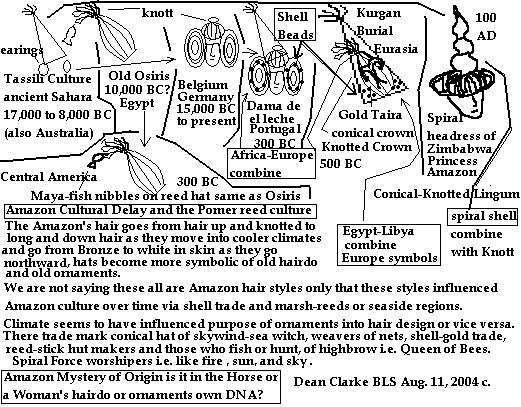
love affairs with bulls). What is interesting is the head dress of these ancient
Garamantians were similar to those found of the Tassili Culture in Central
Sahara (also 17,000 BC Australia), of Spain or Southern Europe which eventually
had a style found in Germany and Medieval Europe of the pointed conical hat with
the broaches on them and the silky long flowing and downward handkerchief tassel
(i.e. the Silk Road) at the top of their hats. The other aspect of the early
Amazon of the North West Africa had a peculiar hairdo only known in certain
cultures like Native American Navaho, Mayo of China, the Dama De El Leche of Portugal,
lost ladies of Belgium and some rock art that shows these Hamatic Women in the
Sahara, North Africa who were depicted riding bulls or cows about 8,000 BC
clothed in what looks like fine linen, same hairdo as above mentioned, and in
some cases a bridal in hand and a conical hat. What is even more striking is
they are depicted as more white then yellow, black or brown and in some cases
have red hair (if they are not hennen dyed while they are white in complexion in
the Sahara rock art). This hairdo is actually seen in some Mongol groups of the
spiral and circular hair around the ears which even German women ware as
traditional hairpiece goes back to the ancient horse rider days, and actually
before that back to almost 15,000 BC. There also seems to be some indication
that the Amazons were in Syria before they fought in Troy or may have
associations to the Hittite nation. This again would indicate a near Phoenician
association to the Amazons as near cousins via Libya and before the days of
Carthage. Now the reader will see the Amazon mystery thickens that it is not so
much were they end up on the steppes of Russia-China nomadic peoples border, but
were hence they came from in origin. One story in Greek folklore is that the
Amazons came to the region of below the Black Sea due to the 'Phoenician'
conquests and often connected to the stories surrounding Melkhart (Hercules)
which often ties into the raping of the Amazons. In which case the story seems
to predate Jason and the Argonauts for the Amazons were as a culture not far
from Colchis, and some have claimed as Herodotus did that the Egyptians
colonized Colchis before the Corcyre Cossacks and Phoenicians later colonized.
If the Egyptians were there in Colchis then some displaced Amazon Warrior women
possibly had already arrived before them. We must keep in mind language always
needs a transition for trade to more easily to be acquired thus a
Caucusian-Hamatic like speech with some Berber affinities would by being along
side with Welsh-Hittite like idioms or expressions be quite easy for a trading Egyptians
to acquire. The date of this process before the Egyptian arrival to Colchis is
about 6,000 to 3,000 BC sometimes called the great Caucasian Migration which had
tied the Celtic from Europe to Syria in a Arcadian type of language. The click
language was noted like the Hottentots to the Celtic 'click' language which
shows a near Azillian ancient bushman connection which is unexplainable to
linguists as to why the ancient northern Greek and some of the Hittites and
Cretans would even emulate this language of the 'birds' it would indicate their reverence
of birds, and horses! If we follow the Azillian migration 5,000 years before the
Caucasian Migration we will find that white women are roaming around with
semi-nomadic Azillian half bushman and half harpooner culture. But this is were
the mystery gets weirder. The Azillians did in fact herd animals such as horses
and cows, sheep, or goats though they hunted animals such as fish and hippos.
The deer or antelope was both revered and sought after for food and the Amazon
Women were known in the first position as excellent hunters of this game, and so
it would seem some kind of food source amalgamation had occurred with the strong
association of the taboo of eating horses and who had been chosen instead to be
something to ride upon. Meanwhile, progressive steps into the bow and
arrow then emerged near this time say 8,000 to 11,000 BC. We do not know if
horses were rode on for hunting purposes but feel very likely they were used in
some capacity once they were rode upon to corral or gather with or to
specifically hunt down prey. It must be remembered the Amazons were first known
for their spearing of game with tritons or spears not with arrows or bows such
as Nut, Neith, and others are first shown with spears before the arrows. Also it
is true the nautical element always followed the Amazon like shells on their
bridals, or girdles much as the bushman women did of north and west Africa as
well as the earlier cowry shells of the Ethiopia coastal origin. The Azillians
we know loved to trade with shells and thus the Amazons sought out their trading
impetus long before the Silk Road began to draw them away from the shell and
pearl seaways. My last point is maybe we should do the DNA of Horses along the
Silk Road and Russia-China Kurgan group steppes compared with the Arab Horse or
the Africa-Morocco Akal and see if their is a match, or compare the DNA of the
woman (blond hair teenager) found by Dr. Jeannine Davis-Kimball (on the
Secrets of the Dead show that was about the Amazon Warriors) with the DNA of a
Woman of the African Amazon Priestess of Zimbabwe with her conical shell headdress,
or the north west African Garamantian of some ancient western Sudan nomadic
culture as compared to the last vestiges of them found in the Dogon tribe DNA
when they left the Tunisia region before the 1600's AD?
You only have to read about the Amazons of classical
scholars to find out that one of their oldest homes was the region around the
extinct Lake of Triton which is south west of Tunisia!
I hope this suffices to put forward a very
plausible aspect of nomadic post Azillian Amazon life, for both the Doctor and
her study respectfully and to the reverse discussion of a greater mystery then
where hence the Amazon finally rested. Hopefully, this article will inspire
those to wake up to the real origin of the story and I say go ask a Berber first
before someone in the Black Sea. The real resting place of a Amazon would be
some woman from Morocco-Mauritania to Dogon and Central Africa to Sudan-Chad-Ethiopia
who has red hair and hazel eyes, yet has a tall stature compared to other Africans
as a lost Amazon Garamantian and who may be black or brown now but was almost bronze
white or red before in the mitochondrial line (maternal). It would seem the
oldest knowledge known about them is that they were akin to Canary Island People
and of Cro Magnon descent who moved to North West Africa, Sicily, Tunisia, and
finally were of Ancient Ethiopia region i.e. the western one (Ethiopia) not the
present eastern one. From were they came before this is the greatest gypsy
question of all, but the tale goes of ATLANTIS. The fact the gold and knotted
tiara on the Black Sea conical headdress in a Kurgan Burial of the Amazon woman
once depicted by itself a much older headdress found in ancient Libyan-Tunisia
Tribes a style that stretched from that region to nearly Persia like the huts of
tied reeds, and the bee queen? We must remember the basis of their identified
name of 'Ama' and 'Amazu' related to a ancient earth or sky goddess and also
indicates what is 'red colored like Ochre' and of the 'salt trade' or salt road
(south) first then later became the silk road when they went north. For this
reason Amazon is often connected to the metal trades such as Brazza and Brazil
terms due to bronze or gold color and is a generic term for tall women related
to protection of their trades. Their secret name before the Amazon in general
became their cultural identity was 'Corku', Gorku and Corcu thus a Karakon
Person of Carthage was often confused with the adjacent Amazon tribes. This
might explain the 'Gallic' Horse people and Matriarchal Queens as the last vestiges
of some lost Amazon culture in Western Europe. Twin Worship (Like Gemini) in
warrior cultures actually may have lead to the demise of the Amazon mater system
into a pater one which pushed the Amazons more and more a field from their
original home.
Sincerely, Dean Clarke BLS Aug. 11th 2004 c.