| Taro
|
|||
| Click here to view a picture version of this web page. | |||
| History | |||
| Taro, as it is called in Hawaii, is one of
the oldest known vegetables and has been grown in some regions of the
world for more than 2,000 years.
Taro is not indigenous to Hawaii. It has long been identified with the South Pacific islands, but nowhere has it attained so much importance as in the Hawaiian group. The seafaring Polynesians carried it aboard their double-hulled sailing canoes. They knew that taro, cooked, and crushed with no water added could be wrapped in ti leaves for several months without fermentation. Historians believe taro was brought to Hawaii in about 450 AD and was the main staple food in the Hawaiian diet. Records show that many of today's taro patches have been under cultivation for more than 100 years. The main area in Hawaii where taro is now commercially grown is in the beautiful Hanai Valley on the island of Kauai.
|
|||
| Taro, Poi, and Taro Leaves | |||
| There are said to be 85 types of taro grown in the
Hawaiian islands. Color plays an important part in differentiating
the varieties.
The oblong taro is covered with a dark fibrous bark, but is is inside which varies in color, from white, to gray, to green, rose, and purple. The plants corms take from eight to fifteen months to mature. The so-called "dryland taro" is considered best for producing flavorful corms; those grown in water are preferred for making poi. When preparing taro corms for consumption, they must be washed to remove any dirt and cooked thoroughly. If not cooked thoroughly; crystals of calcium oxalate react on the tongue, roof of mouth, and throat like tiny needles. After cooking, the crystals are broken down and the tingling sensation will not be present. To ensure thorough cooking, corms should be baked or boiled until tender. Once the taro is cooked it can be peeled. Cooking before peeling eliminates the itching sensation on the fingers, due to the calcium oxalate. Stormed corms should be kept in a cool dry area or be refrigerated. In ancient Hawaii, preparing poi was considered "men's work". The taro corms were cooked, peeled, and mashed by hand using a stone pestle (poi pounder) until a desired consistency was reached. Today, taro is pressure-cooked and mashed in modern sanitary processing plants. To develop a taste for poi, take a bite of a flavorful food like Kalua pig or lomi salmon and follow it with a taste of poi. Devoted poi consumers prefer one or two day old poi over fresh poi because of its flavorful, pleasant tang. Poi can be found in most grocery stores and major supermarkets throughout the state packaged in glass jars or plastic bags. The simplest way to remove the poi from the bag is to pour about a half-cup of water into the bag, reseal it, and knead it briefly. The poi will then separate freely from the bag when pouring it out. Continue mixing the poi while gradually adding water until the desired consistency is achieved. After mixing, poi should be kept in the refrigerator. To avoid drying out during refrigeration, pour a thin layer of water over the top of the poi and cover the container with a tight seal. Taro leaves are an essential ingredient to the traditional Hawaiian feast or luau. "Luau" is also the Hawaiian word for taro leaves. They are very similar to spinach and can be substituted for spinach in many dishes. When preparing taro leaves for cooking remove the stems, pare off the bottoms of the mid-rib and wash the leaves well. It is important to prepare the leaves properly and have them thoroughly cooked by baking or boiling. The leaves and stems also contain crystals of calcium oxalate that react on the mouth, tongue, and throat when not cooked well. When storing raw taro leaves, place them in a plastic bag, seal and refrigerate. Taro corms, poi, and taro leaves, are a versatile ingredient in the modern culinary arts. Recipes have been developed that feature taro products in many main dishes, side dishes, salads, breads, and even tropical drinks. These recipes show uses of taro products in new and traditionally favorite dishes.
|
|||
| Nutrition | |||
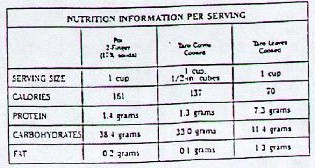
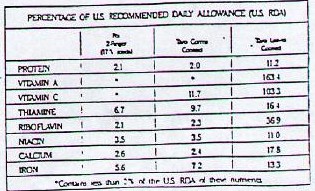
| Nutritional data on a one-cup serving of cooked taro
leaves are even more impressive, as it is low in calories, fulfills the
U.S. Recommended Daily Allowance (U.S. RDA) for vitamins A and C and is
an excellent source for other recommended nutrients in an adult's daily
intake.
In the dietetical field, poi has been shown to be an excellent food with many healthful attributes. Due to its small starch grains, poi is easily digested and is a helpful food item for people with specific health problems. Stomach ulcer patients might find poi a smooth and satisfying food well worth trying. It has also been a popular and ideal food for babies, the elderly and the sick. It has been a benefit to those who suffer from food allergies. Where neither milk nor grains could be eaten, poi, could be consumed with no adverse reactions. Because of its wonderful wholesome qualities, poi is ideal for people who must choose their diet carefully.
|
|||
| Pictures | |||