 Philosophers of Memory
450 BC Parmenides. Italy. That which we experience
as a memory of the past, must be in present existence when we experience
it. A recollection occurs now. What is experienced as recollection is not
exactly the same as what was initially expereinced in the past. A memory
is a type of description or re-enactment of a past experience. This entire
analysis is centered on subjectively experiences memory, which raises the
question, when in the course of history did the idea of unconscious memories
arise? Did the ancient philosophers distinguish between implicit (or proceedural)
and explicit (subjectively experienced) memories? (See Russell, page 51-52)
400 BC Plato. Athens. Deep into dualism.....perception
vs. reason as sources of knowledge and perception vs.
memory (See Russell, page 151-52). As we saw above, even
prelitarate people distinguished between mental activities like memory
and thought. Like a modern digital computer with Von Neuman architecture,
it is natural to think of our own minds as containing a memory store and
a separate processor that can produce thought by being able to manipulate
what is stored in memory. Plato divided the process of thought into four
parts: object, perception, conceptualization, and Form.
(source)
The Platonic Memory Model: "Imagine that there exists in the mind of
man a block of wax, which is of different sizes in different men; harder,
moister and having more or less purity in one than another... and that
when we with to remember anything which we have seen or heard, or thought
in our own minds, we hold the wax to the perception and thoughts,
and in that material received the impression of them as from the seal of
a ring; and that we remember and know what is imprinted as long as the
image lasts; but when the image is effaced or cannot be taken then
we forget and do not know."
"Imagine, again, there exists in the mind of man an aviary of all sorts
of birds - some flocking together apart from the rest, others in
small groups, others solitary flying anywhere and everywhere. When reaching
into this aviary to grasp a particular bird, I may emerge with the wrong
one such that when I thought eleven to be twelve I got hold of the ring-dove
which I had in my mind, when I wanted the pigeon."
It seems natural for us to now distinguish the object, its perception,
the raw and unconscious qualia that produce a primary and implicit P consciousness
(Ned Block) from conceptualizations, meaningfullness, and rationalized
and explicit A-consciousness. Reaching this point has been slow. When we
look at the reality of the brain, be see even greater complexity, a series
of mechanisms bridging from the quick and crude unconscious to the slow
and refined conscious. Does Art and philsophy "percieve" such a reality
bofore or after science makes it explicit? Or is it a long-drawn out process
of both of these interacting in order to ititeratively reach the correct
conclusion? Certainly in the case of the brain, there has been a long period
of blundering around before the required tools for a science of mind were
found.
Aristotle. Athens. Attempt to find a compatabilistic compromise
between Plato and materialistic monism. Substance dualism: soul as a special
functional substance that vitalizes living things.
Democritus or best atomist for coverage of mind.
220 AD Plotonius. Rome. Idea of the perfection of the soul
as involving a process by which the soul loses memory of wordly experience
and becomes only concerned with pure, abstract(?) thoughts. (See Russell,
page 292) Relate to "channeling" and access to "memorie of past lives"
and Freudiam ideas: access of childhood "repressed memories, etc.
1725 AD Berkeley. Representative of modern philosophers
debating the role of experience in the production of knowledge. Perception
producing Memory which is then availabl in thought as a source of knowledge.
(See Russell, page 656) Focus on ideas, not physical mechanisms (Jones,
893)
1750 AD Hume. Distictions discussed between memory
and imagination in terms of degees of vividness of the thoughts. Hume's
argument against the Absolute Truth of empiracle knowledge. (See Russell,
page 661)
1818 AD Schopenhaer. Germany. Process by which brains construct
our view of external reality is mostly an unconscious response to sensory
organ activity that leads us to only be aware of what is seen, not the
process by which we see. According to Jones, page 893, Schopenhaer is similar
to Berkeley, but more complex. Recognized that although we are only conscious
of the ideas produced by the brain, there IS a real physical basis to thought
that we are not aware of.A definition of knowledge in terms of that which
we can (infer?) about physical reality from our imperfect subjective experiences.
What we share with non-human animals in terms of mental capacities is more
important than that which is unique to man. "man's reason is more of a
liability than an asset" (Jones 894). Spontaneous insights come first (example,
Newton's idea of gravity) then the rational mind can express the idea in
a formal way (equation). Much concerned with all the error introduced by
rational thought. Tried to find a place for philosophy between the purity
of "intuition" for reality and the problems caused by mistaken rationality.
Focus seems to have been on aplying a type of austere logical analysis
as a selection process that will aid our understanding of intuition without
introducing the common errors of rationality. If all truth arises from
unconscious, then that needs to be properly nurtured and protected form
the too often crude desctuctiveness of rational thought. This is an escape
from the Platonic view that supposes that it is our conscious rational
thoughts that can contact Reality and make it known while the senses and
(usually ignored unconscious brain activity) is only a source of error
(world of objects in imperfect, world of pure reason can access Ideal Forms
and perfect truth).
Wow. Again, like Wittgenstein, struggling with selectionistic ideas
independent of understanding the concept of selection.
 1950
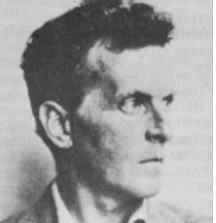
AD Wittgenstein. In Hallet,
page 640, cites Shoopenhaur as source of Wttgenstein's ideas on evolutionof
metal capacities. "what the eye is in space and for sensuous knowledge,
reason is, to a certain extent, in time and for inner knowledge. Role of
complexity in conscious experience, evolved complexity!
1950
AD Wittgenstein. In Hallet,
page 640, cites Shoopenhaur as source of Wttgenstein's ideas on evolutionof
metal capacities. "what the eye is in space and for sensuous knowledge,
reason is, to a certain extent, in time and for inner knowledge. Role of
complexity in conscious experience, evolved complexity!
"The False Prison" by David Pears provides us with an interesting metaphor
for the human condition. A visual metaphor for the false prison is the
Klein Bottle, a bottle that at first looks like it has an inside, but upon
closer examination we find that even though the bottle is closed (has a
continuous, unbroken surface), the inside is continuous with the outside.
 A Godelian Strange Loop, if you consciously recognize the importance of
the unconscious brain activities which support and can subvert conscious
brain activity, then you escape ideas of the infalability of rationality
and look towards the need for a careful selective process by which what
is correct in unconsciously produced ideas is pure and correct and need
only be made explicit in conscious thought without perverting it.
A Godelian Strange Loop, if you consciously recognize the importance of
the unconscious brain activities which support and can subvert conscious
brain activity, then you escape ideas of the infalability of rationality
and look towards the need for a careful selective process by which what
is correct in unconsciously produced ideas is pure and correct and need
only be made explicit in conscious thought without perverting it.
Can we interpret Wittgenstein as the pioneer in "subjective science",
a move within philosophy away from the methods of scientific objectification
of knowledge, understanding, and theorizing and a return to "philosophical,
or we might say, direct objectification from the Solipsistic perspective
which recognizes all of human knowledge as originating in personal experience.
Development of an epistemology that can return better balance to philosophy
by emphasizing the subjective part of human experience that we experience
as SELF rather than the "virtual reality" part of human experience which
we mentally accept as our awareness of the external world. In his Tractatus,
Wittgenstein tried to play the game of philosophy-as-objective-science;
he tried to levitate the complexity of human language and thought right
out of the human body and into the rarified domain of abstract theory and
formal systems. After failing to do so, Wittgenstein then decided to create
a new way of doing philosophy "from inside" human experience.
Owen Flanagon