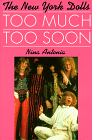
Needing a Make-over:
(Picture Source: amazon.com)
Review of Too Much, Too Soon: The Makeup and Breakup of The New York Dolls by Nina Antonia
by Annzaunt
It's surprising how little has been written
on the New York Dolls, one of the founders of punk rock. In fact, few book-length
studies of the Dolls exist--the only other is out of print--so Nina Antonia's
recent Too Much, Too Soon: The Makeup and Breakup of The New York Dolls
(Omnibus, 1998) examines a topic that certainly deserves study. Antonia,
a British rock journalist, has written for Mojo< and Record
Collector and has also written biographies of Peter Perett and the Only
Ones as well as Johnny Thunders. (The Thunders bio is no longer in print.)
Although it's always difficult to be the first person to take on a biographical
subject and Antonia clearly loves the band and wants to do right by them,
Too Much needs a bit of work.
The problems begin in the book's introduction when Antonia sets forth her
understanding of the Dolls: That they "put the Chaos Theory into rock'n'roll";
that they "irrevocably altered the course of rock'n'roll"; that
they "set new standards for rock'n'roll excess"; and that they
were "the archetypal, hedonistic rock'n'roll band." Bear
in mind, all of these statements appear in the course of less than a page
and are fairly arguable. Fans of Iggy and The Stooges, for example, might
disagree. Moreover, an introduction like this makes it difficult from the
outset to accept Antonia's objectivity, which is crucial to the success
of any biography.
Too Much c overs all of the Dolls' career, from its beginnings through
the band's collapse. More exhaustive treatment of band members' individual
histories would be helpful, and a stronger establishment of the historical
context--especially notions of gender--would also strengthen Antonia's case.
She tries to establish the major players as well as their contributions
to and detractions from the band: Johansen's amazing talent and his isolating
ego; Thunders' guitar work, image, and destructive addiction; Nolan's hold-it-together
drumming and his fatal drug abuse. Kane (generally in a drunken haze and
sadly under-represented here) and Murcia (who died early in the Dolls' career)
also emerge here, though not as strongly as Sylvain does because of his
substantial contributions to Antonia's research, whose narrative voice is
distinctive yet distractingly homophobic. Antonia's fact-finding is adequate,
and she's talked to most of the major players, though more material from
those outside the band but also in the New York punk scene would be helpful.
(For example, Lou Reed and Iggy Pop get mentioned, but are never quoted
or interviewed.)
What would a book about the New York Dolls be without pictures? Antonia
has included about 15 pages worth, and the photos she's selected show the
evolution of the Dolls' career and look (even those red vinyl outfits Malcolm
McLaren had them wearing at the end). These pictures are grouped together
in the middle of the text, though they would be more effective if placed
throughout the book at appropriate points to underscore Antonia's points.
Very distracting is the poor writing and editing of Too Much. Let
me share a few favorites: "Thunders' attack is sharper than a tatooist's
needle making its mark, but the outline is coloured by Sylvain" (30),
and "Thunders' guitar sound bucked and whinnied like a wild pony"
(33). Try this one out: "Life for Clyde was hard without Bonnie Thunders"
(192). It took me a minute to figure out that Antonia was describing how
Jerry Nolan might have felt following Johnny Thunders' death. This kind
of overblown prose pervades the book and, ultimately, undercuts its effectiveness.
I suppose the explanation would be that Antonia is trying to replicate with
her prose the outlandishness of the Dolls, but in the context of writing
a serious biography, her attempt fails.
Similarly, Antonia has only one way of integrating quoted material: After
giving exposition, she names the speaker, adds a colon, and then gives the
quote. Here's an example: "Then Sylvain spied a tantalising Les Paul
cutaway for sale and memorised the serial number. Sylvain: 'Me and Billy
forged a receipt with the serial number of the guitar we wanted and antiqued
it up . . . '" (32). You get the idea. In doing this, Antonia consistently
keeps reader separate from the speaker and, by extension, the band. In fact,
there's little sense that those interviewed speak for themselves; Antonia
keeps reminding the reader that she's in control by explaining how to interpret
something and then giving the text. This style, coupled with grammatical
errors, hurts the book's readability and reliability.
And that's too bad because the last two chapters are, at times, compelling.
(By this time, I must have gotten used to the quote integration.) At this
point, Antonia considers the effect Malcolm McLaren had on the Dolls as
well as how he appropriated ideas from them that he would later use to establish
the Sex Pistols. Her observations here are good, McLaren's poor understanding
of American culture and how it would receive "Red Dolls," the
label's abandonment of the Dolls in favor in Aerosmith, the role of ego
and substance abuse in the band's collapse. More analysis like this would
strengthenToo Much<, and, in addition, the book needs a better
introduction, not the gushy one Antonia's written. And the "Afterlife"/Epilogue
is a bit troublesome. In the course of 12 pages, Antonia touches on what
happened to the band members but is frustratingly vague. For example, Sylvain
found himself a single parent driving a cab and Kane was savagely assaulted.
Antonia mentions this, but never explains any of it, a real frustration.
Indeed, she spends more time describing what happend to the dead Dolls as
opposed to those still living.
Too Much Too Soon has its moments, but the New York Dolls are a central
American punk band; they need a better biography than this one.