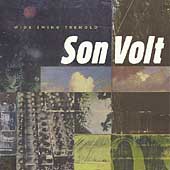
Jay Farrar, singer-songwriter of alt.country’s Son Volt, has for some time found himself in a difficult situation. A founding member of Uncle Tupelo, generally recognized as the inspiration of today’s alt.country scene, Farrar is often painted as the movement’s figurehead, a moniker he has repeatedly said he neither requested nor enjoys. Want it or not, Jay Farrar still carries a heavy historical burden; Wide Swing Tremolo, Son Volt’s third album and a haunting call for change, is Farrar’s response. Since “Drown,” his philosophy has been fairly clear: “When in doubt, move on / No need to sort it out.” With Tremolo, Son Volt further explores this theme while moving into new musical territory with an album that traces the waste land of paralysis that is the late twentieth century.
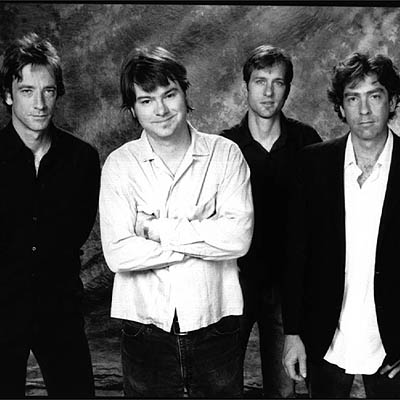
Farrar’s trademark is his imagistic songwriting, pieces of ideas that hint at parts of a whole. Consider, for example, these lines from “Right on Through”: “Break for the wayward / Pan for the stranger / We’re all in this danger / Said the screed on the wall,” an oblique reference to contemporary dogma. Making the writing even more powerful is Farrar’s voice, a mournful baritone, tired but always honest. Joining Farrar in Son Volt are Dave Boquist (guitar, lap steel, fiddle), Jim Boquist (bass), and Mike Heidorn (drums). In recent interviews, the band has repeatedly noted the effect their recording situation had on Tremolo. They worked at their own pace, in their own studio, freely experimenting with instruments not traditionally associated with Son Volt, though the band continues to meld musical genres such as rock, blues, country, and folk. That Son Volt is exploring new ground is apparent from the disc’s explosive opening, the angry “Straightface” with its ragged garage sound and distorted vocals.
Son Volt then takes the listener through a waste land as barren with personal, cultural, and political paralysis as any found in T. S. Eliot’s poetry. But here, Farrar is Tiresias, the central consciousness who is, at times a participant, such as in “Question”; at others, he is the apocalyptic prophet, foretelling disaster. Consider “Medicine Hat,” with its declarations: “There will be droughts and days inundated”; the repeated, “There will be right, there will be wrong”; and, the final insight, “The time is now to be on the run.” Farrar’s waste land has its version of Eliot’s “Hollow Men” (with their “[h]eadpiece[s] filled with straw” and “dried voices” that “[a]re quiet and meaningless”) as seen in “Dead Man’s Clothes.” The narrator, with a distorted vocal set against a dirge-like drumbeat, describes “Just hollow legs and hollow platforms / Kickback parties and raising dimes.” This suggests a critique of American politics until the speaker confesses, “I’m going downtown / In a dead man’s clothes.” The observation is clear: We are all living in dead men’s clothes. We are the Hollow Men.
 To leave Farrar’s waste land, we must move past the paralysis of Prufrock’s “patient etherized on a table.” Perhaps nowhere is this more obvious than in “Streets That Time Walks”: “Beliefs from the status quo picture / Drop down like from a drip dispenser / And too many pasts can lead to / One-way talk with only the darkness.” It is action that moves us into the light. Such lines also call attention to Farrar’s careful poetry and his love of sound. The “d’s” here, for example, replicate the sounds of dispenser slowly releasing deadening moments from the past.
The journey ends with “Blind Hope.” There is a sense that the speaker, who has described such danger and disillusion throughout the journey, has arrived at some kind of understanding, even though he “[s]aw no revelation.” The music is positive, upbeat and lacking the darkness and distortion found in other parts of the album--especially two musical fragments, “Chanty” and “Jodel”--with the traditional Son Volt pedal steel making a rare Tremolo appearance. The message, however, is more ambiguous. The narrator explains: “Don’t mind and don’t regret it / Just move on.” That is, leave the stasis, the trap that is the past, behind. Indeed, Tremolo ends not unlike Eliot’s The Waste Land, for there, Tiresias fishes, waiting for rain, with the waste land at his back. Such an act is not chance, for the fish traditionally symbolizes life and regeneration. Similarly, Farrar’s speaker finds himself “Casting out, reeling in / Living on blind hope again.” He chooses to live, not to give in to the desperate “blue side” described in “Trailing the Blue Side” (interestingly enough, perhaps the most traditionally sounding Son Volt track on the disc), even though he realizes that what he’s chosen to believe may be a fiction. Something unusual happens at the end of “Blind Hope”: The music gets louder while Farrar mutters a string of unintelligible words before articulating, “That’s it.” It is the end of the journey; now we are responsible for our own motion.
Modernist artists were known for their conscious break with a tradition they saw as deadening, which brings us back to Wide Swing Tremolo and its title. In “Strands,” the speaker makes references to “a wide swing tremolo,” which provides solace when there is “No mercy in a pokerface / . . . / No sentence yet decided / Just a wide swing tremolo.” Most dictionaries define “tremolo” as “a perceptible rapid variation of pitch in a musical tone.” Certainly Tremolo, in the best modernist tradition, illustrates such a variation on a number of levels and urges us, as listeners and fellow travelers, to make our own changes.
For information on subscriptions or submissions, visit the journal's website,
or email Editor Gary Burns; for review information, email Reviews Editor George Lewis.