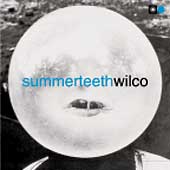
When asked about the title of Summer Teeth, Jeff Tweedy, lead singer of alternative country darling Wilco, answered, “It was just a phrase we thought fit the record. It’s hard to name something these days without there being a direct connotation that immediately comes to mind.” He added, “‘Summer Teeth’ comes from a bad joke. Like ‘I’ve got summer teeth--some are, some aren’t’” (Joshua Green, Salon). Tweedy’s words provide the key to Wilco’s third album, which rests on a lack of connotation, a kind of freedom for a band leaving behind an alt.country label they’ve carried since before their inception.
As in Tweedy's joke, things on Summer Teeth never seem to fit quite right. For example, the first track has an uplifting, almost choir-like opening and a pop, upbeat sound, but soon the narrator points out, “No love’s as random / As God’s love,” and by the close, Tweedy is screaming the song’s title, “I Can’t Stand It.” This kind of tension and instability is the genius that drives Summer Teeth.
The album is a complex music stew, the band’s re-vision of its musical heritage, with some Beatles and Beach Boys, a little Velvet Underground, a touch of Lovin’ Spoonful, and lots of other voices thrown in--and with Phil Spector overseeing the whole concoction. But to write off Summer Teeth as a rehash of AM radio’s glory days, as many critics have, is to miss much of the disc’s lyrical and musical complexity and cohesiveness. This isn’t a repeat of 70s pop music; it’s a postmodern exploration of relationships that takes the music and themes of Wilco’s predecessors and places them in a new context.
With Summer Teeth, Wilco charts its progress away from alt.country. On only a couple of songs is a banjo or pedal steel vaguely discernible; instead, Wilco serves up a disc of pop music that relies heavily on keyboards and synthesizers--complete with backing “oohs” and “ahhs”--an occasional Mellotron or chamberlin, perhaps a brass band, and even birds chirping. While Tweedy sings and assumes various guitar and keyboard duties, Jay Bennett plays guitar, keyboards, and synthesizers, John Stirratt frets on bass, and Ken Coomer adds percussion. While the music can be heard as light pop, it is juxtaposed with a complex and lyrical darkness. At times, even the music dissolves into chaos, unable to fight off the despair always crouched at the edges of the light. The tension is relentless. Although the disc’s liner notes indicate that all songs are by Wilco, interviews suggest that the bulk of the lyrics are Tweedy’s, and his writing has never been better; it’s more overtly poetic and rhetorical. Tweedy populates Summer Teeth with a kaliedoscopic cast of changing “I”s who explore relationship issues: love, isolation, power, homelessness, fear, and honesty, and tells these stories in a voice as strong as his writing, a baritone weary with resignation but always cautiously hopeful.
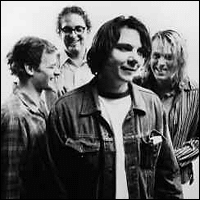 Wilco Then | 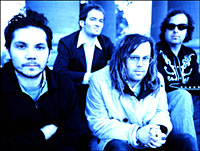 Wilco Now |
The initial tension builds on “She’s a Jar” with an acoustic guitar opening that soon finds itself fighting synthesizers for control. What at first seems to be a love song, with the narrator describing his lover as a “jar with a heavy lid,” a “sleepy kisser” and a “pretty war,” grows troubling with Tweedy’s almost automaton delivery against a backdrop of electronic chaos. That this is not a love song is increasingly apparent, and as the song ends, Tweedy repeats the opening description, this time ending with an abrupt “She begs me not to hit her.” Becoming clear is the deceptiveness of the opening, much in the way that domestic violence often remains hidden.
Similarly, the next track, “A Shot in the Arm,” explores power in relationships. Tweedy’s opening image, “The ashtray says / You were up all night,” illustrates how damaged this relationship is; the partners depend on others--even inanimate objects--for communication. From there, the song dissolves into a Velvet Underground/Lou Reed “Heroin”-like scream with “What I really need is a shot in the arm” repeated in a frenzied attempt to persuade the speaker of the statement’s veracity. The song’s last line, “What you once were isn’t what / You want to be anymore,” illustrates the source of the speaker’s panic: fear of change and isolation.
Wilco explores emotional situations, from the scared devotion of “We’re Just Friends” and the manic euphoria of “Nothingsevergonnastandinmyway (again)” and “I’m Always in Love” to the emotional fear of “Pieholden Suite” and the effects of art on a relationship. “When You Wake Up Feeling Old” is the upbeat song of a artist telling his partner how important she is, “bring[ing] the song to life,” while “Summer Teeth” is the story of an isolated writer who commits suicide. Complicating these diverse narratives is Wilco’s music, at times pure pop, at times a barely controlled chaos.
Perhaps most prominent is “Via Chicago,” opening with an emotionless Tweedy singing, “I dreamed about killing you again last night / And it felt all right to me.” His voice is isolated as he describes the twisted love of an unhinged speaker who fantasizes about watching the “hot cold” blood of his victim “run away . . . / to the sea.” The song centers on the singer’s repeated promise, “I’m coming home / Via Chicago.” In the last verse, he comes “home” to find his scared lover silently crying, “crumbling ladder tears don’t fall / they shine down your shoulders.” From there, the narrator moves into an imagistic rape/murder: “Crawling is screw faster lash / I blow it with kisses.” After that, the speaker, resting “on a pillowy star,” while “a cracked door moon / Says I haven’t gone too far,” finds something comforting in his actions. The music is as distressing as the lyrics, and musical distortions cut through and confuse the narrative, which ends with a final “I’m coming home / Via Chicago,” as Tweedy’s voice breaks with emotion. It is an unnerving moment.
Not all of Summer Teeth is so dark. The lullaby “My Darling” tells the words of a parent soothing a child. But when the father sings, “And be sure, darlin’ / To make the good times last,” there is a sense of delayed inevitability. A parent can only protect a child for so long; adulthood brings with it real nightmares--like those of “She’s a Jar” and “Via Chicago.” “In a Future Age,” the last listed track, treats life as a transcendent natural cycle based on the narrator’s Shakespearean realization: That we “mark our page / In a future age,” or live on through art. To say Summer Teeth has a positive vision perhaps overstates things, but there are moments of hope.
Included are two bonus tracks: “Candyfloss,” an upbeat number that reiterates the disc’s early false enthusiasm, and an out-take of “A Shot in the Arm” emphasizing acoustic guitar, though it remains the same unsettling song. When Tweedy sings the final words of Summer Teeth, “What you once were isn’t what you want to be anymore,” the line takes on new meaning, for in this context, it also points to how Wilco wants to be seen--as an evolving band that defies labels while complicating itself and its musical history.
This one definitely has teeth.
For information on subscriptions or submissions, visit the journal's website,
or email Editor Gary Burns; for review information email Reviews Editor George Lewis.