Satanic magic is best explained by use of Jungian psychology. Basic Jungian principles (the archetype, collective unconscious, the functional complex, the Self and perhaps at some later event, synchronicity) are discussed.
Sigmund Freud developed the idea of pyschoanalysis. According to Freud, man's behaviour is governed by his mind. Freud believed in a Conscious and a Subconscious. Each 'layer' of the mind has specific functions.
The conscious is the method in which the mind allows the individual to act and to relate to reality. The conscious mind has two basic components: the ego and superego. The ego is the element that recognizes an object. It is what, specifically, makes the person aware of an external reality. You know that you are looking at a computer screen because that is what the ego tells you: it connects the visual image with the internalized essence applied to the object it perceives. The superego is the conscience. It is influenced by values taught by both the parents and society. It restrains the subconscious desires.
The subconscious has the element of id. Id is an unrestrained desire. It is not aware of what it desires, because it cannot relate to the external world. It wants everything, literally. The superego, manifested as conscience, restricts what the id can obtain. The psychic energy which gives rise to both the conscious and unconscious is the libido, energy of a sexual nature in Freudian thought.
A complex, according to Freud, results when a repressed idea, desire or memory cannot be defeated. Basically, when it is repressed, it retains energy and saps that energy from the mind. The id begins to take control, and the superego relinquishes its hold over the id, manifesting in behavioral problems. The basic tenet of pscyhoanalysis is when the conflict in the mind, which exists because the superego (i.e. moral standards) clash with a strong desire, having instinct as a base, is recognized and defined. This is supposed to result in the destruction of the complex.
Jung and Freud disagreed on many points. Jung believed that complexes can be more (for lack of a better word) complex than Freud suspected. When he came close to discovering the actual complex in the mind, he noted a great degree of energetic presence, a degree so high that it seemed impossible that a human brain could give off so much psychic energy. He came to the conclusion that certain complexes have, at their root, not conflicts between superego and id, but the influence of certain unconscious behavioral tendencies he called archetypes. These complexes have a function in regard to the mind: hence the term functional complex.
Archetype is defined as "the symbolic manifestation of all instinctual or unconscious behaviours inhertited through the experience of race, family or tribe, given a certain type of 'form' from latent energy that is projected by the mind of an individual". In other words, it is a throwback to an earlier time. Archetypes are symbols representing unconscious behaviour that is genetically linked to the race, family, "tribe", and the species, of an individual. Events that occur on a very wide scale with an emotional response to it create archetypes that are biologically linked to the mind. Archetypes influence conscious behaviour: can anyone tell me why funerals are conducted in black in the Western world, while they are regarded as celebrations in the East? Or why Christmas is so often marked by wreaths? Behaviours that seem perfectly normal and socially acceptable but don't seem to have any rational basis for existing, are often archetypes.
As was said before, archetypes can be the basis of complexes, and when this is so, the complex is a good thing. The ego, in the Jungian sense, is a functional complex, as is the self, the persona, the animus (for women) and the anima (for men).
The archetype cannot exist within the realms of either conscious or subconscious. It requires far too much energy to exist. So, Jung conjectured that a third realm must exist, in which the archetypes (and which the "inherited predispositions" that result in the construction of the archetype) may be stored.
Freud had previously categorized the mind with two layers: the conscious and the subconscious. According to Freud, the conscious deals with neural impulses (the five senses), allowing reality and individual to relate. The subconscious deals with the natural human drives and certain thoughts/desires that the individual cannot deal with about him or herself. These thoughts/desires are repressed in the subconscious giving rise to complexes and manifesting themselves in everyday activities.
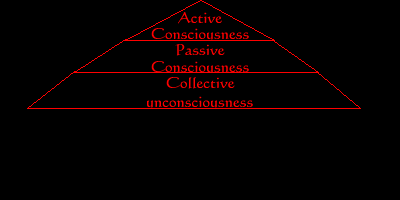
Jung theorized that there was actually a third layer of the mind. This idea led into the concept of the collective unconsciousness. Imagine this as a pyramid:
To Jung, the conscious can focus itself only on a few specific tasks at once. It cannot perceive too many things, because it has a very small capability for perception. He felt that the three layers act and coexist with one another, each one peforming seperate functions without the knowledge of the individual. The collective unonscious serves as the area from which all possible archetypes originate.
Jung would probably object to my diagram above of the psyche, because it implies that the unconscious is somehow below the other two layers. It is not. Jung described the unconscious as being on all sides around the conscious, surrounding it.
The unconscious is a scary beast. It is made up of the memories and instincts passed down by heredity from generation to generation. The unconscious behaves as if it collects all the memories of life that existed before the individual.
In addition to the ego, id (having various possible bases for mental activity), and the superego, Jung believed in the Self. The Self deals with all things residing in, or related to, the conscious and unconscious. There are two aspects of the Self: the Shadow and the Persona. The Shadow is the collective negative qualities of the personality, and the Persona is the qualities of the personality that the individual displays in relationship to other people: it has charateristics that the individual finds to be preferable and serves as a medium for communication and socialization. The aspects of Shadow and Persona are subjective: that is, the qualities of each are relegated to that particular functional complex (for that's what they are) based on how the individual views them to be good or bad.
At this point I feel that the reader should have a rather useful idea of the Jungian mode of thought. I think it is now pertinent to explain the concept of reality. These three short rules were developed largely by myself, based on metaphysical philosophy and Subjectivism:
1)Time, space and motion are illusions. Because of the limited capacity for perception in the conscious mind, not all things can be sensed as they actually happen (see subliminal perceptions, which are not consciously percieved, but recorded independant of consciousness). All occurences happen in a point that does not exist in a dimension of time and space. The mind breaks them down and orders events in a way that it deems is logical. This succession gives the individual the illusion that things move--if they must move, then it can be said there must be a way of quantifying that movement: hence the idea of time. And if objects move, they must have a destination and trajectory: space. These factors can be altered by archetypal influence, because archetypes continually effect conscious perception. Some people can predict future events because the unconscious already knows what will happen: it then changes its perception of time by removing psychic contents from consciousness, and replacing them with unconscious contents for a period of 'time'. When this unconscious content is an archetype, an event can occur simultaneously, coinciding with another event, usually related in some symbolic way. This event may reoccur at times when a new occurence appears that is similar with the original occurence which happened in the presence of the archetype as it was briefly in the conscious (this is where omens come from, and is the basic principle of synchronicity, an important part of magic in general).
2)Reality is not absolute--it is subjective. The only two factors involved with reality are potential and perception. These are interrelated. There is a potential to perceive reality in an infinte amount of ways. The mind controls what is real, and what is real can be modified by directing the way it is perceived. Think of reality as a wheel with spokes pointing in all directions and the potential road of reality as each spoke. The individual chooses in his or her mind which 'spoke', or 'road', they will perceive.
3)Nothing is inherently 'good' or 'evil'. Classical philosophy holds that both good and evil are value standards independant of the human (this is known as Objectivism). On the other hand, more modern philosophy says that the individual chooses for him or her self what is good or evil (called Subjectivism). Or, at least, morality and value in general is a subjective matter--constructed either through psychological constants, evolution, or biology. In this way, morality is independant of the words "good" and "evil": the basic point of Nietzche's great work, Beyond Good and Evil. When moral codes lose their usefulness, new ones are adopted in their place (Nietzsche's "transvaluation of all values").
Now I ask the reader to combine the Jungian view with that of the metaphysical view. The purpose for magic in the Satanic sense for the Warlock (or Witch if you are female) is to delve into the realms of the mind where reality is perceived and to direct which 'road' will be experienced by the magician. This is done simply by willing the change in reality...it can be said that Satanic Magic in it's loosest sense is simply any act of concscious will.