Structure of the Agreement
The Agreement on Agriculture is made up of the following parts:
1) The text of the Agreement itself, comprising 25-pages of articles and annexes covering three major sections: market-access, domestic support and export competition.
2) Country Schedules where each country had to calculate their suggested commitments on such matters as tariff rates and export subsidy constraints.
3) The ‘Modalities’ section which specifies both the reduction percentages and the calculation methods, as well as technical details regarding the commitments to be undertaken.
Parts 1 and 2 are legally binding documents. The Modalities paper is
not. Therefore, aspects which are not fully reflected in the schedules
of individual countries but which are described in the Modalities document
cannot be used as the basis for dispute settlement proceedings.
Period of Implementation and Review(return to index)
The implementation period of the Agreement is from 1 January 1995 to 31 December 2000, or 6 years for developed countries. Developing countries were given 10 years to undertake reduction commitments.
Countries agreed in the Agreement to continue the process of reductions of support and protection beyond the implementation time-frame. Hence, a review process will take place by the end of 1999, one year before the end of the implementation period for developed countries.
Key Provisions of the Agreement on Agriculture (return to index)
The main provisions of the Agreement on Agriculture fall into the following 3 categories:
· market access
· export competition and
· domestic support.
Table 1 gives a summary of these provisions. The provisions are either price-related (reductions in monetary outlay by governments or cuts in tariffs), or quantity-related (reductions in the volume of goods either allowed into a country or reduced in terms of subsidies provided).
Developing and Least Developed Countries (return to index)
Reduction rates for developing countries are two-thirds those for developed countries, and stretch over 10 years instead of 6. Least developed countries have to bind their tariffs and provide minimum access quotas for imports but are exempt from any reduction commitments.
Table 1: Main Provisions of the Agreement on
Agriculture
|
|
(Base: 1986-8) |
(Base: 1986-90) |
(Base: 1986-8) |
| Price | Tariffication of non-tariff barriers for all countries
Developed countries: Reduction of new tariffs by 36% on average, and minimum of 15% per tariff line. Developing countries:Reduction of tariffs by 24% on average, and minimum of 10% per tariff line |
Developed countries:Reduction of outlays on export subsidies by 36% (product specific) Developing countries: Reduction by 24% |
Developed countries: Reduction of total AMS by 20% except
for ‘green box’ measures
Developing countries:Reduction by 13.3%
|
| Quantity | Developed countries:Minimum access commitments:
3% of domestic consumption growing to 5% by 2000
Developing countries: Minimum access: 1% rising to 4% in 2004 Current access maintained by all countries |
Developed countries: Reduction of subsidized export
by 21%
Developing countries:Reduction of subsidized exports by
14%
|
|
| Other | Safeguard provisions | Due Restraint clause | Due Restraint clause |
3.1. Market Access(return to index)
Market access is the extent to which a country allows the importation of foreign products. Countries have traditionally used both tariffs and non-tariff measures (such as quotas and variable levies) to regulate imports of agricultural goods. The market access provisions aim to regulate and lower protectionist barriers to trade.
The provisions relating to market access have to do with
a) tariffs, and
b) minimum and current access volumes / quotas.
Tariffs
· All existing tariffs are to be bound, that is, fixed. Countries can only reduce bound tariffs when complying with the AoA tariff reduction commitments. Bound tariffs cannot be increased.
· All non-tariff barriers (border measures other than simple customs duties) must be converted to tariffs. This is usually termed ‘tariffication’. The tariffs should work out to be equivalent to the barriers that were in place in the base reference period of 1986-88.
· All tariffs must be reduced over a period of six years by an average of 36 per cent for developed countries. Reductions are 24 per cent for developing countries over 10 years.
This is an unweighted average. That is, some items can be reduced more than others as long as the aggregate works out to the required 36 or 24 per cent. However, each tariff line must be reduced by at least 15 per cent for developed countries, and 10 per cent for developing countries. The reductions are to take place in equal annual steps.
· There are two exceptions to tariffication:
- When circumstances allow for countries to use the Special Safeguard
Provisions (SSG)
- Those countries which are covered by the Special Treatment Clause
with regard to specific commodities. (These are
elaborated upon later.)
Minimum and current access quotas/volumes(return to index)
The relevant provisions on current and minimum access are contained in the Modalities section of the Agreement and are therefore legally binding only if they had been translated into specific commitments detailed in the country schedules. The only mention in the text of the Agreement to market access provisions refers to ‘other market access commitments as specified’ in the Schedules.
· In products where there are no significant imports, developed countries must provide minimum access opportunities for these products at the rate of 3 per cent of 1986-88 domestic consumption. This 3 per cent access was to commence in 1995 and rise to 5 per cent by 2000. For developing countries, it is 1 per cent rising to 4 per cent by the tenth year in 2004.
It is important to note that this provision on minimum access does not require a country actually to import a given volume, but rather to establish an access ‘opportunity’. Within-quota tariffs are to be low or minimal, but no general formula was agreed as to what that meant in quantitative terms. Whether or not real access actually exists is open to differing interpretations.
· For items that had been newly tariffied, and where current access opportunities have become less favourable than those in the base period, tariff rate quotas must be established at quantities imported in 1986-88.
· If the volume of access at the time of implementation in 1995 had already exceeded the minimum access commitment (3 per cent of 1986-88 consumption), the 1995 volume had to be maintained and increased.
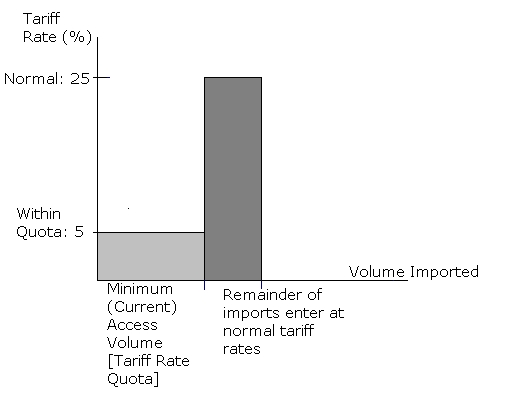
· In general, countries have created current and minimum access opportunities by allowing imports of specified quantities at a second tariff lower than the usual tariff rate. This lower tariff is often referred to as the ‘within-quota tariff’. The quantity of goods imported at this lower tariff rate is sometimes termed the ‘tariff-rate quota’. See Figure 1.
However, this is not a rule. A country may not have provided a second lower tariff rate because it considered that minimum access opportunity would be available at the ‘normal’ tariff rate.
· Tariff-rate quotas resulting from minimum access commitments are to be allocated on a most-favoured nation (MFN) basis, that is, it should be equally available to all countries.
Special Safeguard Provision
The Special Safeguard Provision was designed to protect domestic markets from disruption as a result of import surges or abnormally low world prices. It allows additional duties to be imposed to control these disruptions.
· The Special Safeguard Provision (SSG) can be invoked for commodities which have been subject to tariffication. They only apply to imports over the tariff-quota volumes. It allows countries to impose additional duties in the event of a surge of imports in terms of volume (quantity-triggered), or a low price based on already established trigger levels (price-triggered). Only one of these can be invoked at any one time.
· When the SSG is invoked, the additional duty may not exceed one-third of the ‘normal’ customs duty in effect for the commodity. Also, the additional duty can only be maintained till the end of the year in which it was introduced.
There is some uncertainty regarding the operation of the SSG as some countries did not specify their reference prices in their schedules.
Special Treatment Clause or ‘Rice Clause’
This clause allows for the postponement of tariffication and was included at the end of the negotiations on the insistence of Japan and Korea to allow for some level of protection of their staple product (rice).
· The Special Treatment Clause comes in two forms -- for developed and developing countries. For developed countries, it allows tariffication to be postponed until at least the end of the implementation period (2000). For developing countries, tarrification can be postponed for 10 years, until 2004.
· In return, developed countries must grant minimum access of 4 per cent of the base period domestic consumption in the first year of implementation (1995), rising to 8 per cent by 2000. Developing countries must give access of 1 per cent, rising to 4 per cent also by 2000.
· Where countries wanted to make use of this Special Treatment clause, they had to declare it in their schedules.
Only 4 countries chose to make use of this clause, hence the use of this provision is limited. Japan (developed country clause), Korea and the Philippines (developing country clauses) applied this provision to rice. Israel (developing country clause) applied it to sheep and goat meat, cheese and milk powder.
Conditions countries must satisfy before qualifying for special treatment:
1) Imports of the product in the base period must be less than 3 per
cent of domestic consumption
2) Export subsidies must not have been provided in the base period
3) The commodity concerned must be the predominant staple in the traditional
diet.
· If Special treatment is to be continued after the implementation period of the current agreement, then ‘additional and acceptable’ concessions must be granted and these concessions will be determined by negotiation.
Should further negotiation not take place, there will be full tariffication while maintaining the existing access, which by then will have become 8 per cent and 4 per cent for developed and developing countries respectively.
The tariff applied will then be the tariff equivalent of the 1986-88
base period reduced by at least 15 per cent (as stipulated in the market
access provisions).