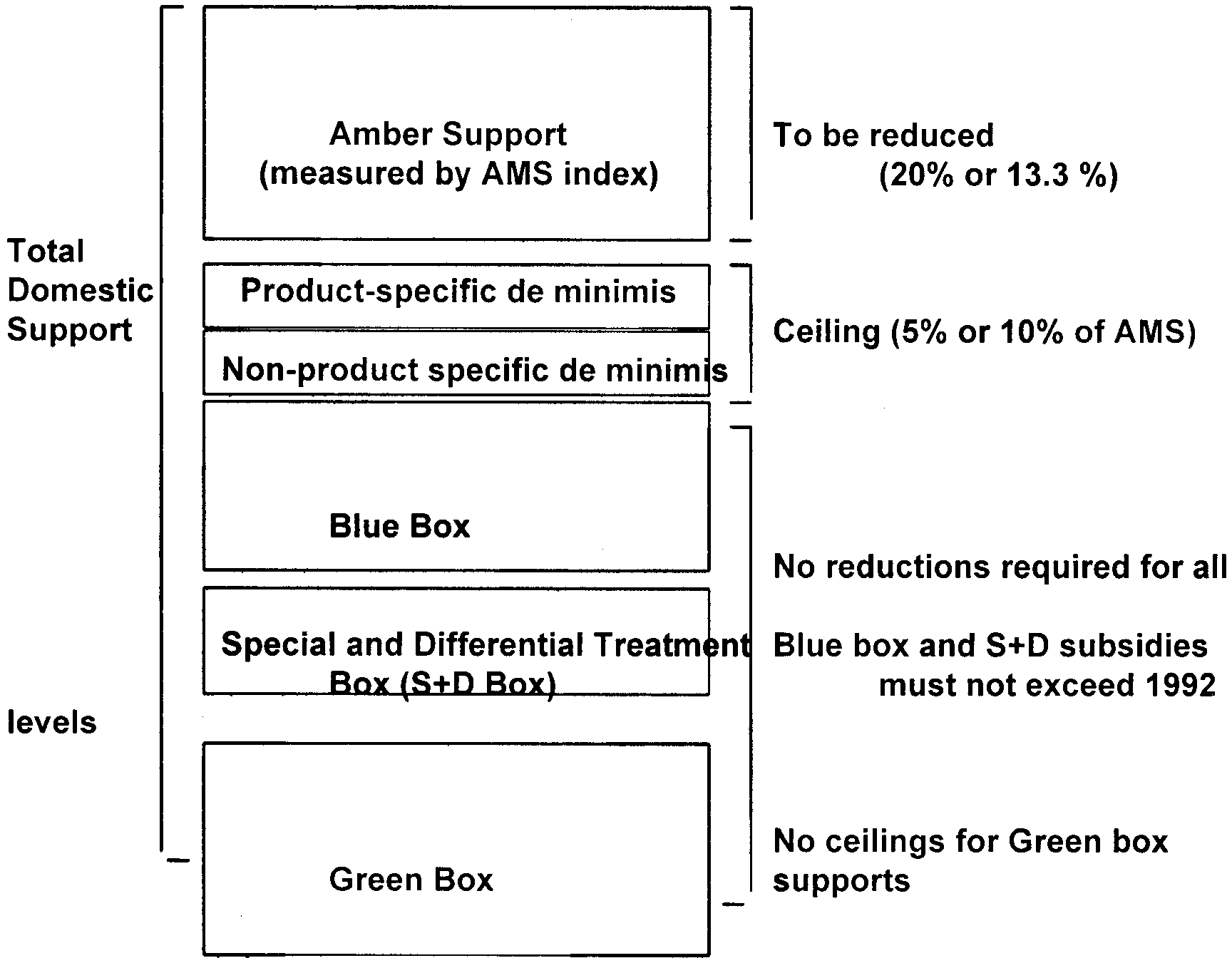
Domestic support is the annual monetary support given by the government to agricultural producers either for the production of specific agricultural products, or in more general forms such as in infrastructure and research.
The AoA classifies supports into several categories -- those that are
acceptable because they are minimally trade distorting, and those that
not acceptable as they are obviously trade distorting; those that have
ceiling levels and those which do not have ceiling levels (as illustrated
in Figure 2).
Categories of Support in
the Agreement on Agriculture (return to index)
Support levels to be reduced:
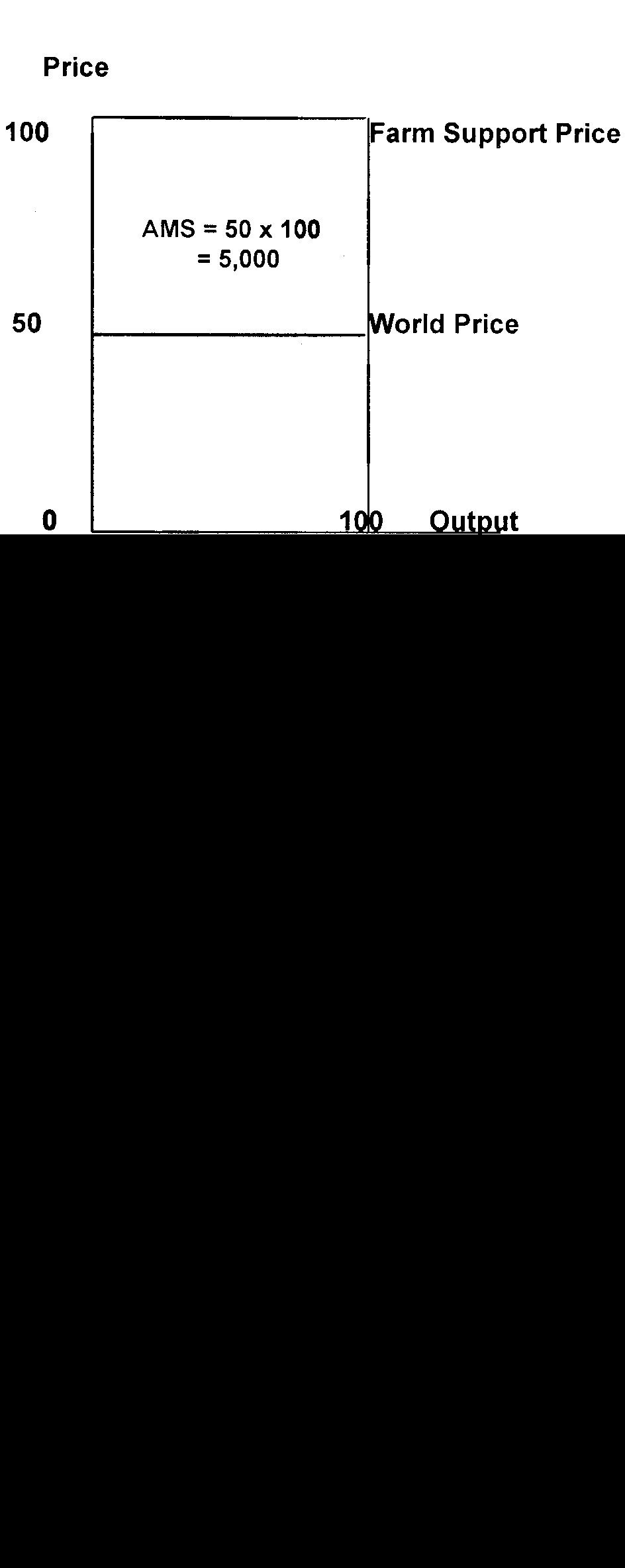
Amber Box: Subsidies measured by the Aggregate Measure of Support (AMS)
·The supports which are considered to be production and trade distorting and are together measured by an index termed the Aggregate Measure of Support (AMS). Three elements are included in the AMS calculations:
AMS support for individual commodities must exceed 5 per cent of the
value of production before the support is deemed part of the AMS (otherwise
it is considered as de minimis support allowable under the AoA, see
below).
Supports which have a ceiling
level: (return to index)
Product Specific De Minimis-related Support / Non-product Specific De Minimis Support
The de minimis clause allows countries to maintain a certain level of
AMS. For developed countries this level can be up to 5 per cent of the
value of production for individual products (product specific support),
and 5 per cent of the value of a country’s total agricultural production
(non-product specific support). For developing countries, support of up
to 10 per cent is allowed.
Supports which have 1992 ceiling
levels but are exempted from reduction commitments:
(return to index)
Blue Box: Direct Payments under Production-limiting
Programmes
The popularly termed ‘blue box’ was created in the final negotiations
of the AoA by the US and EU to specially a allow both the US and the EU
to maintain their payments provided to their farmers under production-limiting
programmes.
The blue box was especially important for the EU as it meant that the EU did not have to radically change its CAP policies which were politically very sensitive in the EU countries. Payments under the EU’s production limiting programmes were provided by the EU’s Common Agricultural Policy (CAP) for cereals and other arable crops to reduce the EU’s agricultural output and therefore raise prices. Blue box payments amount to tens of billions for the EU.
US’s deficiency payments were also exempted from reductions under this blue box category since compliance with acreage reduction programmes was required for eligibility. Payments were made on no more than 85 per cent of established base acreage, and individual farm yields had been fixed since 1986. Deficiency payments bridged the gap between a the national average market price and a politically determined target price to support farm incomes which were set by the US Department of Agriculture (USDA). For example, if the target price was $16 a bushel, and the market price was $12, farmers were awarded $4 by the USDA.
However, the US 1996 Farm Act (FAIR) completely replaced deficiency payments with production flexibility contract payments (which fall under the Green box). US government supports are therefore no longer covered under the blue box.
Though this provision obviously targeted the EU and US, it is general and can be invoked by any country. This form of support though is not an option developing countries would consider as most are dealing with land and financial constraints.
Special and Differential Treatment Support (return to index)
The AoA allows special and differential treatment to be given to developing
countries in two areas. Developing-country governments can provide
1) investment subsidies (i.e., easier access to credit)
2) input subsidies generally available to low-income or resource poor
producers.
Governments may also provide support to producers to encourage diversification
from the growing of illicit narcotic crops.
Note that while these subsidies are allowed, they operate under the due restraint clause so that subsidy amounts cannot exceed 1992 levels. As with the blue box supports, should the 1992 level be exceeded, commodity specific subsidies will lose the protection of due restraint under Article 13 (see below) and the country can be challenged by another WTO member under other relevant GATT provisions and the WTO Agreement on Subsidies.
Supports which are exempt from reduction and have no ceilings: (return to index)
Green Box: Minimally or Non-trade Distorting Policies
This is a colloquial term which commonly refers to a long list of domestic support measures which are considered (in some cases speciously) to have no, or only minimally trade-distorting effects. Two criteria are given for green box supports.
· Supports must be paid out of the government budget and not levied
from consumers
· Supports must not have the effects of providing a price support to
the producers.
Countries have a lot of freedom in implementing green box type subsidies as there are no restrictions on subsidy amounts. The ‘due restraint’ clause does not stipulate a ceiling level for green box policies, as it does for blue box and special and differential treatment supports.
Table 2: Summary of domestic support policies exempted
from reduction commitments
| Description | Characteristics |
| 1. General
Policies which have no or minimal production or trade distortion effects |
Should not involve transfers from consumers or provide price support to producers. |
| 2. Government service programmes
· research · pest and disease control · training services · extension and advisory services · inspection services · marketing and promotion services · infrastructure services · infrastructural works associated with environmental programmes |
|
| 3. Public stockholding for food security purposes Should be predetermined targets. Sales and purchases to be at current market prices. | |
| 4. Domestic food aid | Direct provision of food or the means to buy food. Purchases by government to be at current market prices. |
| 5. Direct payments to producers | As under 1 above |
| 6. Decoupled income support | Eligibility to be determined by reference to income or status for a fixed base period unrelated to type or volume of production, factors of production or price other than in the base period. No production required to receive payment. |
| 7. Income insurance and safety net programmes | · Income loss at least 30 per cent of gross income
· Compensation for less than 70 per cent of actual loss · Related solely to income · Cumulated with disaster payments should not exceed 100 per cent of the loss |
| 8. Natural disasters
Structural adjustment assistance: |
· Only in respect of losses in income, livestock, land or other production
factors and should not exceed replacement costs. Should not specify future
production.
· Cumulated with (7) above, should not exceed 100 per cent of the loss.
|
| 9. -- Producer retirement
10. -- Resource retirement
|
Total and permanent · Land for a minimum of 3 years, livestock, permanent withdrawal
|
| 11. Investment aids | · Restructuring or reprivatization· Non-commodity specific |
| 12. Environmental programmes | · Related to fulfillment of specific conditions including production methods or inputs under government programmes. Payment limited to increased costs or income loss due to compliance with the programme |
| 13. Regional assistance programmes | · Producers must be in disadvantaged regions
· Compensate for loss of income or extra costs in undertaking production |
SOURCE: The Uruguay Round: A Preliminary Evaluation of the Impacts of the Agreement on Agriculture in the OECD Countries, OECD 1995.
The most controversial of these green box measures are those payments which make up ‘decoupled income support’. US direct payments in terms of ‘production flexibility contracts’ fall under this category. They replaced the blue box deficiency payments. They are considered de-coupled because the link between prices and production levels is broken.
Production flexibility contract payments (PFCPs) were introduced in the 1996 Farm Act for contract crops from 1996 - 2002. PFCPs are financed by the Congressional budget and have essentially been predetermined for the entire period of 1996-2002. Independent of production, market prices, changes in input prices, inflation or exchange rates, PFCPs have been allocated based on the March 1995 forecast of what deficiency payments would have been for 1996 to 2002 under the 1990 farm legislation. PFCPs in 1997 totaled $6.4 billion. However, unlike deficiency payments, PFCPs have been put on a descending scale, so that by the end of the seven years of implementation, US farmers would receive nil payment. By 2003, however, a new farm bill will be in place. It is therefore anyone’s guess what forms of decoupled payments, if any, would be legislated then.
Due Restraint or Peace Clause(return to index)
The Due Restraint Clause or ‘Peace Clause’ sets a 9-year period during which green box, blue box, de minimis supports and special and differential treatment supports are exempt from GATT challenges. Competing countries are not allowed to impose countervailing duties on these subsidies. The clause operates in two forms:
For green box policies -- there are no ceiling levels to the amount of subsidies allowed.
For blue box payments (i.e., the US’ and EU’s land set-aside programmes), and developing countries’ special and differential treatment subsidies -- the boundaries on the provision of these subsidies are more limited. Subsidy levels cannot exceed the amounts provided for in 1992.
Producer Subsidy Equivalents (PSEs) Vs AMS (return to index)
In AoA literature, the AMS is often defined in relation to the PSE. The PSE is a measure of support used by the OECD. It measures both trade distorting and non-trade distorting subsidies. It therefore includes all monetary transfers to agricultural producers from domestic consumers and taxpayers as a result of agricultural policies. While the bulk of the PSE would be transfers due to market price support policies which are the most trade and production distorting, it will also include the other forms of payments such as direct and decoupled payments, or general services.
In sum, the PSE measures the transfers which arise from the many different instruments of agricultural policies and it seeks to reflect the full range of economic distortions arising from these policies.
Its coverage is hence broader than the AMS. The AMS only measures the transfers which are defined within the AoA as more than minimally trade distorting. Also, it includes only domestic policies, unlike the PSE. For instance, the AMS does not include supports related to trade policies, such as the export subsidies which are part of the PSE. In the US, the export enhancement programme valued at US$1.7 billion in the 1986-88 PSE is excluded from AMS calculations. Such trade policies are subject to their own separate restrictions in the AoA.
The difference between the PSE and the AMS is best shown in concrete numbers. The AMS for US agriculture in 1995 was US$6.2 billion (after subtracting US$ 7.03 billion in deficiency payments and US$1.3 billion accounted for as de-minimis support) while its PSE was valued at US$19 billion. In 1997, US’ PSE rose to an estimated US$22.8 billion.
The PSE, includes many, but not all green box policies. In 1995, US
outlays amounted to US$46 billion for green box supports. The bulk of the
green box policies not counted as part of the PSE are related to domestic
food programme outlays, for example, food stamps etc.
3.3. Export Competition(return to index)
Some Background Information
A central issue in the agricultural negotiations of the Uruguay Round was the reduction in export subsidies. It took the EU a long time in the negotiations to finally agree to disciplines in this area. While the provisions still carry water, many analysts have concluded that in the short to medium term, disciplines here will hurt the Northern governments more than those in market access and domestic supports.
However, disciplines in export competition also mean the continued legitimisation and existence of export subsidies. Export subsidies allow countries to export goods on the world market at prices lower than those in their domestic markets. Such practices are prohibited for industrial goods, as it is considered as dumping. Because it is in the interest of the US and EU (they are the two largest users of export subsidies), the AoA does not talk about dumping, but instead euphemistically terms it ‘export subsidies’. Developing countries rarely have the luxury to provide such supports.
Export subsidies cause other exporters to face stiffer competition as the prices of their goods are driven down. Therefore countries which can afford to subsidise exports take markets away from more efficient, low cost producers. World prices are lowered, price instability in the world market increases. Most detrimental is that unequal competition destroys the agricultural sector in developing countries. The Cairns Group of agricultural exports has therefore been lobbying hard for the elimination of these subsidies in the coming negotiations.
The EU resorts to export subsidies due to high internal price supports. Historically, the EU has relied on subsidies to export grain. Grain prices were maintained above world levels through government intervention purchases and protection from imports. This has generated a surplus of grain in the EU. As a result, the EU has offered export subsidies to reduce the surplus domestic supplies. Most grain exports have been subsidised and government expenditure on export subsidies are often rather large.
The US, too, has always provided export subsidies in response to those received by their EU competitors. During the late 1980s, the US and the EU were engaged in a ‘subsidy war’, where both countries would target subsidized wheat exports to the same markets, driving each other’s export subsidies higher and higher.
Today, the US continues to heavily subsidise its exports. These programmes essentially help agribusiness by reducing costs of selling on the international market and by transferring the risks from the exporting companies to the government and taxpayers.
In fact, the 1996 Farm Act (FAIR) has preserved and even enhanced export subsidy programmes. For both wheat and dairy exports, the US Secretary of Agriculture has been directed to implement ‘maximum volume and funding levels consistent with GATT Uruguay Round commitments to develop markets throughout the world’ (DiGiacomo, IATP 1998). Furthermore, FAIR has also expanded credit guarantees to finance US agricultural export sales to low and middle income countries.
Domestically, the objective of export subsidies, as publicised, is to stabilise prices and farm incomes by maximising export sales opportunities. The reality is that policy measures become income insurance for agribusiness, but do little to alleviate market price volatility to farmers.
As DiGiacomo sums, these export subsidy initiatives are part of the US federal government’s 1996 stated export strategy to ‘Increase the value of United States agricultural exports each year at a faster rate than the rate of increase in the overall world export trade in agricultural products’.
Export Competition Provisions(return to index)
The AoA stipulates that
· Export subsidies must be reduced by 21 per cent in volume terms and by 36 per cent in monetary terms over 6 years for developed countries. Developing countries must reduce their subsidised volumes by 14 per cent and their outlay by 24 per cent over a 9 year period.
· The base period of 1986-1990 was chosen. Where exports were higher in the early 1990s, countries could chose to begin their reductions from the average 1991-1992 export subsidy levels (front-loading provision). Nevertheless, the final volumes and outlay had to be 21 percent and 36 per cent lower than the 1986-1990 values.
This adjustment was made to appease the EU in the final stages of the negotiations in order to accommodate their large stocks of wheat and beef. However, it also allows significantly larger quantities of subsidised exports throughout the implementation period for US’ wheat, rice, vegetable oils and eggs, Australia’s dairy products and Canada’s wheat and butter. The expected corrections in trade distortions would therefore be less during the first years of the implementation period.
Some flexibility in the reductions was provided to cope with year-to-year market fluctuations during years 2 to 5 of the implementation period by allowing countries to exceed their commitments. However, when this happens, subsidy levels must be reduced in the following year and the total cumulative value of subsidies provided and the volumes subsidised over the entire implementation period cannot exceed the totals that would have resulted from full compliance with subsidy schedules. In the final year of implementation, they must be reduced by 21 per cent in volume and 36 per cent in monetary terms of the 1986-90 base levels for developed countries, and 14 per cent and 24 per cent for developing countries.
The types of export subsidies to be disciplined include the following:
Reduction commitments were made for product groups rather than for
each commodity. The Modalities established a list of 22 product groups.
No export subsidies can be introduced if they were not provided for in the base period, and no increases in export subsidies must take place from those in the base period. That is, all export subsidies are prohibited with the exception of those indicated in the countries’ Schedules.
The Due Restraint provision protects countries’ implementation of the export subsidy provision from challenge for 9 years.
There was no clear ruling on export credit and the bringing over of this credit to the following years. Hence, this issue has since caused some controversy with the EU wanting to roll over its export credits and the US holding the position that such action is not in the spirit of the Agreement.
3.4. Sanitary and Phytosanitary Standards (return to index)
Some Background Information
All countries maintain measures to ensure that food is safe for consumers and to prevent the spread of pests or diseases among animals and plants. These sanitary (human and animal health) and phytosanitary (plant health) measures take many forms, for example, requiring products to come from disease-free areas, inspection of imported products, specific treatment or processing of products, setting maximum allowable levels of pesticide residues etc.
The Agreement on Agriculture and the Agreement on Sanitary and Phytosanitary Measures are closely linked. Though they are separate agreements, the AoA endorses the SPS Agreement, stating that the Agreement on SPS Measures should be given effect by all Members (Article 14).
One major point of controversy since the advent of the Sanitary and Phytosanitary Standards Agreement (SPS) in the Uruguay Round is the enforcement of mandatory food standards. Where before, countries had the freedom to establish their own voluntary food safety standards or follow international codes, the SPS, however, has made it mandatory for countries to abide by the food safety standards of the Codex Alimentarius Commission.
What is Codex and What is the Problem? (return to index)
Codex Alimentarius, also Latin for ‘food code’ is a joint UN/WHO organisation set up in 1962 to ‘create a set of international standards to guide the world’s food industry and to protect the health of consumers’. It includes limits on additives, chemicals, pesticides and other food contaminants. Under the SPS, the once voluntary guidelines are now mandatory as they serve as terms of reference in trade disputes. An example is the US case against the EU’s ban on beef hormones. US considered the EU’s preference for beef free of hormones to be a barrier to trade. The WTO supported the US position.
At Codex meetings, representatives of transnational corporations (TNCs) such as Nestle, Monsanto, United Brands and Coca-Cola outnumber the representatives of many countries.
All standards and decisions at Codex are based on science. To put up a case as to whether or not a certain standard should be abided by in one’s country, scientific evidence must be provided. Small countries lack the scientific requirements to make a case, should they choose to, while the transnational companies are of course the best equipped in this area. Developing countries therefore become vulnerable to the dictates of the TNCs and the richer countries.
As one critic comments, Codex has come up with new standards for fisheries, called the Hazardous Analysis Critical Control Process. The text on this is 400 pages long. How can small-scale fisher folk know how to comply with these standards?
Developing countries therefore now find that because they have lacked the capacity to participate in Codex during the voluntary phase of standard-setting, they are now suffering the consequences. They have proposed that Codex revise its processes so that no standards can be adopted unless a certain number of their delegations are present and voting. It is doubtful if this will materialise. Even then, countries would have to abide by the existing codes totaling 28 volumes!
It is small wonder that developing country governments are muttering that Codex is an encroachment of their sovereignty, while extending the powers of the corporations. Standards are set either very stringently, or are lax, depending on the trade interests of these corporations.
Provisions of the Agreement on Sanitary and Phytosanitary Measures (return to index)
The main provisions of the Agreement on the Application of Sanitary and Phytosanitary Standards (SPS) include the following:
Countries importing products are permitted to take measures - based on scientific principles - to safeguard human, animal and plant life.
Principle of harmonisation - National SPS protection is to be grounded on internationally agreed standards. Stricter measures may be introduced if a member determines that existing international regulations do not achieve an appropriate level of SPS protection. When a member uses internationally accepted standards, it is safe from challenge by its trading partners.
The international institutions specifically mentioned are the Codex Alimentarius Commission, the International Office of Epizootics and the International Plant Protection Convention.
Principle of transparency - Members must ensure that changes to SPS regulations are made known promptly, provide inquiry points for documents and answers to questions, and allow producers in exporting countries sufficient time to adapt.
Special and differential treatment - Developing countries are allowed to request longer timeframes for compliance with the agreement and are encouraged to participate in relevant institutions.
A Committee on SPS has been set up to provide a regular forum for consultations and provide firmer guidelines on implementation.
When there are disagreements, the general procedures on consultations
and dispute settlement for the GATT apply.
3.5. Other Details(return to index)
Committee on Agriculture
The Agreement stipulated the setting up of a Committee on Agriculture.
Its main task is to review the implementation of the Agreement. Matters
relevant to the implementation of the Agreement can be discussed in the
Committee. However, disputes among Members are to be brought to the dispute
settlement body of the WTO.
Decision on Measures Concerning the Possible Negative Effects of the Reform Programme on Least Developed and Net Food-importing Developing Countries, or Marrakesh Decision
A Decision on Measures Concerning the Possible Negative Effects of the Reform Programme on Least-developed and Net Food-importing Developing Countries, sometimes known as the Marrakesh Decision, was passed in conjunction with the Agreement on Agriculture. This initiative rose out of the concerns expressed by net food-importing developing countries (NFIDC). NFIDCs feared that the AoA would bring much higher food import bills, price instabilities and a lower availability of food aid. (return to index)
Should the AoA adversely affect the NFIDCs and least developed countries,
the Decision commits developed countries to provide assistance to them
in the following ways:
Unfortunately, developed countries have since shown little interest
and no commitment in following-up on the Decision, despite the fact that
world cereal prices more than doubled in 1995/6. At that time, donor countries
argued that the price hike did not come about as a result of the implementation
of the AoA.
Indeed, the only progress made regarding the Decision was at the Singapore WTO Ministerial Conference in 1996, where it was recommended that the food aid component of the Decision be forwarded to the Food Aid Committee for consideration within the context of the renegotiation of the Food Aid Convention (see glossary for explanation on Food Aid Convention).
State Trading Enterprises(return to index)
Background
State trading enterprises (STEs) are governmental or non-governmental agencies which handle a country’s domestic procurement or exports. Through their purchases, STE importers enable governments to ensure that their people have access to reasonably-priced food supplies, especially in basic items. They sometimes do this by controlling or restricting trade and access to the domestic market. STE exporters, such as the Canadian Wheat Board, a marketing board, stabilises and supports farm prices as well as encourages trade expansion.
Agricultural STE’s have, for decades, been important players in world trade. The GATT recognises STEs as legitimate participants in international trade, while establishing guidelines on their behaviour.
GATT 1947 guidelines require STEs to conduct their export or import trading activities according to the principle of nondiscriminatory treatment and ‘in accordance’ with commercial considerations. Nondiscriminatory treatment requires WTO member countries to extend the same trading privileges to all member countries.
Agreement on Agriculture and STEs
Interest in STEs arose in the light of the AoA’s disciplines on protectionism. Members were concerned that some may use STEs to circumvent their reduction commitments. This is easily possible because of the lack of transparency in the pricing and operational activities of agricultural STEs.
The AoA therefore recognises the role of STEs in controlling access to import markets and explicitly prohibits countries from averting to non-tariff restrictions, including ‘non-tariff measures maintained through state trading enterprises’.
In the 1999 review of the AoA, the US intends to rein in tighter disciplines on STEs. Their logic is that AoA disciplines, such as market access commitments have little meaning when parastatal organisations regulate total demand. It is therefore difficult to determine whether purchases are being restricted, or if there is a genuine lack of demand.
US’ main target of their discontent is again the EU, which has intervention agencies which manipulate markets but do not directly engage in trade. The EU has failed to include such agencies in its notifications. This has also been a sticky point between the Cairns group and the US. Several Cairns members rely quite heavily on STEs. The US has also attacked many STEs of developing countries. Very tight regulation of STEs as the US wants will certainly have detrimental effects on the food security of developing countries since STEs in these countries play a big role in controlling food supplies.