 |
|
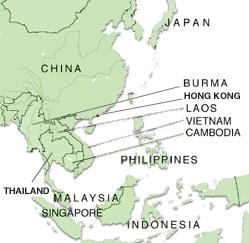
Southeast
Asia. |
I love SE Asia, especially Thailand. Vicki and I lived most
of last year in Chiang Mai, in northern Thailand. We've spent
wonderful months in Laos and Singapore, Malaysia and
Indonesia. I'd love to tell you the region has hit bottom,
that necessary changes are in place, that economic recovery is
on the way. I'd love to tell you this, and maybe some day I
will.
But not in 2002.
Look to Japan
The U.S. powers the
world economy, but in SE Asia Japan does much of the driving.
Unfortunately, Japan has lost its way. In 1989 Japan's Nikkei
stock market index fell from 40,000 to 15,000. Now, thirteen
years later, it's stalled at around 10,000. Years of fiscal
and monetary stimulus have failed to revive either the stock
market or the economy. Japanese consumers stick more and more
money in mattresses, terrified of what might happen to it
otherwise.
The curious thing about Japan's problem is
that everyone, from Prime Minister Koizumi to European
socialists to American economists and bureaucrats--even
including Treasury Secretary Paul O'Neill--everyone knows what
the solution is. Japan has to make deep structural and
institutional reforms, especially in banking and agriculture.
Period. There's no other way. Write off bad loans, throw away
obsolete inventory, open the rice market.
Yet PM
Koizumi refuses to act. I suspect Koizumi fears for his
life--not his political life, but his real life, the kind that
ends in a coffin--if he makes meaningful reforms. After all,
he knows what's needed. He enjoys enormous popularity and
unprecedented political power. Crown Princess Masako even
helped out with a royal baby girl in late 2001, improving the
public mood. Still, Koizumi does nothing.
I may be
stretching here, but think of the parallel with Mexico. In
1994 Mexican old-line party bosses--the so-called
dinosaurs--gunned down reformist PRI candidate Luis Donaldo
Colossio, who had the courage to challenge sixty-seven years
of party hegemony. Koizumi's LDP has run Japan for nearly that
long, and LDP dinosaurs have much to lose in reform. I'm sure
those LDP dinosaurs have made their views clear to PM
Koizumi.
If I'm wrong on this--that is, if Koizumi
takes action in 2002--you'll have plenty of time to return to
Asian stock markets. Figure an open window of at least a year
or two, whether you make the Japan play directly or through
secondary markets in SE Asia. But until you see decisive
action, rather than hopeful words and flowery speeches, keep
your checkbook in your pocket.
Consider Thailand first
A tropical
climate, kind and friendly people, wonderful spicy food, good
roads and airports, sunny beaches, and a cheap baht make
Thailand a top tourist destination. I've been there six or
seven times, staying longer each time; on the last trip
beginning in 2000 Vicki and I stayed almost a year.
If
you want to go, EVA Airways out of Taiwan offers a unique
Deluxe Coach service from both Europe and west-coast U.S.
cities to Bangkok. This EVA Deluxe Coach approaches Business
Class but at coach prices, making it one of the world's best
airfare deals.
At one time Thailand's stock market was
as exciting as the country's tourist sites. These days,
though, the Thai stock market is not so much down, although it
certainly is that, but largely forgotten. Thailand's entire
stock market cap totals only $33 billion, less than one
good-sized company in the U.S., an Amgen, say, or a Qualcomm.
The median market cap of the S&P 500 is about $65 billion,
or double that of Thailand's entire stock market. Low daily
volumes, low market caps, little IPO action: international
investors are looking elsewhere. Thailand's SET index reminds
me of the gold price. Neither one ever moves, ever excites,
ever confirms a trend. And anyway, no one cares.
If
Thai companies return to profitability, and begin to invest,
export, grow, and put money in the bank, will anyone notice?
Not likely. And Thai companies give little indication they're
about to do any of these things.
Still, if I were a
gambler (and I'm not), and had to make one bet in SE Asia,
(which I don't), I'd choose Thailand, especially if the
Japanese return to invest there. Thais have a can-do,
let's-get-on-with-it attitude, and suffer little of the
ethnic, racial, and religious strife that plagues so many
countries in the region.
Investors might also consider
a real estate play in Thailand. By law only Thais can own real
property, but foreigners can and do buy condos, normally in
Bangkok or Chiang Mai. For $80,000 you can buy a beautiful,
view apartment in exciting Bangkok. Seductive. But here's a
warning: A real estate man told me that new condos tend to
depreciate, like new cars, instead of appreciate, like land.
He recommends buying cheaper, pre-owned units in stable,
luxury buildings, units that have been well maintained, with
furniture and fixtures, cable and phone, curtains and
plumbing. If you have the patience to look around, and know
how to do a careful inspection, a Bangkok or Chiang Mai condo
might be fun. At these low prices you have little to
lose.
Forget Malaysia
and Indonesia
Malaysia and Indonesia share a
common language, Bahasa, and a common religion, Islam. When
Vicki and I first visited Malaysia 14 years ago, we hung
around the beach on Malaysia's northeastern coast near Khota
Bahru. Malaysia's northeast was, and is, more rural, more
conservative, more Moslem, and more isolated than the rest of
the country. I remember one day, Vicki and I were in the water
and saw a group of small Malay children come to play. The
little boys tore off their clothes, ran into the water, and
started tossing a ball around. The naked boys laughed,
screamed, ran, and jumped. The little girls, though, stayed
wrapped in their religious garments, covered from head to toe,
in the choking heat and humidity. They sat on a fallen coconut
log, their hands in their laps. Only their eyes betrayed how
much they'd like to play in the water, too.
Today
Malaysia's Moslems let others pilot planes into the World
Trade Center, but in their own country they enjoy vastly more
political power. Lonely Planet reports that, forget the
little girls, these days even foreigners are prohibited from
bathing on those northeastern beaches. Malays are successfully
turning back the clock in other ways, too, in a desperate
attempt to shut out what they consider to be pernicious
foreign influences. Malaysia has exploded in race riots
against ethnic Chinese, tightened racist laws favoring Malays,
and strictly regulated foreign stock and currency ownership.
In a bizarre disconnect Malaysia's tourist literature plays up
the country's former diverse, cosmopolitan feel. Don't you
believe it. Malaysia is an officially racist country moving
rapidly backwards, closing in on itself. Look no farther than
Kuala Lumpur's spanking new airport, built for the 21st
century, but with no one in it. In the past few years
Malaysians have made their country more and more uncomfortable
for tourists and investors alike.
Frustrated Prime
Minister Mahathir Mohammad has lashed out at foreign
investors, currency traders, high tech, and George Soros. In
one speech Mahathir called for a worldwide monetary authority.
Think about this. Kofi Annan, say, or Fidel Castro or, why
not, Mahathir himself would dictate monetary policy to Alan
Greenspan and Wim Duisenberg, presumably with a view to
protecting Malaysia's ringgit and other thinly traded
currencies. Silly, but populist Mahathir has lots of silly
ideas, including his blame-the-victim contribution after the
September 11 attacks. Don't even think about investing in
Malaysia until Mahathir is gone (he's 76, and been in charge
for twenty years) and the new leader shows his
stripes.
Indonesia shares many of Malaysia's problems,
including rising Islamic fundamentalism and riots against
ethnic Chinese. Years ago I was an audit partner in one of the
Big Eight (now Big Five) public accounting firms. At our
partners' meetings around the world I'd wind up in the bar
with the more senior partners, big guys who handled big
clients in big offices. These old-timers had been auditing
multinational companies since I was in grade school,
crisscrossing the globe year after year.
We'd chat
about countries we'd seen up close. Which were the worst
bureaucracies? Which had the biggest liars? Which places were
the hardest/easiest to break into? The most fun, the easiest
to deal with? The most corrupt? On this last, corruption, I'd
been working in Latin America. I suggested Mexico, perhaps, or
Peru. The old-timers laughed patiently at my lack of
experience. Mexican corruption was small time. For really big
time corruption, outside of Africa, which rarely counted
anyway, you'd have to go with Indonesia.
Flash forward
to 2002. The man behind that infamous corruption, General
Suharto, is out of the picture, the currency destroyed, the
economy in shambles. Indonesia has stabilized a bit, in the
past year or so, but it's still premature to think about
putting any money over there. And with increasing tensions I'd
hesitate to spend much time traveling there.
Wait on the rest
The
region's communist countries--Burma, Laos, Cambodia, and
Vietnam--profess to want to open markets and permit private
enterprise. Vietnam even fooled Time magazine into
believing this. These commie governments approve some
projects, now and then, but the process is slow and uncertain.
As time goes by the commies appear more reluctant, not less. I
suppose someone may make money in these countries, but not you
or me. Give these places a pass for now.
If you travel
to the region, consider a visit to Luang Prabang, Laos's
ancient capital. L.P. has the feel of a 19th-century colonial
outpost, right out of Kipling, Conrad, or Somerset Maugham.
L.P. has four French restaurants, and you should try them all.
Don't forget to drink some French wine with your meals,
imported without tax or duty--the locals don't drink the
stuff.
Finally, Singapore and Hong Kong enjoy
good-volume, developed stock markets. In theory investors
should diversify into these markets, instead of putting all
eggs in New York or London. New York goes down, Hong Kong goes
up, you knock the extremes off your portfolio returns. But
American capital and New York markets so dominate that,
inevitably, New York goes down, Hong Kong goes down. Only
Japan has its own drummer, and we've already talked about
Japan.
So by all means put a few bucks in the Singapore
and Hong Kong markets if you feel like it. These markets will
likely do as well as any. But you'll probably have only
limited success in reducing overall portfolio risk. And while
these markets should do well if New York does well, it's hard
to conclude they'll outperform.
Back to the Paulvic Table of
Contents. |
