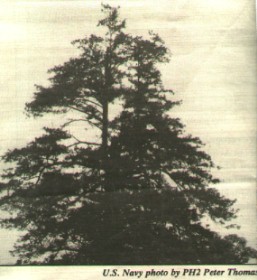
Along the eastern edge of the NAF Atsugi flight line, stands a lone sawara cypress tree.
Other trees like it usually grow much taller, so at first glance it may seem insignificant and unimpressive.
It's short, unproportional, and the upper section is split in half. In fact, if it wasn't the only tree in the field, you probably wouldn't have noticed it at all.
The tree's growth was stymied long ago after it was struck by lightning. So instead of growing up, the tree expands horizontally. This, too, isn't the most interesting story surrounding this solitary cypress.
|
More than half a century ago, the sleepy village of Tadakawa stood near what is now known as the Tade River, which runs through the base along the golf course.
For years, the villagers have been passing along the same message through word of mouth: stay away from that tree. The exact reason for this is unknown, but legend has it that the tree is sacred. |
|
More than half a century ago, the sleepy village of Tadakawa stood near what is now known as the Tade River, which runs through the base along the golf course.
For years, the villagers have been passing along the same message through word of mouth: stay away from that tree. The exact reason for this is unknown, but legend has it that the tree is sacred.
One legend speaks of how a divine punishment would be delivered to those who harm the tree in any way. Another story tells how the tree worried mothers, so they warned their active children not to climb it. Over the years, the warning may have changed from don't climb that tree, to stay away from that tree. The branches of the sawara cypress look strong, but are very soft, and they give way easily. Another rumor that puts the tree off limits notes a secret underground base lying near the area.
It's true that there are more than ten miles of tunnels dug underneath Atsugi, but according to the 4th Airwing of the Japanese Maritime Self Defense Force, there has never been any secret underground military base.
The tunnels include 877 separate rooms and caves, and include everything that was needed to keep the base running, such as a galley or kitchen, airplane hangers, office spaces, and living quarters. These tunnels were built specifically for protecting Japan's front line of air defense during Worl War II. Curiously, the base was never bombed.
When the Japanese Imperial Navy first arrived here with intentions to build an air base, it became necessary to chop down the surrounding trees to eliminate potential landing hazards. So, in 1942, a work detail was organized and they started to chop down all the trees.
The villagers, of course, gave the workers the same message they've been telling their children. But the soldiers, being under orders, took no heed.
Two men began the task of bringing the tree down, one armed with an axe, the other with a saw. Almost immediately, the foretold "divine punishment" was delivered unto them: the worker using the saw was struck down by a bolt of lightning, and the other became seriously ill. Both men died shortly afterward.
Needless to say, the work was stopped, and no other attempt has been made since. The marks of those worker's futile attempts are still visible to this day.
So, is the tree truly "haunted," as some say it is? Maybe. Death isn't new to this area, and the tree could be haunted by a number of possible spirits.
This whole base lies within an area known for many battles during the days of feudal conflict.
Thousand of brave warriors died along with their generals in the hundreds of battles that have taken place. Additionally, the whole countryside of Sagamino was set on fire in an attack between villagers and Yamato Takeru-No-Mikoto, the son of the twelfth emperor of Japan.
In fact, the nearby Sagami-Ootsuka train station literally means "large cemetery of Sagami." Possibly something to think about the next time you wait for a train.
A romantic legendary explanation is set hundreds of years ago. There was once a highway which passed through NAF Atsugi leading to the Afuri Shrine on Mount Ohyama. Tea houses dotted the entire route to provide refreshments and to serve as places of rest for the passing pilgrims. One day, a shogun who was out hunting was captivated by the daughter of one of the tea house owners. He later called for her to meet with him. Soon, their love was blossoming. Unfortunately, their romance between the two was somehow cut short. At the spot of their deaths, the tree grew as a symbol of their undying love.
There have also been several reports of occurrences to curious nonbelievers who come to the tree. One, who broke off a tree branch in defiance, later crashed his car into a fence post. Another came to the tree and stared at it in curiosity. He was later unable to start his car.
Keep in mind that these are only a sample of the many stories that surround the tree. These are only legends and possible explanations. Many legends, however, have been known to be based on fact. Whether sacred or haunted, there's definitely something about it that sets it apart from others. Even in Inter-Cultural Relations Class, the instructors encourage everyone to stay as far away as possible from the tree.
So, believe what you will. But if you ever come close, approach it at your own risk. And whatever you do, don't try to hurt this one particular cypress tree.
You have been warned.