Tetsuo - The Iron Man
Directed by Shinya Tsukamoto

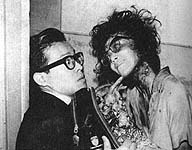
The sound effects in “Tetsuo” are also often exaggerated. There is of course the scene where Girlfriend eats a sausage loudly, which is used to highlight Salaryman’s sensitivity. There are however, examples of sound being exaggerated for dramatic effect. A good example of this is where the reanimated Girlfriend turns her head sharply, and there is the sound of her neck breaking. This type of sound effect, rather than being typical of Japanese films, is more typical of Chinese kung-fu films. This influence can also be seen in the fight between Salaryman and Girl With Glasses, and is even more evident in an early fight scene in “Tetsuo II / Bodyhammer”.
Also the style of acting can sometimes be influenced by established genres. Tomoroh Taguchi, who plays Salaryman, often uses grotesquely exaggerated facial expressions, one good example being when he examines his arm in the scene shortly after killing Girl With Glasses. This could be seen as echoing back to the Kabuki theatre style.
Although there are traceable influences within the film, nevertheless, the sound and mise-en-scene are often strikingly individualistic. The use of make up is similar to that in “The Crow” or “The Cabinet of Doctor Caligari”, giving a bizarre effect. This effect is assisted by the film being in black and white. Had the film been in colour, the make-up may have made the characters look slightly camp, and also much of the bleakness of the film may have been lost. The film being in black and white also adds an incongruity to the robotic effects by placing a futuristic look into black and white, which is usually associated with old films.
One of the most striking things about the film, is the movement, especially the speed and animation. Usually the animation, especially that of metal growing, is jerky, giving an increased feeling of surrealism, but at the same time, the feeling that there is power behind the movement. The stop motion animation is particularly striking when used to animate live figures, such as when Fetishist emerges from Girlfriend’s body, and during the travelling scenes. The scenes with the two main characters travelling through Tokyo are possible the most notable scenes in the film, due to the extreme velocity at which they appear to travel. The most striking of these is where Fetishist is sending Salaryman back and forth. In this sequence, the camera moves not only in a straight line, but switches backwards and forwards and sometimes gives a sideways shot. Also the two characters switch about, and are shown travelling in various directions.
There are also distinctive styles of movement used by the actors in the film. The movements used by Fetishist and Girl With Glasses in the scenes that link them, as mentioned earlier, could be likened to a dance. Some of the scenes suggest automatic, almost involuntary or unconscious movement, such as when Girl With Glasses starts following Salaryman, and when Girlfriend becomes reanimated. For example, when Girlfriend swings the knife towards Salaryman, her arm is straight and swings past the target, and then back again. In both of these scenes the characters turn at right angles, with their bodies remaining stiff. This movement could be seen as having echoes of Chinese ghost films, although in these films the movement appears to be more controlled.
Girlfriend shows the most obvious differences in styles of movement. As well as the zombie movement, there are other styles of movement that she uses that contrast each other. There are many scenes in which she moves in a highly sensual, and even sexual manner. The first scene that she appears in she is doing a strange erotic dance, and there are short scenes of lovemaking depicting various degrees of animal-like passion. In contrast, there are moments where she is shown fighting quite viciously, at one point kicking him into the wall. These changes in movement go towards the overall mise-en-scene of the film.
All these extreme effects of movement, image and sound, could be said to make the film confusing, and to detract from the story. This can depend on whether the viewer understands the language that Tsukamoto creates in narrative in what appears to be a highly experimental and inventive film. Often when Tsukamoto wants to suggest that something is a flashback, then it is represented on a video screen. This includes the scenes of the crash, the scene of Fetishist at the doctor’s, and the couple making love in front of him. The dream sequence is indicated in a more traditional way, making it easier to detect, as at the end of it Salaryman is shown waking up with a start. However, it is not obvious when this scene starts, especially as the scene featuring Girl With Glasses does not appear to be a part of the main story. The only suggested that this is actually supposed to have happened is that Salaryman is shown with a bandage on his arm, and his heel is a mess. However, these small details could easily be missed on the first viewing. Also the shots of laughing and steelworks, which although are used as punctuation and are not necessarily part of the story, can have a confusing effect.
Therefore, it could be said that rather than the imagery and sound being used merely as a tool for telling the story, which they are doing, it is the mise-en-scene and feel of the film that is most important of all. The film is polysemic which is a result of the ambiguity of parts of the narrative, whereas the imagery and sound in themselves are very bold.
whoaa!! go back a bit...
go to my Tetsuo home page
back to my homepage